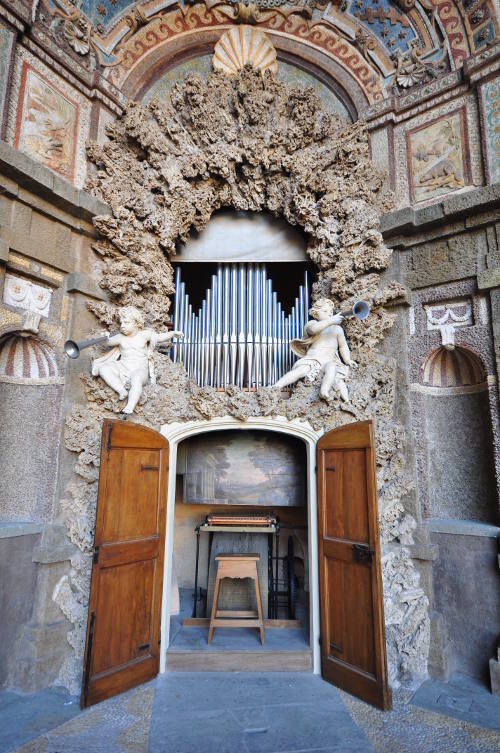
One of the wonders of the Quirinal Gardens is the Fountain of the Organ, a fine hydraulic work from the late sixteenth century.
When we talk about sixteenth- or seventeenth-century fountains that embellish extraordinary gardens, we immediately think of Villa d'Este in Tivoli (here for an example). But you don’t need to go that far from Rome to admire something just as incredible. Those who have the luck to visit, when they are open to the public, the Quirinal Gardens, for instance, might come across the extraordinary Fountain of the Organ. A fountain like this, perhaps far more famous, is precisely the one in the gardens of Villa d'Este, but this one is no less impressive—quite the opposite. The whole scenic layout is wonderful. Imagine entering a sort of cavernous grotto, of which you see little from the foot of the elegant access stairway that looks onto the central large niche. Once you get there, though, at the center of the scene, a world will open up before you, halfway between art and nature, between the visible and the invisible. Your gaze will be drawn to the central section where the hydraulic organ stands. The name says it all. Through the action of the water, which runs through the pipes, sounds are produced—real notes—and thus melodies. Imagine lingering here, at the beginning of the seventeenth century, and enjoying a true concert. This is the Quirinal’s hydraulic organ.

There is much more, though, and this is why your local tour guide wants to show you the beauty of what the idea of the marvelous could produce centuries ago. Let’s not forget how the Quirinal Palace was part of the pontiffs’ properties, who, over the centuries, were the highest expression of those noble families that, through the papacy, managed their power. A power also expressed through some frescoes in the rooms of the building, as in this very special case. And their own prestige was highlighted by owning not only grand palaces, but also grand gardens, packed full of surprises. Not by chance, in the Fontana dell’Organo complex many papal coats of arms recur. We owe above all to the architect Pirro Ligorio the creation of this special fountain and of the whole decorative apparatus. At the sides of the central niche, in fact, marble figures seem almost to emerge from the depths of a natural grotto. On the right the god Vulcan intent on working in his forge, on the left Apollo and the Muses. Concepts very much in vogue in sixteenth-century Rome and especially in that of the Baroque. Arm and mind, body and spirit joining together, becoming one in the music created by the movement of the water. Imagine how much the foreign ambassadors who, in past centuries, came here, to the Quirinal Palace, to meet the pontiff, were amazed. How stunned they must have been, without a doubt.
It doesn’t end here, though, because even the vault above is decorated, in this case with scenes drawn from the Old Testament, with particular reference to Moses. Here we see the famous episode of Moses striking the rock, from which sprang the life-giving water for the Hebrew people who, for far too long, had wandered in the desert after fleeing Egypt. A similar episode can be seen, in sculptural form, in the nearby Fountain of Moses. Of course, the water element takes center stage, along with the impression of being inside a natural cave, thanks to the use of various minerals and stucco that truly give the sense of being surrounded by a product of nature. Instead, it is all part of the minds of men and women from a few centuries ago, who drew on Christian and pagan sources to create something truly special. The papal coats of arms, like that of Pius VI Braschi (who also arranged the square in front of the Quirinal, as you can read here), merely mark the passage of time, since the Fountain of the Organ also underwent rebuilds, complete abandonments, and fortunate restoration work. What remains, however, is the idea that a hydraulic organ could brighten the days of people who, perhaps unaware, seemed to have been catapulted into a small corner of paradise. Here, in the Quirinal Gardens in Rome.