

Many were the ambassadors who came to visit Rome, even from distant lands, as in the case of the Japanese Hasekura, immortalized at the Quirinal
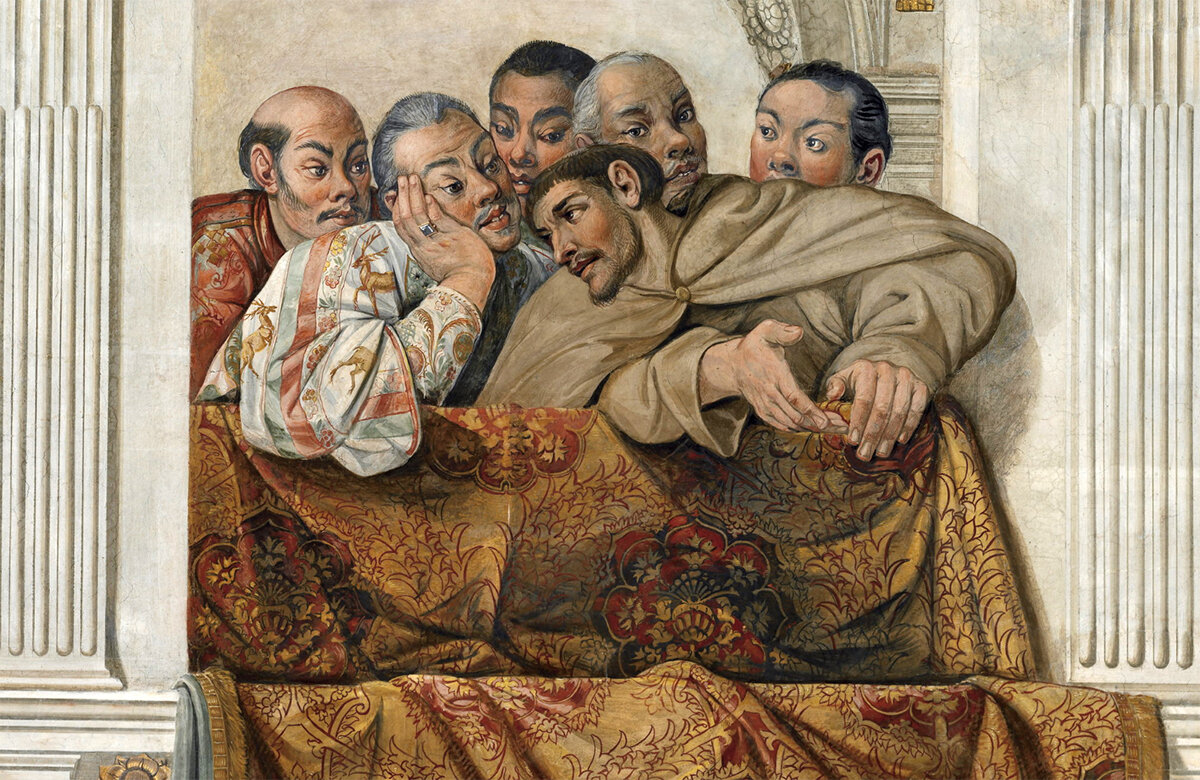
The Hall of the Corazzieri is one of the main rooms of the Quirinal Palace, today the seat of the Presidency of the Italian Republic. A building already erected in the sixteenth century, which became the pontiffs’ summer palace, complete with wonderful gardens that host splendid fountains, such as this one. A palace, among other things, that was a symbol of the temporal power of the pope here in Rome. A building, the Quirinal, that in this hall shows us how many people wished to meet the pontiff, even from distant lands. In the Hall of the Corazzieri there is a cycle of frescoes made in the early seventeenth century, by painters such as Agostino Tassi, showing embassies coming from all over the world to pay their homage to Pope Paul V Borghese. Among these is the portrait of Hasekura Tsunenaga who, surrounded by his travel companions, looks in admiration at the friar beside him, Luis Sotelo, who with a gesture of his hand seems to point to the room below, as if to explain to him what is happening. This panel shows us a glimpse of the politics of the papacy at that time. In fact, among many things, in that period the pontiff promoted the worldwide work of evangelization, carried out in person by friars who, sometimes heedless of danger, made long journeys lasting even months to bring the word of Christ (but also trade agreements), even to lands very far from Rome. As in this case.
At the start of the seventeenth century in Japan there reigned a kind of anarchy, since there was no unified country and government. Local lords waged war among themselves, using their most fearsome weapons: the samurai. At that time merchants and friars from Europe began to land on the Japanese islands, bringing with them new goods and the new Christian religion. Among these clerics there was, in particular, our Luis Sotelo, who landed at Sendai and met Hasekura Tsunenaga, a skilled swordsman who had distinguished himself in local wars but also a refined diplomat. He was therefore entrusted with the mission of meeting Sotelo and even of traveling as far as Rome in his company to bring his respects to the pontiff. Respects, but also advantageous agreements for both sides. In particular, Hasekura wanted to promise pope Paul V Borghese to throw open Japan’s doors to Christianity, evangelizing the Far East. Leaving in 1613, two years later (crossing the Pacific) the expedition reached Spain. Here Hasekura met Philip III of Habsburg, handing him the letter from the local lord for whom he worked, who promised him free-trade agreements and conversion. A conversion that Hasekura himself carried out right there, in Madrid. The next step, then, was to go to Rome to meet the pontiff. Sotelo’s account is illuminating in explaining what happened right there, in the Hall of the Cuirassiers (then used by the popes to meet foreign ambassadors), grasping the expectations of those present: “We were received by His Holiness and by the Sacred College of Cardinals, we and three others who had been expressly designated by those who had converted, so that they might announce their condition with regard to the Christian religion”.
Striking is how much this fresco truly seems the pictorial record of what Sotelo wrote. You can clearly see the Franciscan explaining and translating, helping the Japanese understand what is happening. He and his companions appear pleased, captivated and amazed. Sadly, though, there is no happy ending. Imagine that Hasekura, in company with Sotelo, returned to Japan only in 1620, a full seven years after their departure. Both were full of hopes and expectations, since they brought back to their homeland, especially to Sendai, the promises of King Philip III and Pope Paul V, who were open to trade and religious agreements. Unfortunately things changed greatly, and Hasekura realized that local politics had become far more intransigent toward Christians and that new religious doctrine. Persecutions were organized, Sotelo himself was burned at the stake, sacred objects (such as crosses and rosaries brought specifically to Japan) were burned. It seems that Hasekura himself was killed, after many tortures. According to other versions, instead, with a certain doubleness of spirit, our samurai renounced the new Christian faith he had just embraced, so as not to be killed. The fact remains that this fresco, in the Hall of the Cuirassiers of the Quirinal Palace in Rome, takes us back in time, to when intercontinental journeys were very long, when ideas, goods and faiths moved by land and by sea. Sometimes no agreements were reached, sometimes they were. But it is also here that, at times, history was made.





















