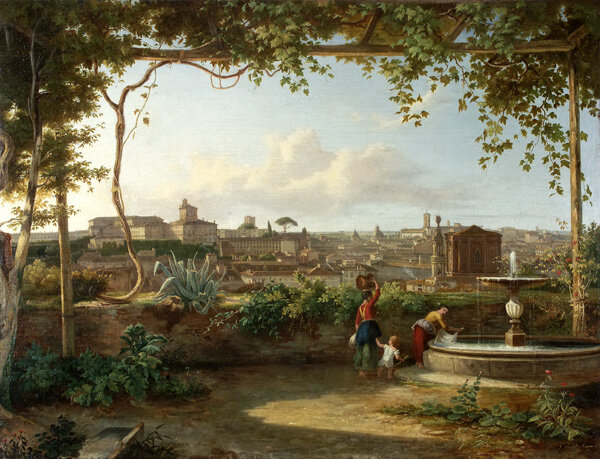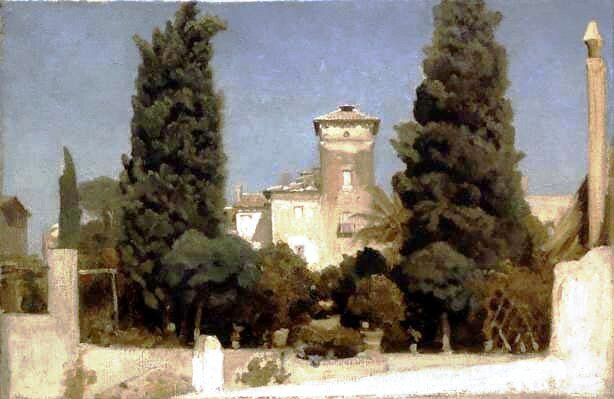
The so-called Villa Malta in Rome, near Trinità dei Monti, tells us how a small yet elegant Roman building has a great story behind it.
We are near Trinità dei Monti, on the street that corners with Via Ludovisi. Hard to spot, but behind an enclosing wall stands a small yet delightful villa, called Villa Malta. In fact the building is much older, if we consider that, after some excavations to build a nearby parking lot, it was understood that already in the Middle Ages there was the very first core of what later, in the sixteenth century, became a real villa. And precisely because of its venerable age, it has been called in many different ways: villa delle Rose, villa della pigna, villa del Vignola or Giardino del Pino. In this last case the curious name is due to the presence of a huge and very tall pine, no longer existing today. Even plants, then, can be protagonists here in Rome. The current name is attributed to the presence of the bailiff (high official) of Breteuil, that is, an important member of the Order of the Knights of Malta. From 1774 the villa became his summer residence. And that explains the name of a villa certainly worth knowing, and which your local tour guide in Rome is about to describe.
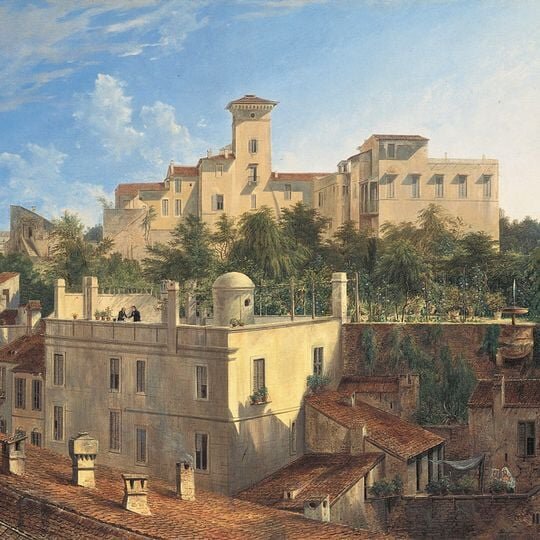
The feature that immediately catches the eye, and that so inspired many painters who, over the centuries, depicted it in their urban landscapes, is the small square tower. Probably, as mentioned earlier, a small turret already existed in the Middle Ages. When the residence was then purchased by the Orsini, a historic baronial family of Rome, it was made more slender and raised. The tower acts a bit as a bridge between a purely medieval city and one opening onto modernity. What strikes one most is the endless number of leading figures of culture and literature who lived here, slept, stayed, studied, philosophized and debated. Just to give an idea, in 1821 it became part of the properties of the royal house of Bavaria, so that Villa Malta became the main cultural center of reference for the German and Bavarian community in Rome. It changed hands several times after 1821, since in 1907 the owner of the house became Alexei Bobrinsky, great-grandson of Tsarina Catherine II. It caused quite a stir that, besides modernizing the building, our Alexei bought from the historic Altemps family (whose main palace, in Rome, is home to a wonderful museum with a fantastic collection, as you can read here), a huge fireplace in marble. Imagine that this artifact still bore the name of Marco Sittico Altemps, who lived in the 1500s and was a leading figure of the family. A full-fledged reuse that spared no one. Alexei liked it that way, even if it had someone else’s name. That was also the period when the garden was filled with roses, so much so that the building was soon called Villa of the Roses.
The 1800s were the century in which, through the luxurious halls of this villa which, at the time, was considered a country residence (near Villa Medici, another building with an attached garden, symbol of the desire of noble families to equip themselves with buildings suited to a more rural life, away from the chaos of the city center), famous figures walked: Canova, Thorvaldsen, or Luciano Bonaparte. In the 1600s the friars of the nearby Church of Trinità dei Monti took possession of the villa, renting it out to many. Among them I mention the noblewoman Maria Casimira of Poland, who lived in what, today, is known as the House of the Monsters, which is located on the very nearby Via Sistina. She was an energetic woman who, after the friars refused to rent her the villa, had the audacity to build a kind of wooden overpass that ran right above the said Via Sistina (it was demolished in the 1700s). A way to access the villa’s garden, an building that, in any case, she considered hers. Finally, a small curiosity about the majestic pine mentioned earlier. It was none other than Goethe himself who spoke of, almost celebrated, that beautiful pine, which inspired in him such nostalgia. In fact, many times he found himself strolling through the villa together with his friend Angelica Kauffman. Too bad that, upon her death, the owner of the villa decided to cut down the pine. A sad fate for the tree, which however reminds us how times can change, and how everything shifts. Even the Villa of Malta in Rome, after all, has been a witness to the history of the Urbs. A history in constant evolution.