

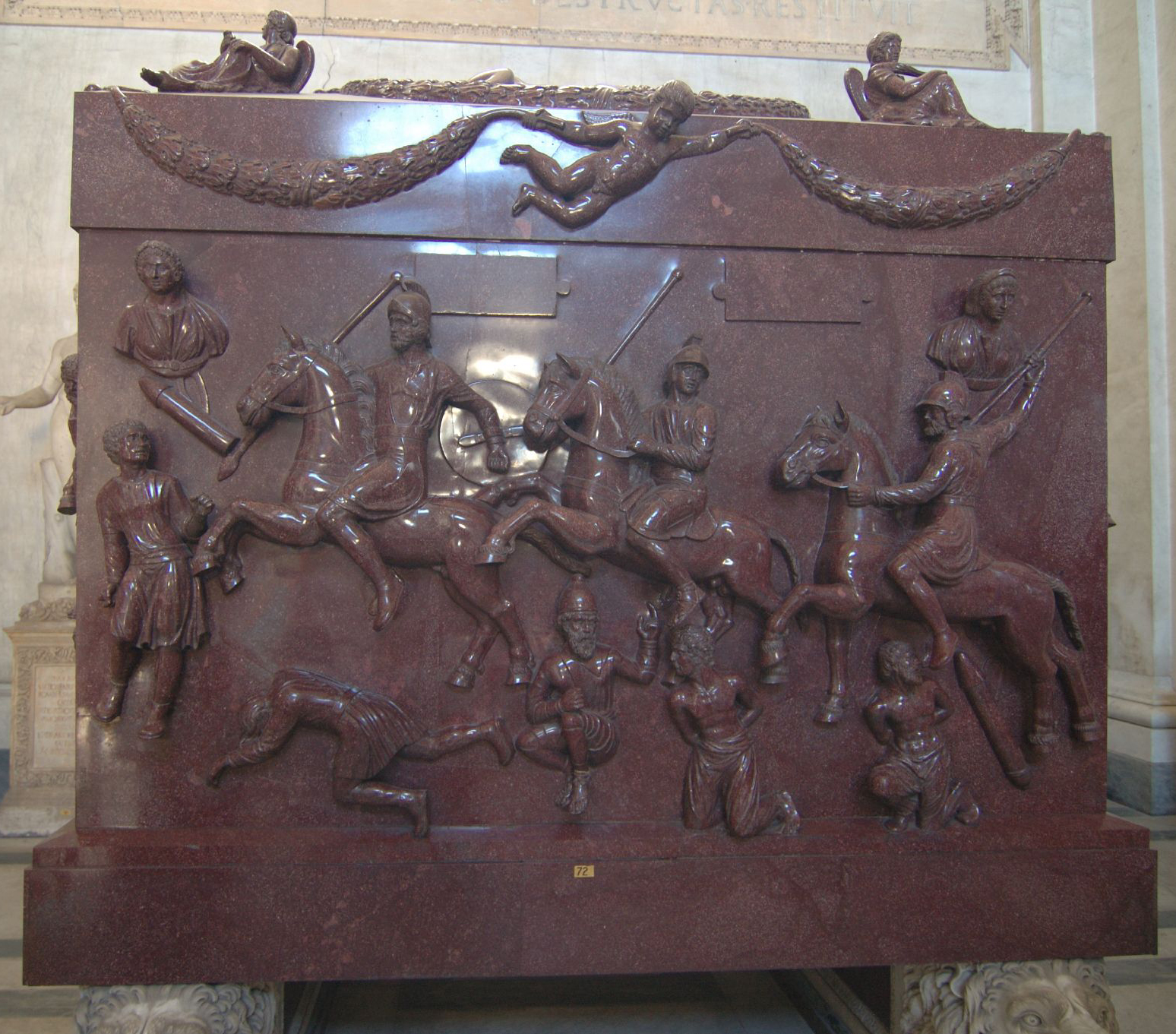
This in the photo is the monumental Sarcophagus of Saint Helena, mother of Emperor Constantine and the one who, according to tradition, in 326 A.D. found remains of the True Cross, the one on which Jesus was crucified. An exceptional and majestic sarcophagus, which helps us understand how the Vatican Museums’ collection is extremely rich and varied. As a local tour guide in Rome it is, finally, a real pleasure for me to explain the real reasons why, in my opinion, this artifact is interesting. Try to think that inside it there is nothing, absolutely nothing...
Let’s begin by briefly mentioning the historical figure of Saint Helena, the one who, as written above, found according to tradition the remains of the True Cross. Many miracles are attributed to this extraordinary discovery, besides the fact that the discovery itself further strengthened the almost salvific role of the imperial family. Saint Helena and Constantine, by then, had been taken up as heroes, champions of Christianity. But it is not so much about the saint’s figure that I would like to talk to you about today, nor about the mystery of why this extraordinary red porphyry sarcophagus bears war scenes, unsuitable for a woman (according to some, in fact, the tomb was originally meant for Constantine himself). Today I would like to tell you about the saint’s mortal remains, scattered a bit all over the world.
Of course her remains could only be shrouded in sacredness, to the point of becoming true relics. And, unfortunately, as often happened especially in the Middle Ages, the relics market was so thriving that many, even members of the clergy, fought to collect as many relics as possible. For personal gain, to make a church or a basilica even more important, or simply for collecting. Something like this also happened to Saint Helena when her sarcophagus, originally placed in the mausoleum of the same name, located along the Via Casilina, was opened in the 9th century by French monks who, without too many qualms, carried off as much as possible to France. For this reason some human remains, considered in every respect relics, are kept in Paris, in the church of Saint Leu-Saint Gilles. It doesn’t end here, because other body parts attributed to Saint Helena are inside a beautiful small shrine located in the last chapel on the left of the Basilica of Ara Coeli in Rome. And then, so as not to miss anything, the Saint’s head is instead in Trier, a city that Constantine often used as a strategic base, and from where his conquest of Rome began in 312 A.D.
Finally there is also another tradition to mention, the most uncertain of all. According to this version, Saint Helena lies inside the church of the same name on the island of Saint Helena in Venice. How could her body have reached that far? According to some interpretations of ancient texts, Saint Helena was not buried in Rome, but in Constantinople. During the Fourth Crusade, after the sack of the city carried out by the Venetians themselves (it was 1204), the sarcophagus too was opened and moved. The ship carrying the saint’s remains ran aground right in front of this little island in the Venetian lagoon, where a small church was then built, suitable for keeping the relics. In short, as you can see, often there really is no peace for the dead...