

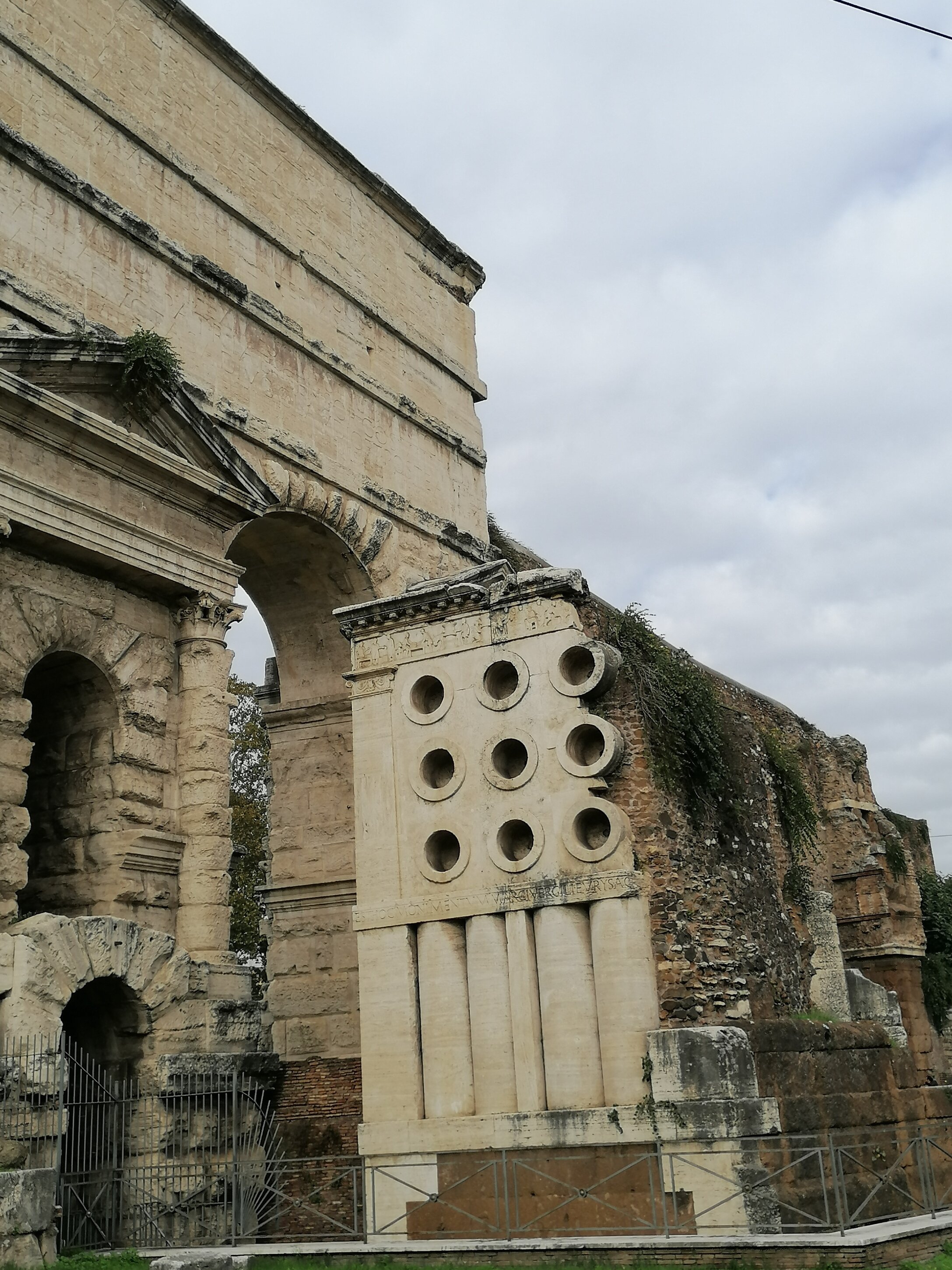
In the photo you can admire what, in my opinion, is the strangest funerary monument in all of ancient Rome: I am talking about the so-called Tomb of the Baker Eurisace. It is certainly a real landmark for those thousands of drivers who, day after day, drive around the monument and the so-called Porta Maggiore. It's a shame that today this wonderful structure is now engulfed, almost suffocated, by city traffic. But today your tour guide in Rome wants to take you beyond the usual, daily routine, to immerse us in something exciting. Let's set off together to discover this incredible funerary monument.
We are at the end of the 1st century BC, when Romans, both the wealthy and those of the middle class, almost competed to show off a bit, to demonstrate their noble lineage and also to be remembered for eternity through unique and dazzling funerary monuments. In this case, the tomb can be dated to around 30 BC and was discovered during the demolition ordered in 1838 by pope Gregory XVI, of the defensive towers built by Honorius on Porta Maggiore in Rome. For centuries Porta Maggiore, besides being an excellent spot to bring together more than one Roman aqueduct, was fortified to protect the city. And as they kept digging, during the intervention, the tomb belonging to Marcus Vergilius Eurisace, a baker, and his wife came to light, having remained embedded in the cylindrical tower between the two arches of the gate and now visible just outside it. But who was this Eurisace, a man so wealthy that he could afford such a funerary monument? He was not just a simple baker but probably the official baker, as well as the official supplier, of the Empire and its legions! For this reason, having become extremely rich, he thought it best to promote his own image even beyond death. After all, a tomb, or a funerary monument, was the preferred way for Romans of the 1st century BC not so much to remember death, but to celebrate what had been accomplished in life. And in this tomb there is certainly no shortage of elements that confirm this trend: it is clear, in fact, that the entire travertine block is shaped like an oven, complete with reproductions of the mouths of the ovens where the flour was kneaded. There are also bas-reliefs running along the walls of the tomb, in which we see the entire bread-making process from start to finish: from weighing the grain to preparing the dough, from sifting the flour to baking. Furthermore, always in the context of that obsessive self-celebration, the inscription is certainly noteworthy, which says: «Est hoc monimentum Marcei Vergilei Eurysacis pistoris, redemptoris, apparet[oris]» ("This tomb belongs to Marcus Vergilius Eurisace, baker, contractor, apparitor"), from which we learn that the baker worked for the State. Probably from this we can also deduce that he was a sort of private baker for some wealthy member of Roman society. It is almost certain that his business was very prosperous, and that Eurisace could count on numerous slaves, used for bread-making. It is precisely these slaves, dressed in the characteristic and rough tunic, that we see intent on baking, buying, or kneading along the reliefs of the funerary building.
Another curiosity is that, inside the podium on which the entire structure rests, there was a hole in which to insert the ashes of Eurisace and his wife. As for the latter, it is curious to note that the urn containing the ashes of Eurisace's spouse is shaped like a bread kneading trough! As if to say that even the figure of the wife, in reality, was used in function of the memory of her husband, the great baker and prominent figure in Roman society. Do you see how much the Romans of the past loved to show themselves off, even after death?