

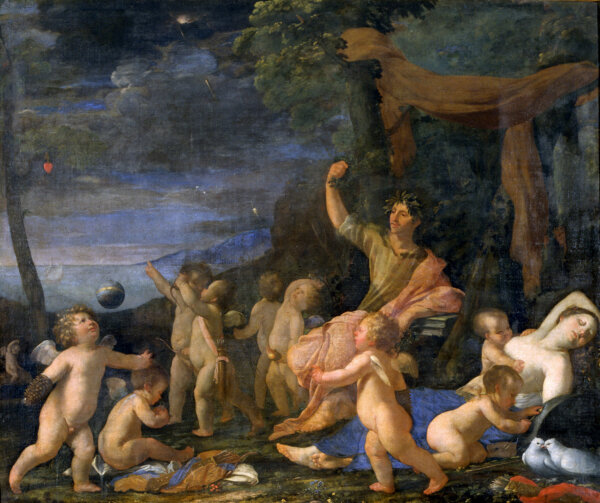
Let's return to Galleria Corsini, after having spoken last week about the so-called Corsini Throne, an ancient artifact both precious and, at the same time, quite mysterious. The art collection present in the sumptuous rooms of the historic palace in Rome, however, hosts numerous paintings, among which is the one your tour guide would like to tell you about: the Triumph of Ovid by Nicolas Poussin. A artist well-known in seventeenth-century Rome, with many of his works exhibited in the most important museums of the Eternal City, not to mention the particular funerary monument dedicated to him, located inside the Basilica of San Lorenzo in Lucina (click here to learn more about the subject). Let's find out more, in any case, about his Triumph of Ovid at Galleria Corsini.
The seventeenth-century French artist, always ready to look at and draw from the world, mythology, and classical culture, here presents us with his personal tribute to Ovid, the famous Roman poet and writer, above all known for his celebrated odes to love that still strike us today. It is no coincidence, then, that here Poussin has deliberately drawn our attention not only to the figure of Ovid (placed at the center, semi-reclined, with his right arm raised and a crown on his head), but also, and perhaps above all, to the theme of love. Making the whole scene lively and dynamic, set in this environment with a clear bucolic character, is a series of cherubs engaged in various activities, all related to love. On the left, for example, hanging from a tree, we find a heart, and below a little to the right two cherubs try, with bow and arrows, to hit it. This emphasizes that love that strikes you suddenly and with force, as Cupid does with his arrows. In front of the tree, in the foreground, we instead find a cherub playing with a ball. Love, as we know, is also a game after all. Completely to the right, instead, another figure is lying down: this is Venus, here depicted with her breast exposed and with an attitude halfway between lascivious and seductive. There are our usual cherubs intent on extracting milk from Venus's breasts, even trying to soak the tip of an arrow with the white substance. Milk, after all, is a symbol of purity, just as love should be. Only one figure, or rather a face, seems almost to break this idyll, this magical moment immersed in the calm of an imaginary and almost utopian landscape. Above Venus, just hinted at and difficult to see even in person, there is the profile of a satyr, with a red face. In his Triumph of Ovid, Poussin wants to indicate how love understood as a feeling can always be "disturbed" by blind passion, by a sexual instinct capable of coming to the fore and clouding our thoughts. In this work, in short, love has no secrets.
So, with the Triumph of Ovid, Poussin wanted to pay homage to the historic Roman writer famous, for example, for his Amores, in which he describes love, often with much irony, and just as often as if it were, almost, a game. The same mocking theme, if you will, can be found in the painting I have just described. Another way to understand how the ancient world did not end with the fall of the Roman Empire but, on the contrary, its culture and traditions have survived over the centuries, to be revealed even today through the eyes of a seventeenth-century painter. This is Rome.