

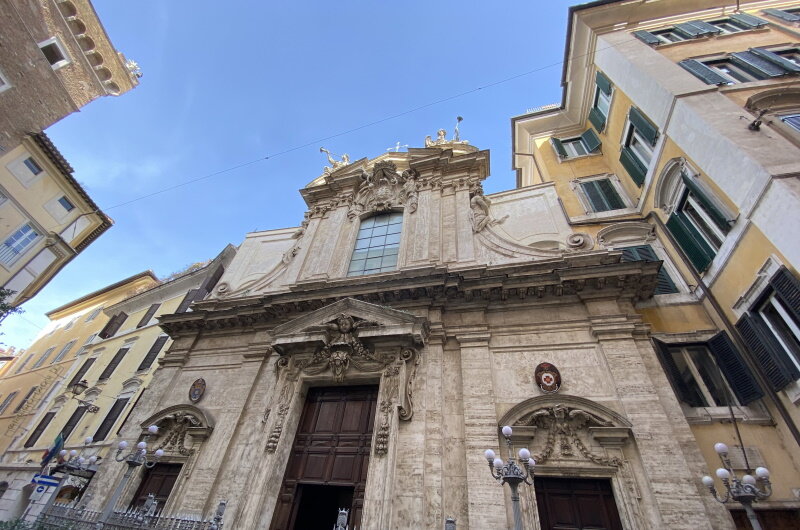
Among the lesser-known churches of Rome that your local tour guide would like to suggest to you today is that of Sant'Antonio in Campo Marzio, also known as Sant'Antonio dei Portoghesi. We are just a few steps from the so-called Tower of the Monkey, not far from the Pantheon. Come with me and you will discover something truly surprising..
As you can tell from the name mentioned above, the church has, in some way, to do with Portugal and its people, as well as with the Portuguese community in general. It is enough for you to know, to understand the reason, that this place of worship was founded in 1445 by Cardinal Antonio Martínez de Chaves on the site of a hospice for Portuguese pilgrims established by the noblewoman Guiomar from Lisbon. As often happened in such structures that had, among their many functions, the mission of assisting in every way the numerous pilgrims coming from all the nation-states of Europe and beyond, here too, next to the hospice, there was a small chapel. From this place of worship would later arise the actual church. After a couple of centuries, however, the Portuguese ambassador decided to enlarge the church, which, due to its small size, was no longer suitable to host a Portuguese community in continuous growth. We thus arrive at 1624 when, with the acquisition of nearby properties, work began to expand the structure. The church was completed in 1638 by Martino Longhi the Younger, a very active architect in Rome. Not only him but, later, other architects such as Rainaldi also worked on the restoration and expansion. And it was at this time that the name was changed in honor of Saint Anthony the Abbot, of Portuguese origin. As often happens in Rome, however, history often leads to an almost cruel fate for services and churches that, in one way or another, have assisted entire communities for centuries. Imagine how, after the Napoleonic occupation of Rome, the church and the related hospice for pilgrims were closed in 1799 and sold at auction. The property returned to the Portuguese government in 1814 and the church was first subjected to a delicate restoration and then reopened in 1842. Apart from this troubled history, which has a bit of politics, a bit of nationalism, and a bit of art, today the splendid façade by Martino Longhi remains, as well as some works of art that embellish the interior of the Christian place of worship, such as a panel by Antoniazzo Romano and, above all, the De Souza Monument by Antonio Canova (1808).
A little curiosity: today, in the church of San Rocco in Lisbon, shines a wonderful chapel, commissioned in 1740 by King John V of Portugal. This chapel was designed by great architects such as Nicola Salvi (the one who completed the Trevi Fountain) and Luigi Vanvitelli. What does all this have to do with Rome? Simple: the chapel that is now in San Rocco was actually here, in the Church of Sant'Antonio dei Portoghesi. It was so beautiful that the Portuguese king absolutely wanted it to adorn the most important national church of his homeland. He therefore ordered the ambassador to arrange for all the decorations of the chapel to be dismantled, piece by piece, and transported to Lisbon. A truly unique and very, very precious move...