

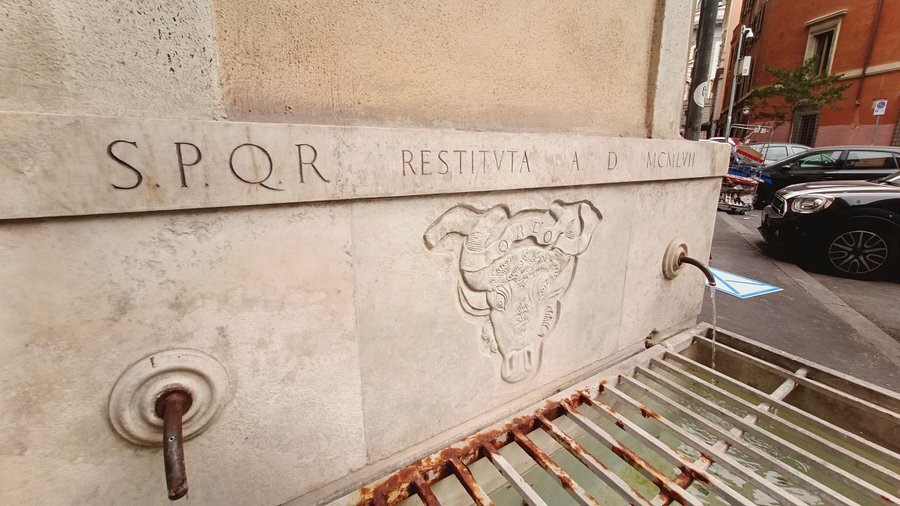
Not long ago, as is increasingly happening in Rome also thanks to major events like the Jubilee, the "veils" were lifted from one of the historic fountains of the Eternal City, something located in a very central area of the city (practically between Piazza di Spagna and Trevi Fountain), but which is often only glimpsed by thousands of tourists every day. And it's a shame because the Fontana del Bufalo, as it is called, may not be a grand monument but, after all, it too has five hundred years behind it. Follow your tour guide in Rome to discover a small example of the cultural and artistic richness of this extraordinary city.
Only recently, as previously mentioned, it became visible again after months of restoration and various cleanings. Imagine how many processes have led to the deterioration of this small fountain, now located in Largo del Nazareno (just a few steps from the headquarters of the PD political party), including vandalism and detachment of marble portions due to the erosion of time and, above all, water. The limescale deposited formed encrustations of varying thickness on all surfaces and especially on the slab with the buffalo. Deposits of dirt and polluting materials were found on all surfaces of the structure, particularly on the walls of the basin, located at floor level and therefore particularly subject to deterioration. But now, after understanding why the Fontana del Bufalo was restored, and what the fate is of all the fountains in Rome in the absence of a real periodic maintenance strategy, let's move on to some historical background. The fountain was originally located in front of the entrance to the Palazzo del Bufalo, on the street of the same name, and was built by Marquis Ottavio del Bufalo in 1596 in exchange for the concession of an ounce of virgin water taken from the conduit of the nearby church of Sant’Andrea delle Fratte. From this, you can well understand the origin of that buffalo head that stands out in the center of the fountain. Note, moreover, that for the Romans of the past this type of decoration was not at all unusual, considering that even in ancient Rome it was common to decorate marble surfaces with reliefs in the shape of a buffalo head, often connected to each other through further marble reliefs in the shape of a garland. This was the so-called bucranium easily visible at the Ara Pacis of Augustus. Returning to the Fontana del Bufalo, it was defined until 1872 as a "semi-public fountain," and also served as a watering trough for the stables of the ancient noble family. From the archival documentation we learn that as early as 1822 the original basin had been replaced by a new one, leaving the maintenance and care to the del Bufalo family, owners of the fountain. This often happened, especially in the absence of a real body, as today can be the Superintendence, whose main function is precisely the maintenance of public heritage. With the birth of the Unitary State in 1861, little by little the ownership and maintenance of the fountain passed by right to the Roman Municipality. The increase in vehicular traffic since the early years of the last century and the repeated damage resulting from it led the Municipality of Rome to move the fountain, in July 1909, to via del Nazareno, placing it against the facade of the College of the same name, in its current location. Only in 1957, as the cited inscription recalls, did the fountain find its definitive and current arrangement.
As you can see, after all, even a small fountain, certainly curious for its decorations, can have a thousand curiosities to satisfy. There are other examples, like the fountain of the organ at the Quirinal Palace and the fountain in Tor di Nona. But, for sure, even the Fontana del Bufalo has a lot to show…