

This is the first part of an article in which your local tour guide of Rome will tell you about another sack suffered by the Urbe (after the one already analyzed in 410 AD, as you can read here). After all, the Eternal City, simply by being the undisputed protagonist of the ancient world for so long, also suffered sudden and ruinous setbacks, which contributed decisively to its fall from a political point of view and beyond. Today I will talk to you about the siege of 545 AD, when Rome, truly and perhaps for the first time in its history, suffered such a calamity that it could no longer recover, as had happened previously. A sack, preceded and followed by a siege, carried out by the Ostrogoths.
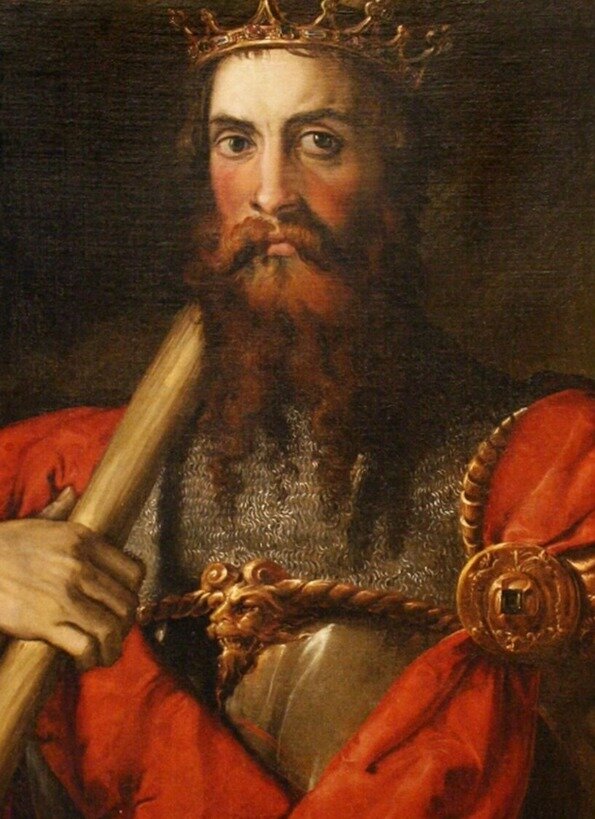
At the bottom you will see a portrait by Salviati depicting Totila, leader of the Ostrogoths, a name that became synonymous with destruction and devastation for the Romans of the 6th century AD. We are in the full post-Roman Empire era, when Rome was no longer, from a social and cultural point of view, the Caput Mundi. The Senate ruling the Urbs had been stripped of its powers, the papacy was not yet able to control and administer the entire city, and the Byzantine Empire, from Constantinople, was constantly trying not to lose control of Rome. The city was prey to very fragile political balances, also dictated by the fact that the Urbs, after the fall of the Western Roman Empire in 476 AD, was by then in every way a city under the control of the barbarians. Odoacer, who deposed the crown of the last emperor, was succeeded by Theodoric, in a reign that was peaceful for the time. Then, however, power struggles in which, among the protagonists, we also find Justinian, emperor of the Eastern Roman Empire who wanted to wipe all barbarian kingdoms off the face of the earth, regaining constant control of Rome, managed to make the situation degenerate. So much so that already in 537 AD Vitiges, leader of the Ostrogoths, tried to conquer the city by besieging it. But the almost legendary Belisarius, general in chief of Justinian's army, took Rome and resisted the siege. The techniques used by Belisarius were very effective: no open field battle, but massive use of mounted archers who managed to attack the besiegers without suffering too many losses. Among other things, Vitiges had managed to besiege Rome only from the north, and not from the south, thus allowing Belisarius to better organize the resistance. Later, Belisarius was recalled for another military campaign, and the city was left in the care of a contingent of soldiers and Byzantine officials led by Bessas, a member of the imperial army. However, things did not go as planned. The members of the body that was supposed to manage Rome got carried away and, due to the political and geographical distance between the Urbs and Constantinople, began to use a heavy hand against the Romans, taxing them heavily, almost enslaving them, taking as much wealth as possible. They were greedy and usurers, and plunged the Romans into moments of pure terror. Then, however, in 545 AD Totila, successor of Vitiges as leader of the Ostrogoths, came down again from northern Italy, besieging the city. Totila, unlike the first, was a skilled strategist and a long-experienced military man, and besieged Rome in an impeccable manner. First of all, he bypassed Rome to head to Naples, conquering the city and thus preventing anyone from approaching from the south to support the Urbs. Not only that, but it seems that Totila, after conquering Naples, did not put it to the sword and fire, on the contrary. He helped the peasants to work the land again, also helped in part with the necessary reconstruction after a siege and, as a good politician if we want to put it that way, managed not to leave scorched earth around him, even managing to gain some support. Furthermore, Totila not only besieged Rome also from the south, cutting the aqueducts and plunging the Urbs into the deepest hunger and despair, but also conquered Portus, the city's port, thus cutting off any possibility of resupply or reinforcements. Totila was also lucky, because as mentioned, the situation was already dramatic: when the siege began, all that little that Bessas and the other Byzantine officials managed to gather, they kept for themselves. It is said that the inhabitants of Rome asked Bessas for two things in order to survive: either to let them go, to throw themselves into Totila's arms, or to kill them directly. According to the chronicles, especially those of Procopius of Caesarea, the Romans found themselves eating nettles, even before corpses, so desperate was the situation. "Bessas' brokers, during their foray, having seized an ox, sold it to the Romans for fifty gold coins; if a dead horse or anything similar happened to turn up inside, the buyer considered himself very lucky, being able to get a full meal from that meat. The common people sustained their lives only with nettles, which grew abundantly all around those walls and among the little walls within them, and so that their lips and throats would not be bothered by their harshness, they ate them after much boiling." These are some of Procopius' words, which all the more reinforce the idea that Bessas was certainly not up to Belisarius, nor to the situation in which the Urbs found itself.
In fact, for the first time in all of Rome's history since their construction, it seems that the Romans could no longer use public baths and thermae, due to the destruction of the aqueducts. They were forced to wash in the Tiber. Perhaps, then, it is no coincidence that Totila managed to penetrate the Aurelian Walls in only one way: betrayal. It seems that one night, the four soldiers guarding the Porta Asinaria, went at night to Totila's camp, promising him and his men to let them in, opening the gates for them. On more than one occasion, in truth, the Eternal City was conquered due to betrayal by the besieged, rather than because of a breach opened in the defensive walls. In any case, the sack was dramatic. Not even Belisarius, who had tried to reconquer Portus, even risking his life and failing in the attempt, could do anything. We are in 546 AD, and one of the most terrible sacks suffered by Rome began, as you will read better next week, in the second part of this tragic adventure.