

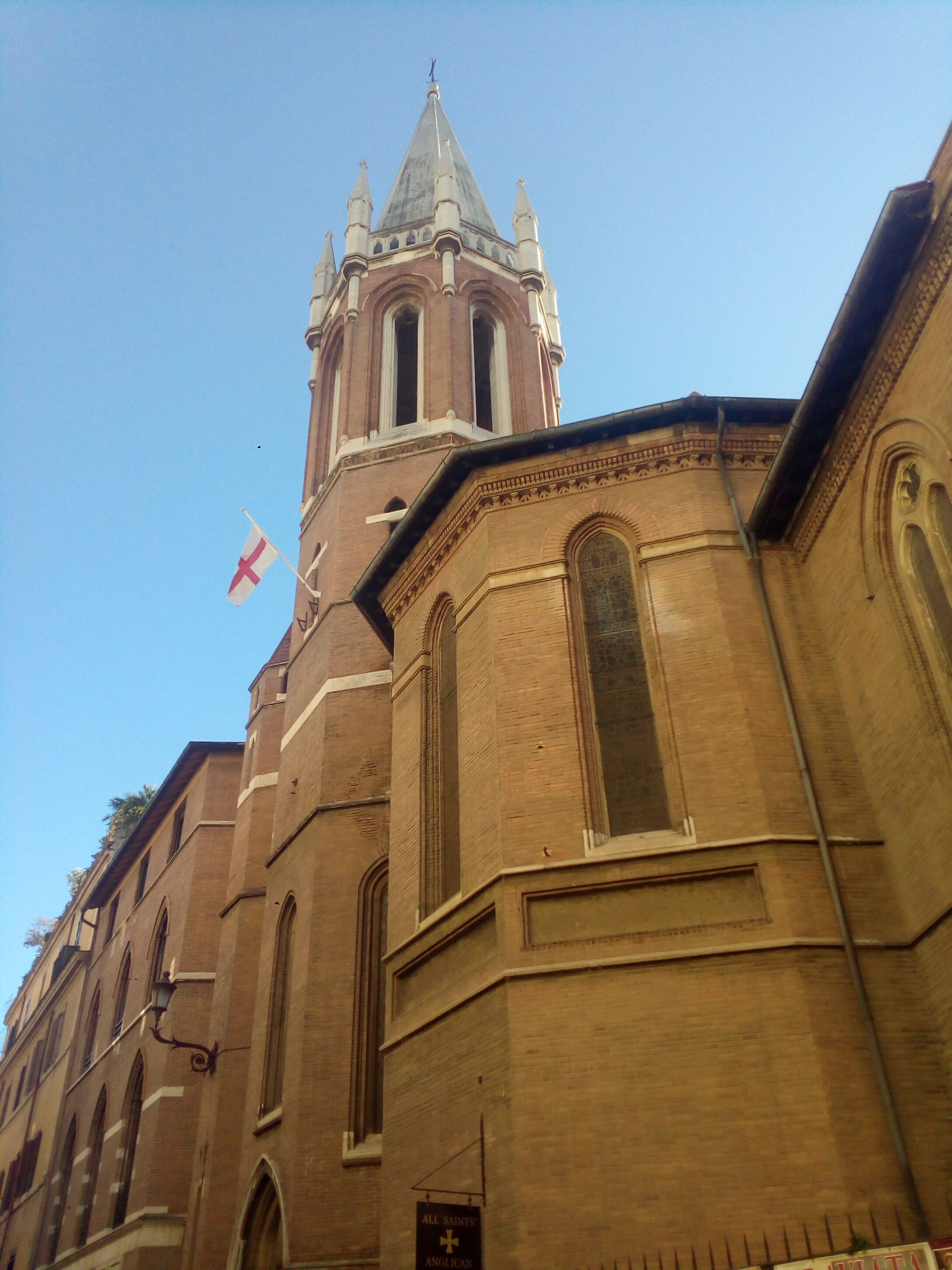
Did you know that Rome doesn't only have Catholic churches? After all, being one of the holy cities par excellence, over time it has also opened its doors to other things. Although we are used to associating Rome with the papacy, we must not forget how, for centuries, the Eternal City has had many relationships, often even violent ones, with religions other than Christianity. In this sense, it is immediate to think of the role that Rome had, starting from the sixteenth century, with Protestantism led by Martin Luther. This, and much more, can evoke a church like the one I am about to describe to you: the Church of Ognissanti .
Try to leave Piazza di Spagna from Via del Babbuino, without forgetting to take a look at the fountain that gives its name to the entire street. Continuing towards Piazza del Popolo, on your left, you will come across the slender facade of the Church of Ognissanti (All Saints Church), the official seat of the Anglican church in Rome. Obviously the shapes and style are borrowed from the British tradition: exposed brick walls, vertical and agile, with an interior divided into three naves punctuated by large windows capable of letting in a lot of light. A perfect example of late 19th century Gothic Revival when, especially in England, they wanted to recover the Gothic style of the Middle Ages of which many people in that country are proud of. Sure, the building smells modern, in a city as ancient as Rome, but we mustn't forget that the history of the place actually begins much earlier. Imagine being in the sixteenth century and having, along the modern Via del Babbuino which saw light at the beginning of the century thanks, above all, to pope Paul III, the premises of a noble villa. Subsequently the building was purchased by the community of barefoot Augustinians, and it remained so until the end of the 19th century. That was the decisive moment since it was the newborn Municipality of Rome that gave the Anglican community in the city the possibility of having a church all to itself. The construction site was inaugurated in 1882, while the church was completed in 1887. The period in which the place of worship was built is not accidental. We are, in fact, in a moment of great turmoil for the city of Rome, the moment in which, since 1870, the papacy lost its dominance and political power over the Eternal City. Thus it was that the more secular power that settled there, an emanation of the new Kingdom of Italy, promoted numerous initiatives, often with purely anti-clerical motivations, to make Rome a less Catholic city. Thus, giving Anglicanism the possibility of having a point of reference came almost naturally .
Let's not forget the architect to whom we owe the work, that George Street who also designed the neo-Gothic church of San Paolo within the Walls in Via Nazionale. Despite being a revival, it is still a fine example of Gothic that enriches Rome with another style foreign to our tradition. Also, I recommend following the concerts or operas (from Verdi to Rossini) held in this church. The sacred and harmonious atmosphere, combined with the music and singing of the choir or tenors, makes the experience lived in this Anglican place of worship something special.