

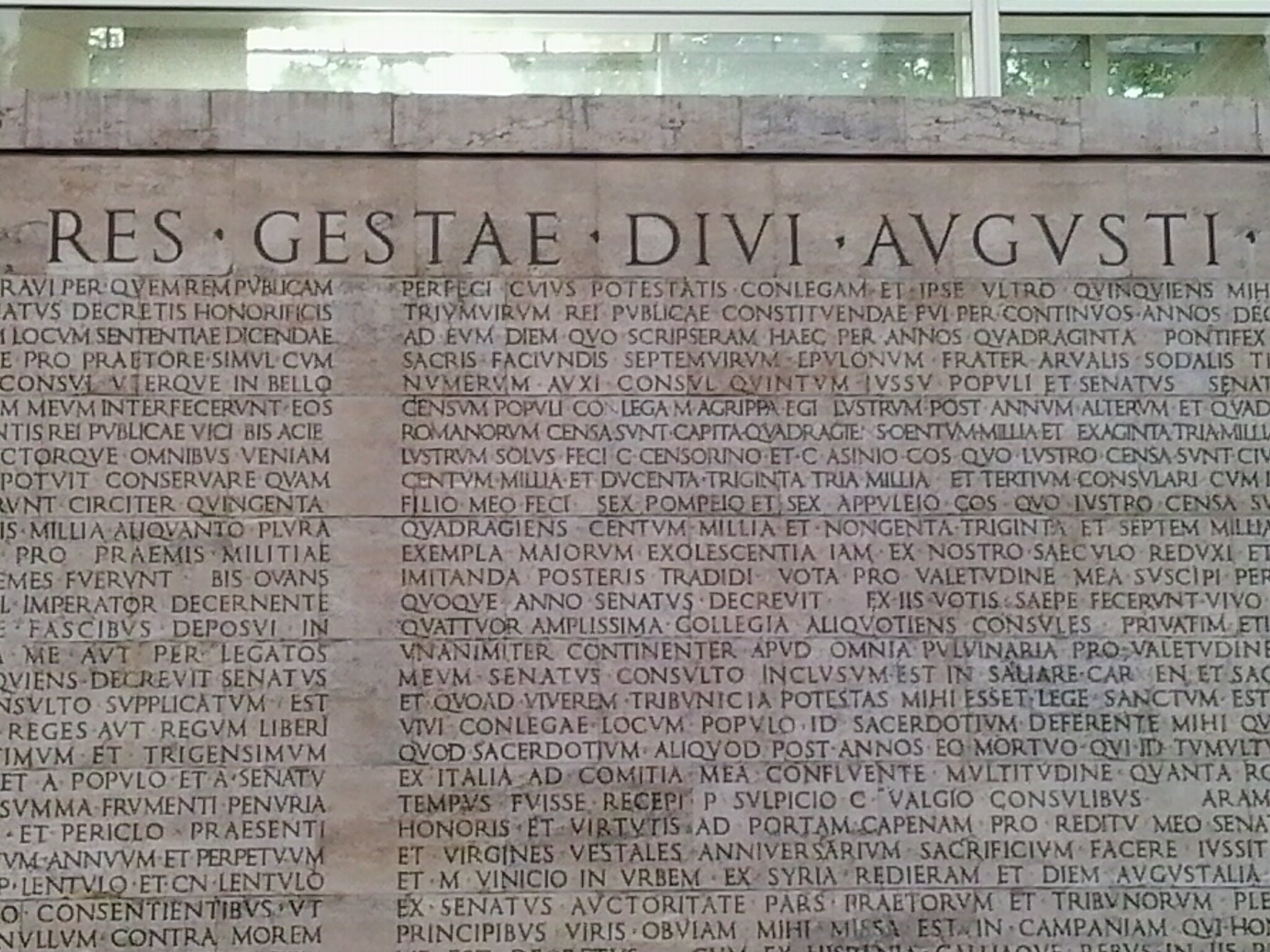
Flanking the large glass and steel case, built by Meyer years ago, to incorporate the famous Ara Pacis Augustae (the great marble altar wanted by the princeps of Rome to immortalize his politics and propaganda based on peace and stability), you will notice a series of characters written in Latin, with the following words in the foreground: Res Gestae Divi Augusti. What does it mean? Here's what your local tour guide in Rome has in store for you today: Augustus'testament.
What is imprinted here is, in fact, the testament of the one who, to all intents and purposes, is considered the first emperor of Rome. A will he himself delivered, along with his estate, to the Vestal Virgins. The real Res Gestae Divi Augusti, or rather a practically contemporary version of Augustus, was partly found in a temple dedicated to the deified Augustus, located in Ankara, Turkey. Some walls of the inner cell, little presented in any case, present these words, which represent in all respects the life, works , decisions, words , the way of being of the supreme princeps of Rome. Probably Augustus wanted to have his will carved on bronze plates, but nothing of the kind has ever been found... In any case, his Res Gestae consisted of 35 chapters, divided into 3 bands. In the first, Augustus celebrated his cursus honorum, rattling off all the public and religious offices, with the relative honors, which he covered in his life. Typical Roman behavior of the time, since communicating the glory received to posterity meant bringing honor to oneself and, above all, to one's family, which could have facilitated the educational and political path of the descendants. The second part is dedicated to public works (but also to games) created at the behest of Augustus. As if to say, to underline what Augustus, also from the legislative point of view, did for the Roman community. A way to be recognized as the father of the country.
The last part is dedicated to his military exploits and his foreign political career, with victories brought to the battlefield and diplomacy with foreign kings. As if to say that if peace reached Rome with his kingdom it is also due to its ability to protect Rome. According to the official propaganda circulated directly by Augustus during his long reign (41 years), ours won three wars, thus obtaining three triumphs. Although, in reality, the princeps must thank above all his trusty Agrippa for his military victories but, also, for the tireless construction activity of the latter (as you can read here), in the end the will you have in front of your eyes honors, in every sense, a man who changed the city. In short, as in the Roman style, an inscription aimed completely at what was done in life, to emphasize what honorable may have been achieved, always for the good of the community and its family . But, as always, never forget your friends! An essential element of the Roman who wanted to be successful, the social network of friendships always had to be cultivated, to have the necessary support in times of crisis or success. And, as we know from the Appendix of this testament (probably inserted posthumously), Augustus spared no expense in helping and supporting, especially in serious moments of difficulty, friends who had fallen into disgrace (former senators or other). As if to say that the generosity of Augustus was truly imperial, if we consider that in the appendix it is written verbatim that the economic aid given is incalculable.