


On Via Gardibaldi, a latrine from ancient Rome amazes with its stuccoes and its refined setting.
We are on the Janiculum, the historic Roman hill that offers a spectacular view over the city. A hill that was a battlefield at the end of the 19th century, home to the Botanical Garden or wonderful Renaissance villas (like this). But, buried underground on this rise, there is much more. Imagine how, in 1963, a wall, built in the 17th century, partially collapsed; it served to reinforce the little square in front of the church of San Pietro in Montorio (spectacular, you should visit it). And there was great surprise when, digging, the workers began to find remains of a very unusual room, dating back at least to the 2nd century AD. It was not a simple room, but rather a typical public latrine of ancient Rome. A rather special latrine, if you like, since many remains of stuccoes and frescoes were found here. So it must not have been something for everyone’s pockets, since we must consider that one had to pay, even if not very much, to get in. A kind of luxury toilet, that’s it. Let’s see a bit more together with your local tour guide in Rome.
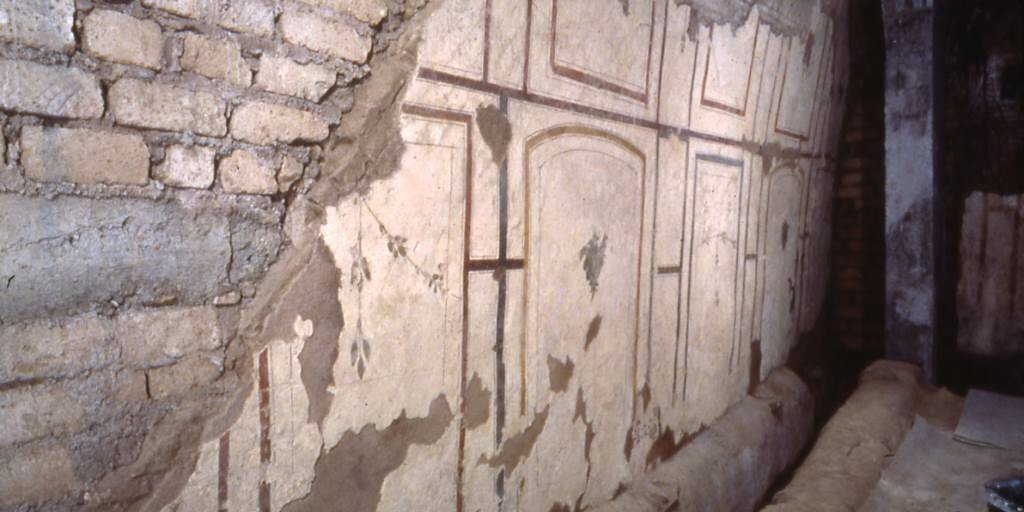
As mentioned, even today it is striking, the quality of the preservation of some of the original stuccoes and frescoes. The walls are divided by elegant colored frames in the middle of which stand rural little figures and, above all, animals. Famous is the image of a rearing ibex depicted here and extraordinarily well preserved. Traces of paint dating back to the 1st century AD have also been found, so it is possible to suppose that this room, originally, was part of a private residence belonging to a noble family. A room that then, who knows for what turn of events, became for public use, no longer private. After all this bath was, from the point of view of the ancient Romans, but also to today’s eyes, quite luxurious. The floor too was richly decorated, in this case with a classic black-and-white mosaic in tesserae. Let’s not forget, though, that we are still in a latrine. So the remains of the main channel were found, running along three of the four sides, a channel lined with cocciopesto since it was here that, continuously, the waters flowed, first clean then waste. Parallel to this channel, here partly appears another small channel, useful for the constant recirculation of water. Something is missing, though…
In fact the first drain channel, the main one, as in all latrines of old Rome, was covered by stone or marble seats, with on the surface the hole on which one had to sit for one’s ablutions. Similar examples have almost always been found when a latrine is present, but not in this case. Why? Archaeologists suggest that the seats, like other furnishings, must have been made of wood. Nothing exceptional, since there are other examples around the world, but certainly something unusual, that’s for sure. Just as unusual, if we may say so, are the lewd, crude or ironic phrases that archaeologists found along the latrine’s walls. Engravings left over the centuries by the latrine’s customers! Let’s not forget that in a place like this there was everything except privacy. No element to separate the holes running along the stone or marble slab placed above the drain. So imagine doing your business just a few centimeters from someone busy doing the very same thing as you, or worse. It was also a way, a rather peculiar one, to chat about this and that, to socialize. A public place par excellence where you could meet friends or strangers. The same irreverent Martial, for instance, tells us about a freeloader named Varra, who spent his days in a latrine to sponge a free lunch. Once finished with their ablutions, some would let themselves go with truly encouraging maxims, like an engraving where we read: “After enjoying the pleasures of the table it is good to stop by here before then devoting oneself, lightened, to the pleasures of love”. Here, finally, is yet another example of how the underground of Rome can give us timeless surprises (as you can also read here and here). Wonderful, isn’t it?


















