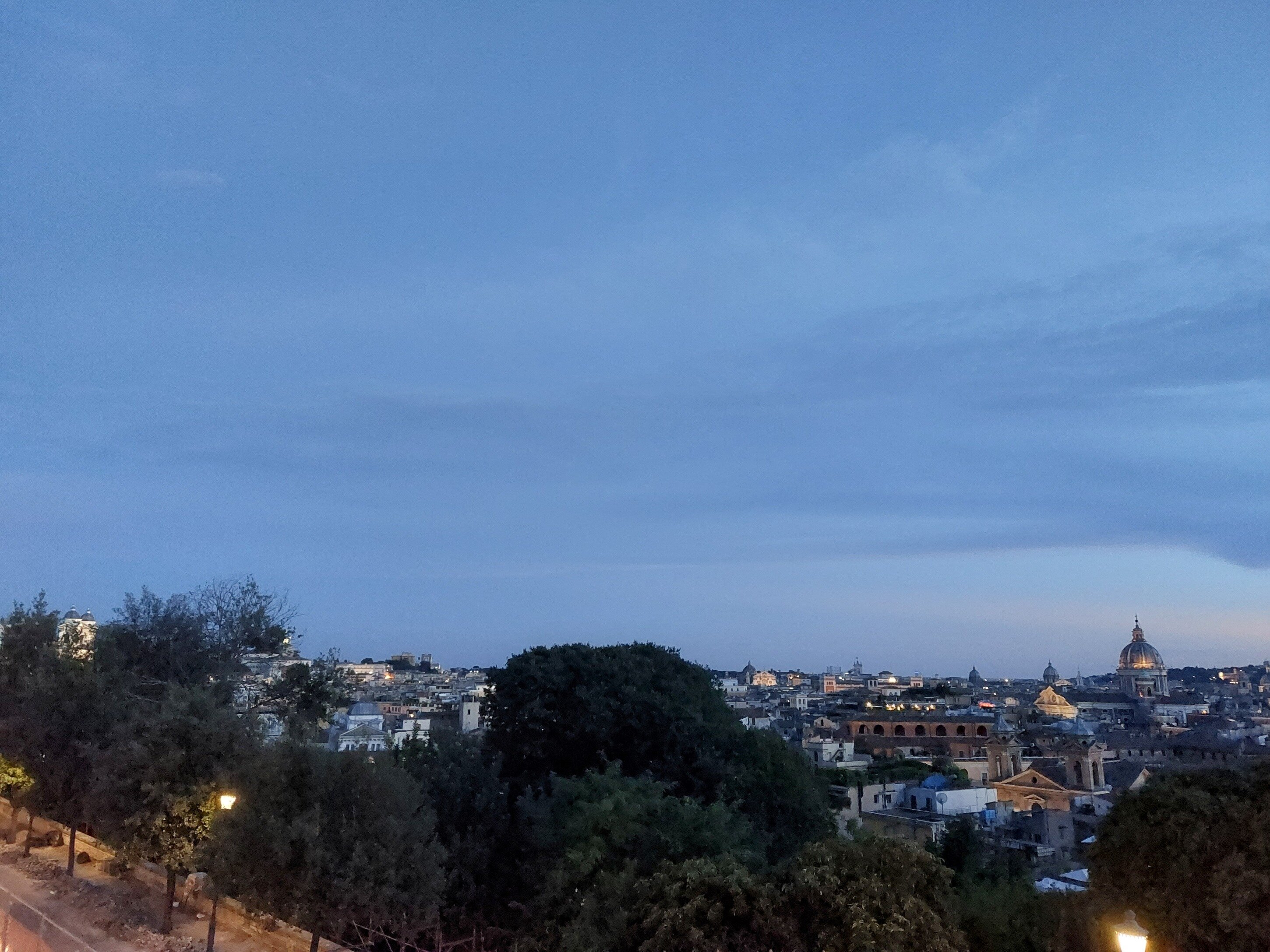
Here are a couple of photos capturing Piazza del Popolo as the Sun sets on the horizon, a new angle to admire from another viewpoint one of Rome’s most celebrated squares. I certainly never fail to explain to my tourists how Piazza del Popolo is, however, not only a square embellished with unique monuments and buildings because, after all, it is also what happened on its ground that is truly interesting.
All of us can appreciate the breadth and elegance of the square, completely rearranged in the early 1800s by the architect Valadier, (a true Roman despite the surname) who worked a lot in Rome. But this place, first crossroads and entrance on the north side of the Capital, also has a dark history behind it. Suffice it to think that Piazza del Popolo for centuries was used as a place for public executions. During Papal Rome those sentenced to death climbed the scaffold to be hanged or, also, to be condemned to the so-called "Roman mannaja". What was it? A kind of guillotine ante litteram! It was a real guillotine whose blade came down from above to behead the condemned. The French therefore, even though they patented and improved it, invented nothing! Certainly this is a dark page in Rome’s long history, but all in all it is interesting to know how citizens could freely attend public executions which, of course, had as their main purpose that of setting a good example, making it clear what the fate was of those who did not follow the laws of the pope.
The famous Mastro Titta, a executioner active in Rome in the 1800s who noted in his diary, in detail, every sentence carried out by him, was skilled in the use of the "Roman mannaja". Mastro Titta (whose real name was Giovanni Battista Bugatti), had to his credit as many as 514 executions successfully carried out. Not by chance, therefore, he was nicknamed "er boja de Roma". A man certainly active and colorful, our Mastro Titta, who lived in the Borgo district and who, consequently, to come here to Piazza del Popolo had to go to the other side of the Tiber. From this move from one bank to the other, by means of a bridge (Ponte Sant'Angelo in particular) comes the Roman saying "Mastro Titta passa ponte", to announce the start of a new public execution. It should also be said that such executions were real shows, as well as public warnings, that always drew many people. Illustrious figures found themselves face to face with public death, like the English poet Byron, who in his diaries tells us how one day, walking through the streets of Rome, he came across, right in Piazza del Popolo, a public hanging. He was appalled by the presence of screaming and cheerful children, who could not wait to witness the death of those condemned. It is thought that that very experience put an end to Byron’s romantic and intense Roman adventure. In short, a Rome that at times is not only ancient monuments or Christian basilicas...