Your local tour guide in Rome takes you today inside the famous Palazzo Corsini on the Lungara, located along the street of the same name near the Tiber. A historic building, home to the Accademia dei Lincei, whose rooms have hosted prominent figures, such as Christina of Sweden, just to name one. A building that belonged to a noble family that also gave a pontiff to the Catholic Church, pope Clement XII, in the first half of the eighteenth century. Palazzo Corsini, among other things, also houses an interesting collection of artworks of various kinds, especially the so-called Corsini Throne. Certainly one of the most fascinating and problematic objects in the collection of the Corsini Gallery. Let's discover it together.
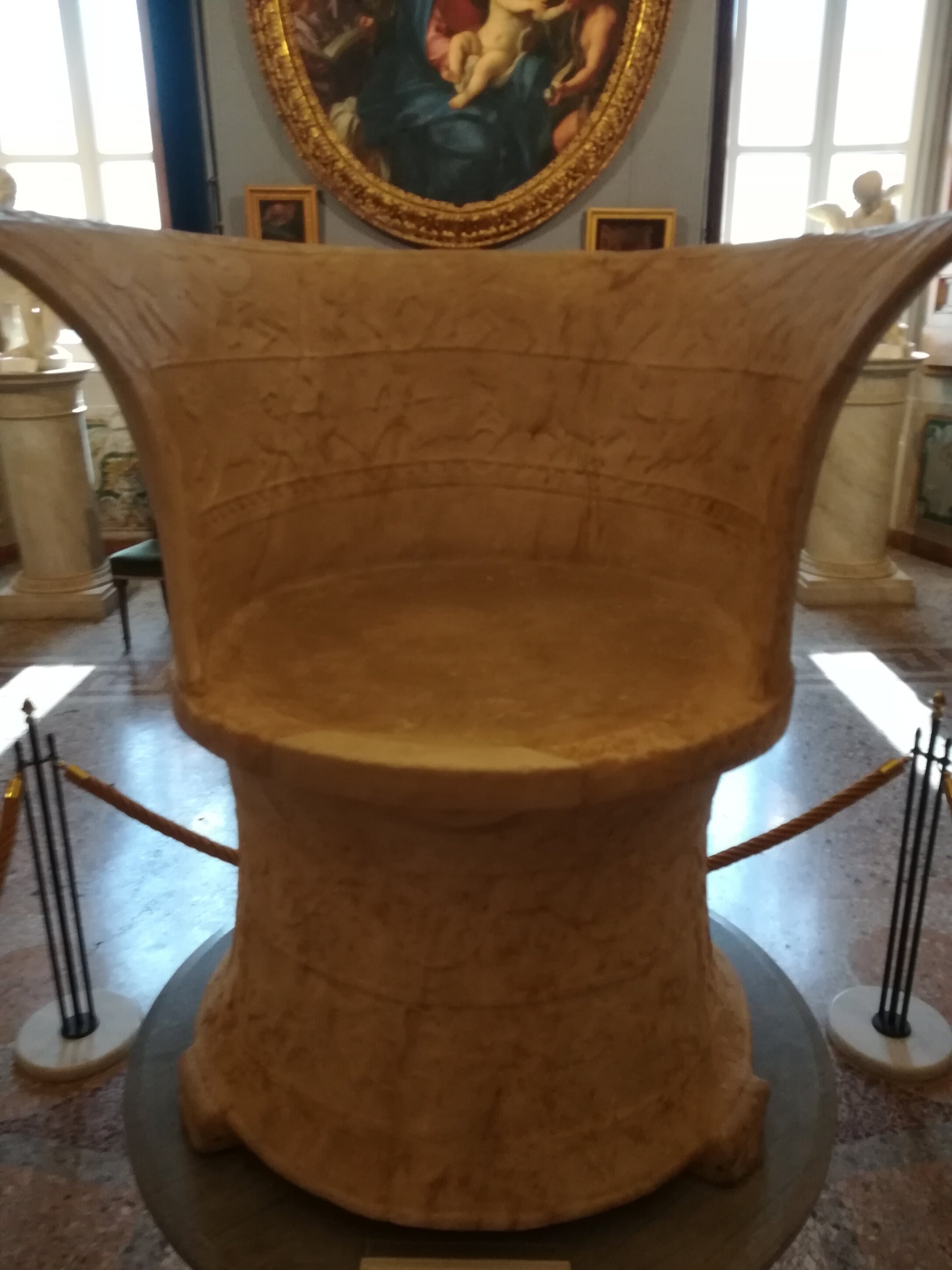
In fact, there are many unsolved mysteries regarding the work. First of all, let's understand what we are talking about: this is a small marble throne, about 80 centimeters high, with numerous figures and reliefs. The backrest is divided into two registers by an ivy garland frame: the sequence of soldiers with their weapons on the upper register is beautiful, and equally magnificent are the hunting scenes on the lower register. Completing the decoration are the reliefs on the base, where ritualistic scenes are clearly visible, with processions and battles between warriors. The religious character is, therefore, clear. Now the question is: what was this throne, dating to around the 1st century BC? It is interesting, first of all, to understand where it was found: the work was discovered between 1732 and 1734, during excavations carried out to build the foundations of the Corsini family chapel in the basilica of San Giovanni in Laterano. And this creates a problem... In terms of type and decoration, in fact, the work falls within the series of funerary thrones common in the Etruscan environment and made mainly of bronze or terracotta. The use of marble and the place of discovery, however, bring the object into the Roman sphere and make it unique in the panorama of ancient sculptural production. So? Etruscan or Roman object? Why is it made of marble and not terracotta, as one might expect? The answer probably lies in between. Precisely because of its uniqueness, one of the hypotheses is that the Corsini Throne was the symbol of the royal descent of the most important woman of the Plautii Silvani family, Urgulania, of Etruscan lineage and wife around 40 BC of M. Plautius. To emphasize, therefore, the royal and Etruscan lineage of the bride Urgulania, they did not hesitate to commission a truly unique and valuable work.
The two cultures and traditions, Etruscan and Roman, which have often intertwined over the centuries in many fields, starting with art, have here too shown how their meeting can sometimes generate true works of art. Here, then, is one more reason to visit the Corsini Gallery and its very interesting collection. Another gem of Rome, after all.