

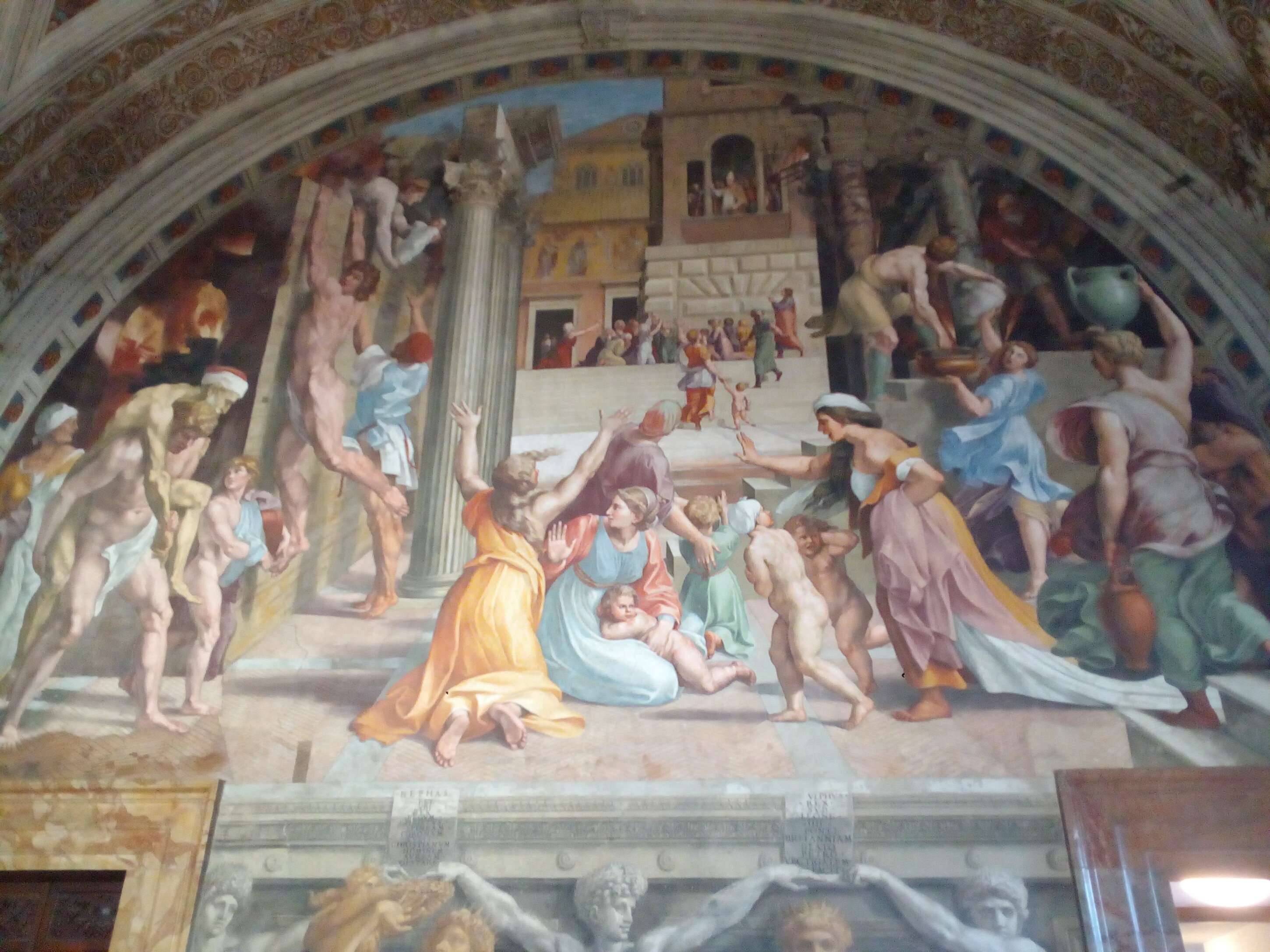
In the Raphael Rooms in the Vatican Museums we find grandiose frescoes by the young master from Urbino, to whom the rooms are dedicated, which still fascinate us today. As a tour guide I never miss an opportunity, when I can, to visit the marvelous Raphael Rooms to be able to show how much beauty a master can create. This fresco, the most beautiful of its rooms, also reminds us of how very strong the relationship between art and popular and religious traditions was. Let's see together why the painting you see in the picture has made history in every sense.
As for the fresco of the Liberation of St. Peter (an analysis of which you can read here), we are inside one of the private rooms of pope Julius II, later used by Leo X, embellished by Raphael and his workshop. Here we are in the room of Borgo, and in the picture you see the fresco that refers to the miracle that gives the room its name. Borgo is, still today, that district of Rome close to St. Peter's Basilica and the Vatican, which arose thanks to the first communities of pilgrims and others who, since the Middle Ages, settled near the place of worship dedicated to the first of the Apostles. A very popular neighborhood symbolized, among other things, by a small fountain next to Bernini 's colonnade in St. Peter's Square (here you can find out what I'm talking about). We are in 847, and a large fire threatened the whole area, including the basilica. According to the tradition the pontiff Leo IV, with the simple Sign of the Cross, managed to tame the fire, extinguishing it. Here is what we find written in the Liber Pontificalis , a collection of stories and anecdotes from the Middle Ages from which many artists and theologians found inspiration for works of art of various kinds. "And right at the beginning of his pontificate, already mentioned before, a violent fire spread in the Saxon quarter, which, due to the strength of the flames, began to burn everything rapidly; there a large crowd of people gathered who tried to put out the flames of the fire. But due to the blowing of the wind the flames spread higher and higher in the air, burning and destroying everything, so as to get closer and closer to the basilica of blessed Peter, prince of the apostles, burning and demolishing the houses of the Saxons and of the Lombards and the portico. Hearing this, the most blessed pontiff in person ran there, and stood in front of the force of the fire. He began to pray to the Lord that he might extinguish the flames of the fire, and making the sign of the cross with his own fingers, the fire could not extend beyond its flames; failing to resist the power of the blessed pontiff, the flames extinguished were reduced to ashes" . It all seems very clear. The Raphael's fresco, which can be dated around 1514, represents exactly this moment. We see the pontiff in the background with his sacred vestments, looking out from a Renaissance-style loggia. He is making the Sign of the Cross, which is very providential in this tragic moment. The tension is palpable, and the desperation too. Let's see the group of people in the foreground for example, with the alarmed women and frightened children. But we notice above all on the left, where a group of figures are trying to escape the fire. Here we see how Raphael took a lot from Michelangelo, perhaps inspired by the frescoes in the Sistine Chapel. The bodies, naked and almost heroic in ancient Greek fashion, are so plastic and dynamic as to be strong and lively. The man in the foreground, perched on a wall, is of unprecedented power. As well as the young man who, soon, carries an elderly man on his shoulders. Here it is easy to understand how Raphael, like the other artists of the time, knew the epic poems or the writings of the classical world. It almost seems to see, here, an Aeneas fleeing from burning Troy with his old father Anchises on his shoulders. It really seems to be attending a theatrical performance, with us spectators looking at those colors and those bodies which, arranged and positioned with criteria on the pictorial space, tell us the story of the miracle of a pontiff, Leo IV, who has the same name as the client of the work (and of the entire room): Leo X. A way to celebrate the work of the Renaissance pope, a member of the Medici famil , who in a turbulent moment wanted to restore peace and stability to Rome.
Even Leo X, like his predecessor, somehow wanted to put out the fire that flared up within the Catholic Church, due to theological scandals and disputes, starting from the earthquake caused by Protestantism. After all, Renaissance art is also this, above all if the client was curial: politics represented by means of artistic marvels. This fresco, among other things, highlights not so much the miracle as the tragedy. You see how small the pope depicted on the wall is compared to the fire that is consuming the souls of the people (women, men and children ), who flee terrified, ask for help, cry and scream. Only a powerful miracle could save them. And that was what Leo X wanted to do: restore peace and harmony in a time of conflict for the faith. All, finally, with the facade of the old St. Peter's Basilica in the background, the one not yet modified and not yet reached by the works promoted a few years earlier by Pope Julius II. In short, a real historical photo in one of the rooms of the Vatican Museums in Rome, a place always full of treasures to discover and study.





















