

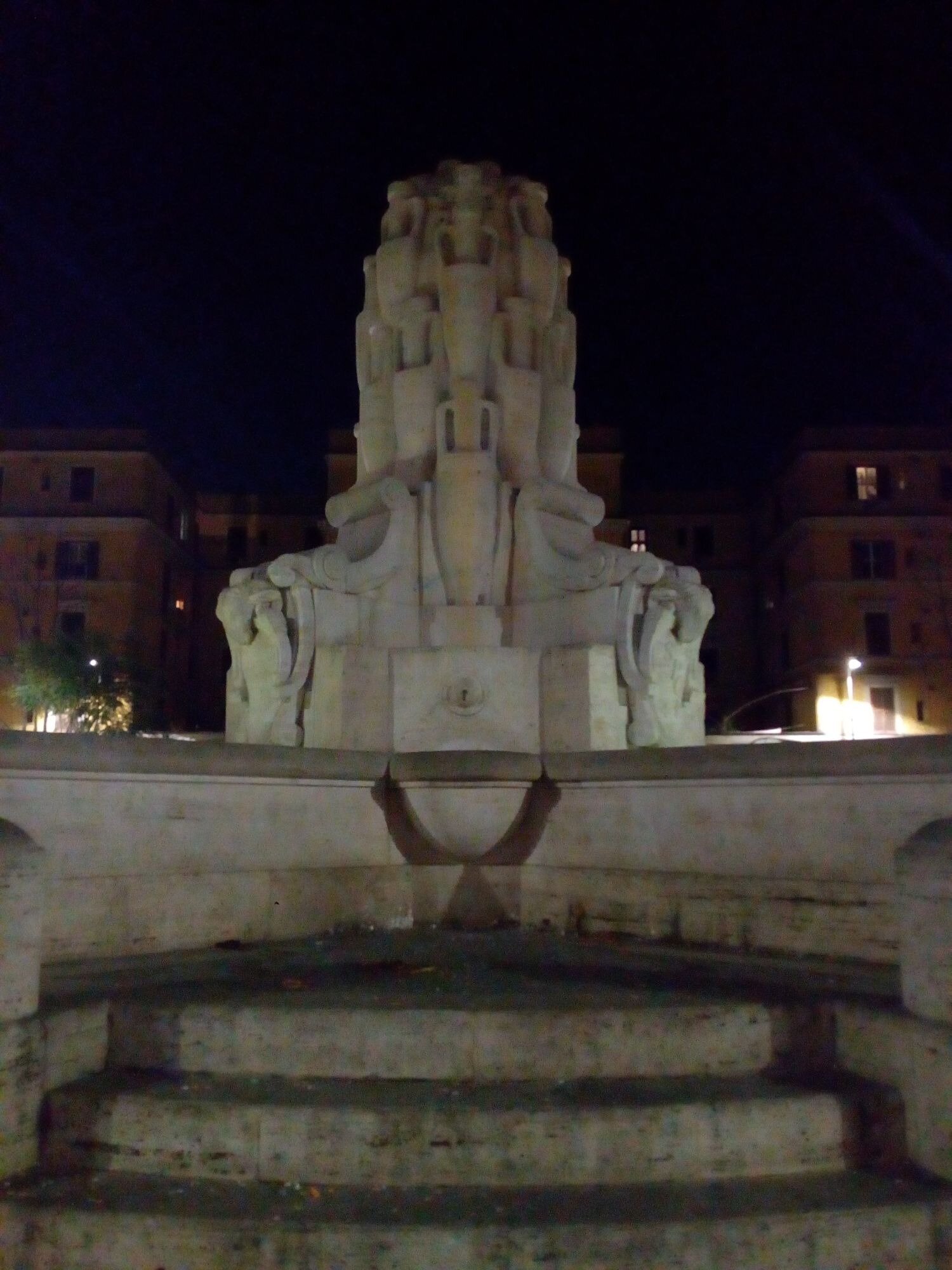

Among the symbols of Rome there are not only the great monuments but also the districts, those traditional districts that sink their roots in the history of the city making them unique and inimitable. For example we have the curios Fountain of the Books, while in this photo you can see the Fountain of the Amphorae, created by Lombardi in the 1920s to decorate the Testaccio district, creating a symbolic place for the whole historical and traditions neighborhood of Rome! Even for me, a local tour guide here, is a pleasure to visit this area.
Famous for its nightlife and its restaurants, Testaccio has a long history that begins with the... amphorae! Right here, in fact, in the part close to the Tiber, there was the main river port for the ancient Rome, a place of extreme importance for the economy and the trade of the city. The so-called emporium was a strategic place for the economic and commercial growth of Rome since the second century b.C., when a series of paved quays and warehouses were built, with a sloping trend, on the banks of the Tiber. Today some remains are still visible, some walls and ruins that come out of the ground and that cold be seen at the end of Via Marmorata, along the bridge in front of you for a short distance. The basic necessities, as well as luxury products, food, thirst and so on, arrived in Ostia (the main port of Rome) along the Tyrrhenian Sea, to then be transported (by barges pulled, often, by slaves or cattle), along the course of the river. And from here, from the halls of the emporium, they were sorted everywhere in the city, thus allowing unprecedented development. Consequently it is easy to understand how the Testaccio district, which at first became an industrial area and then a residential area since the end of XIX century, at the beginning of its history was nothing more than a commercial area, very important for the city economy.
Among the products most loved by the Romans there was oil, coming mainly from Southern Italy and Greece. The oil was transported in huge jars that could contain up to 30 kg of oil and which, we must imagine, enormously filled the area with intense perfume and an equally intense activity dedicated to the transport and recovery of the same. These jars, in fact, in contact with the viscous liquid could not be used for a second transport, as at times they broke and, just as many times, they were no longer reusable as they were irremediably dirty and stained. For this reason the Romans strove to find a way suitable for the disposal of those fragments of vases, defined testae in Latin (hence the name Testaccio), and from this need the so-called Monte dei Cocci. Imagine a kind of artificial mound about 35 meters high and made up of millions and millions of ceramic fragments placed neatly on several rows, in a clean and tidy recycling. Monte dei Cocci is a symbol of Testaccio but all this is represented by the Fountain of the Amphorae, located in a small square that symbolizes the entire neighborhood, surrounded by buildings built, in some cases, more than a century ago. A fountain from which clean and healthy water still gushes which, with its beautiful amphorae placed in plain sight, reminds us of the very origin of an original district of Rome.