

The central bronze portal of St. Peter’s Basilica shows scenes of saints, a fifteenth-century pope, and celebrations.
Every year millions of people cross the threshold of the wonderful St. Peter's Basilica in the Vatican, in Rome, to admire its extraordinary works of art and its historic - religious importance. Just think that the place of worship was built where, as you can read here, even today the tomb of the Prince of the Apostles, namely Saint Peter, is still found. And for this very reason, for centuries now, the pontiffs have lived in this area, to be close to the one considered the first pope in history. Let us not forget the incredible wonders housed in this basilica: Michelangelo's Pietà, the bronze Baldachin by Borromini and Bernini, as well as the funerary monument to Pope Alexander VII Chigi, also the work of Bernini. But there's more, much more. Like, for instance, the central door in bronze. If the others are about a century old, this one has still been here since the distant 1400s, when it was commissioned by the ill-fated pope Eugene IV in the first half of the 15th century. The work was made by Antonio Averlino, known as Filarete. A pupil of Ghiberti, who surely knew his bronze, Filarete was someone who knew what he was doing. And let's see how, thanks to your local tour guide in Rome.
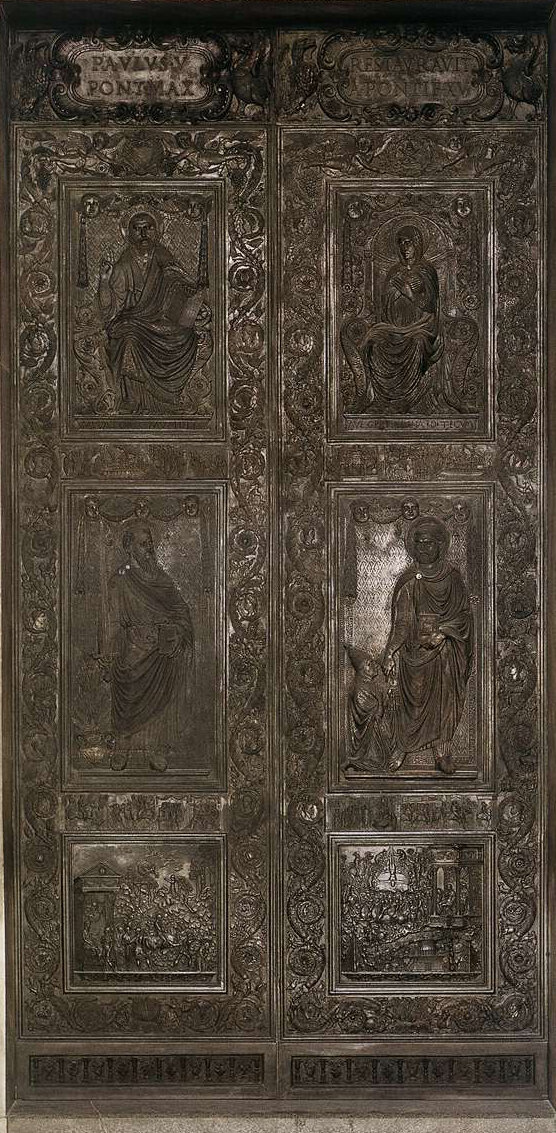
The outer front, the one facing the square, is divided into six large bronze panels, with the usual depictions of Christ, the Virgin Mary, Saints Peter and Paul and their respective martyrdoms. A way to understand that one is about to enter a sacred place, born also thanks to the sacrifice of men and women who gave their lives for Christ and for their faith. But there is more, both on this and on the inner front. Between the large panels there are also scenes connected to the pontificate of Eugene IV. In 16 years, from 1431 to 1447, the pontiff had to face many problems, so much so that his reign was considered, in part, unlucky. It is said that, on his deathbed, the pope himself regretted having been elected, having preferred to remain a simple monk. His greatest problem was being the successor of Martin V, the pontiff who healed the long-standing wound of the Western Schism, today buried in the Basilica of St. John Lateran. The predecessor was a member of the very powerful local family of the Colonna, and this was a major problem. In fact, once he rose to the throne of Peter, Eugene IV did not continue the favorable policy toward the Colonna that Martin V had planned. Imagine that in 1434 Eugene IV, disguised as a monk, had to flee for a time from the Eternal City, which he later regained thanks to the help of powerful friends. Of course, our Eugene can also boast great successes, above all in the diplomatic field. He was the pope who in 1439 brought to a favorable close the Council of Florence, which for a few years reconciled the Latin Church with the Orthodox one, as shown in one of the plaques of the bronze portal. But there is also more, something even more curious.
As said, due to many internal enemies, the very pontificate of Eugene IV was criticized and attacked more than once. As a result, even everything he commissioned was, at times, harshly and unfairly little regarded. As in the case of the bronze portal of St. Peter’s Basilica in the Vatican. Even years later Vasari himself described the work as the result of a “wretched manner”. Poor Filarete suffered criticism even from his contemporaries, despite the quality of his work. Even centuries later, however, the master’s irony does not go unnoticed, for he did not worry in the least about the attacks he endured. First of all, he left clearly in view, right beneath the scene of the martyrdom of Saint Paul, his signature: “Antonius petri de Florentia fecit MCCCXLV”. But it is on its inner side that the door, like Filarete himself, tells us of the satisfaction he felt in completing his work. In the lower right corner, in fact, one notices a long relief in which Filarete can be recognized, with some of his assistants, intent on celebrating. Drinking and eating, they all enjoy the end of the great effort of making, with enormous satisfaction though, this important work of art. All around there is an engraved inscription, made in the vernacular and with a Latin full of mistakes. A sort of little comic strip in which one can see how much Filarete truly took pleasure in signing such a monumental and important work, considering the building in which it is still visible today. Our man let all the criticism slide off him. Chapeau.
