


With its 770 tons, base included, the Foro Italico Obelisk towers over the area strongly desired by Mussolini, also to self-celebrate.
The whole Foro Italico area, in Rome, was endorsed by Mussolini because, in line with his politics and ideology, a new area was needed in the Eternal City where one could take care of one’s body, treat it and improve it, like the ancient athletes. A new forum for Rome, as some emperors did before Mussolini (click here for an example), at whose center stood the newborn stadium, later renamed Olympic Stadium. A way to celebrate the new Mussolinian course, which dreamed of creating the so-called Third Rome. Of course, in his program, based on a mix of art, symbolism and propaganda, an obelisk could not be missing. Exactly like the Roman emperors who, from Egypt, brought into the Urbe those grand monuments meant to underline their power (as in this case), Mussolini too wanted to seal his power. Erected under the supervision of architect Costantino Costantini in 1932, at first it was imagined to shape the obelisk using typical Egyptian granite, just like in ancient times. Because of the prohibitive costs, they chose the classic, yet still special, white marble from Carrara, a material donated with great enthusiasm by a group of industrialists from Carrara, led by Renato Ricci (president of the Opera Nazionale Balilla).
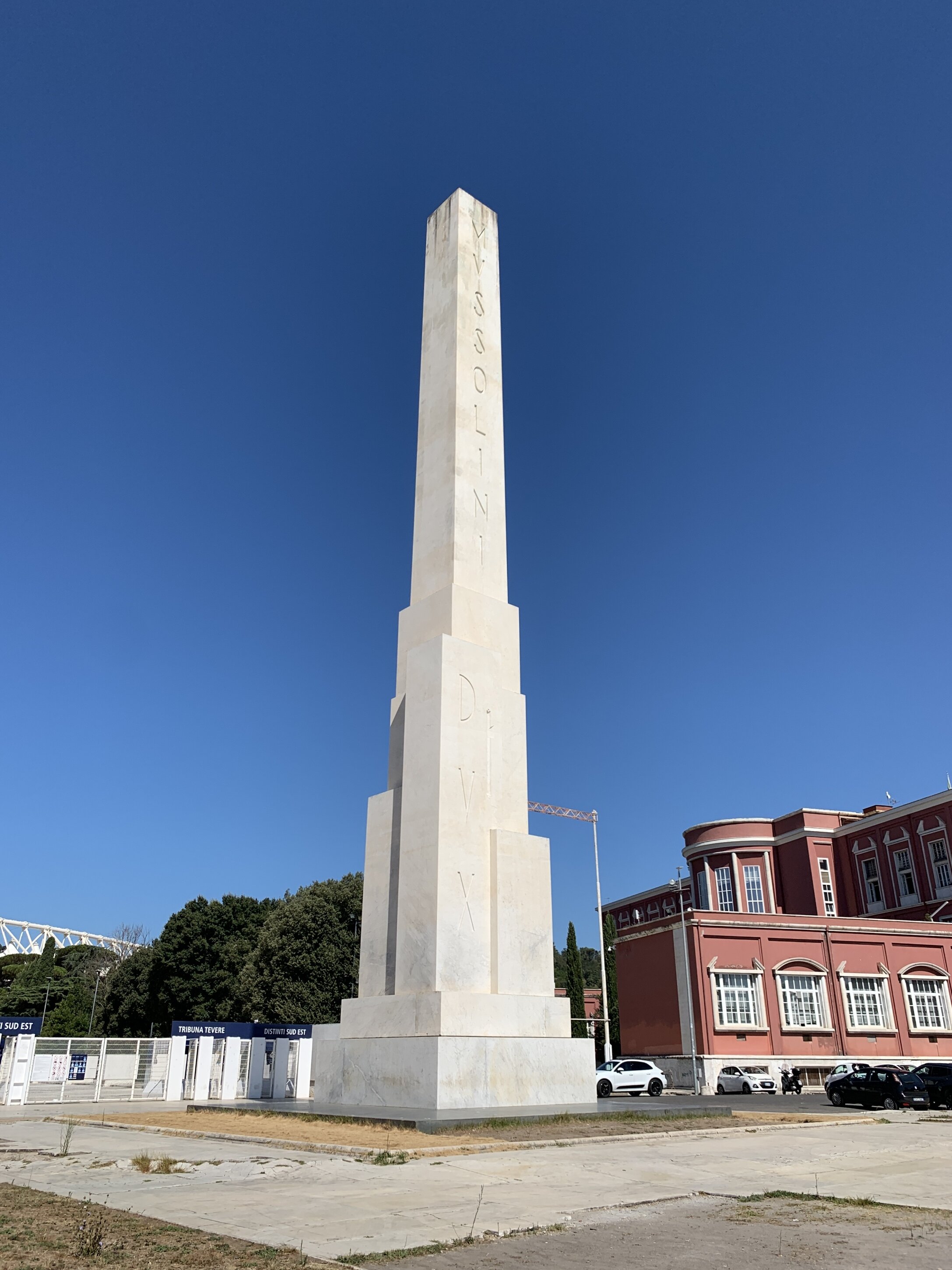
But there is more, besides the smooth marble surface of the obelisk, on which the inscription Mussolini and Dux stands out. In the constant link between the past and its present, the Duce wanted to do things properly. For this reason it was ordered to adorn the obelisk with a golden pinnacle. It is not a block of granite, the noblest material there is, but a bronze pinnacle clad with gold-plated sheets. Of course, the hefty cost for the gilded decoration alone was glossed over, so much so that the addition of the pinnacle was justified by saying that, in this way, the obelisk would be better protected from bad weather and the passing of time. The fact is that, for decades, a fanciful rumor circulated. It was said that, in the turbulent months between the Nazi occupation of Rome and the arrival of the Americans (we are in the first six months of 1944), someone managed to steal the real pinnacle, replacing it with a fake. Needless to say, it would be rather odd if no one had noticed such an engineering miracle. Just think of what heavy machinery would have been needed to reach the top, remove the pinnacle and replace it with another. For what purpose, then, if the aim was to steal the original anyway? Here is a classic example of a hoax! But your local tour guide in Rome has another little surprise to reveal to you.
We leave the summit to reach the underground. Right beneath the base of the Foro Italico Obelisk, in fact, even today a real time capsule is preserved, deliberately left by leading figures of the time to commemorate the raising of the monument. A real custom, actually, because time capsules are still left today in similar circumstances, not to mention the times it happened in Rome (as in the case of the Palazzaccio, which you can read about here). Of course, after decades, the presence or absence of this artifact began to be shrouded in legend, so much so that two scholars had the chance (and the permits) to dig to recover what had been left in 1932. They found, therefore, some coins minted by the Mint that year, bearing for example the profile of King Victor Emmanuel III, and also a document called Codex Fori Mussolini. An inscription on parchment in which Mussolini is mentioned, a new “man of providence” (so it is written), written by Aurelio Giuseppe Amatucci, a man of letters and professor at the Catholic University of Milan at the time. A real time capsule in a sense, like the one placed not far from here under the monument to Cavour (click here to learn more). As always Mussolini wanted to leave nothing to chance, to leave a trace and memory of himself. All the more so here, in the Eternal City.