

Well yes, in Rome there have been, in more or less recent times, even cases of cannibalism, more or less involuntary, as a marble plaque tells us.
Piazza della Rotonda is famous for the Pantheon, one of the most important monuments in the world, an outstanding symbol of ancient Rome's architecture and engineering. Not surprisingly, it is also a building that has inspired curious stories and macabre legends (as you can read here), something that a local tour guide like me always enjoys describing. But, speaking of dark and raw facts, try turning your head to the other side from the facade of the Pantheon. Move closer to the area where the restaurants are and try to read the curious inscription in marble fixed to the wall. Let me write the translation: “Pope Pius VII in the 23rd year of his reign, through a very provident demolition, reclaimed from hateful ugliness the area in front of the Pantheon of M. Agrippa, occupied by ignoble taverns, and ordered that the view be left free in an open place.” What so scandalized Pope Pius VII that he decided to order the “provident demolition” of the “ignoble taverns”? According to some accounts (and we are at the beginning of the nineteenth century), there was a kind of open-air market in the area. A fruit and vegetable market where, however, a bit of everything could be sold. And it is known that, between eating and drinking, there were some who went too far, heating up tempers and causing fights or unpleasant situations for the patrons of the area's taverns. But, speaking of taverns, it seems that one in particular caused such a stir, in a negative way, that it had to be targeted by a papal decree. Let's find out more.
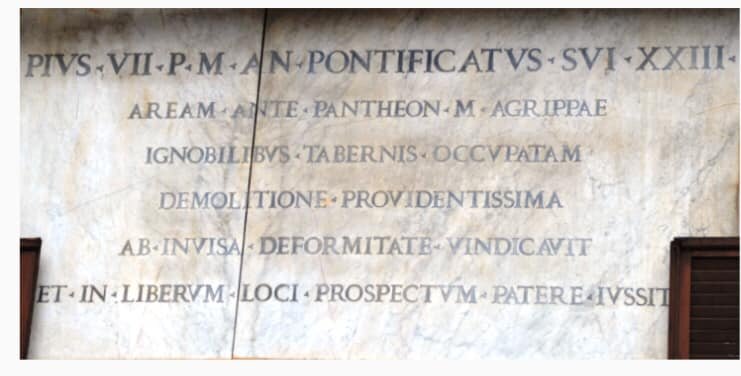
It seems that right here, where the inscription is today, for many years there was a famous pork butcher shop (some say it was actually a real restaurant). The owners were two brothers, or according to others, cousins, originally from Norcia. Even today, the town in Umbria is famous for its meat, especially pork. In particular, the sausages were considered the true delicacy of the shop, something all of Rome talked about, long before reviews existed. Everything was fine, except that a rather disturbing rumor began to spread. It seems that not only pork meat was being sold to customers. No, because according to the reports and official documents of the time, it often happened that some restaurant patron would suddenly disappear. With some excuse, they would be led down to the cellars of the building and then, indeed, vanish without a trace. What is most chilling, according to judicial and notarial records of the time (so very likely true), is that these men and women were literally cut to pieces, and then added to the menu. In short, sometimes in that shop, people ate human meat!
Certainly, someone like Hannibal Lecter would be more than pleased with such a practice. Just as certainly, however, the pope could not accept such atrocities. I repeat, although it is hard to believe, it seems that the story is not just a mere legend, but actual truth. Who knows, maybe the owners of the place had such powerful enemies that they managed to invent a story like this, making it reach even the holy ears of the pontiff. The fact remains that a marble inscription, like others of its kind in Rome (read here to believe it), once again tells us the story of an event, if we can call it that, that has marked the history of the Eternal City.