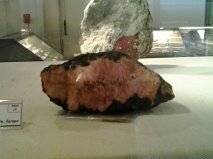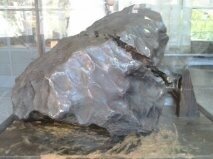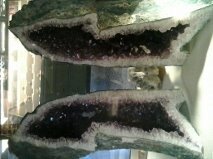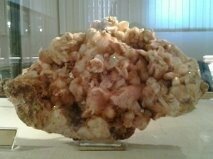
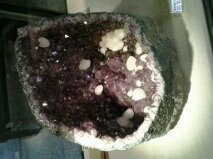
Here we have photos of minerals taken directly in the halls of the Mineralogy Museum of the La Sapienza University of Rome! I am not an expert on the subject, but I was struck by the colors, the shapes, the beauty almost artistic of these minerals found in various parts of the world, as a result of excavations and expeditions. Come with me to discover better this fantastic world, in a place of Rome that is not so known. And it is a pity...
It is curious to think about the hard work that we should be behind each find, and then proceed with the cleaning and cataloging. Also impressive to think about the hundreds of pieces that the rooms of the Mineralogy Museum at La Sapienza University house. Imagine that the museum was founded at the 1804 by the pope Pius VII. The collection today consists of about 30,000 pieces, including minerals and gems. There were many directors that tried to improve this museum, and many contributed to enrich the collection, which today can be considered as one of the most appreciated in Europe. Among these men I would like to mention in particular Father Carlo Giuseppe Gismondi (1762 - 1824), one of the most distinguished scholars of mineralogy of his time. He was the one who draw up the first scientific catalogue of the collection, and was so important in the environment that his name was used to name a new mineral discovered at the time: the gismondite.
Moreover I have to quote the director Peter Carpi, who later managed to acquire the huge mineralogical collection owned by the pontifical prefect Lavinio de Medici Spada. Imagine that around 12,000 pieces in the current collection come from this collection. However it is for only one reason that I wanted to publish these photos: to remember how the patrimony of Rome is huge and varied. At La Sapienza University (founded by Pope Boniface VIII in the early XIV century), there are several museums, and imagine how all of them are also free. From the Plaster Cast Gallery to the Museum of the History of Medicine. A sin that only the students (and not all) know their existence. I feel lucky because I studied at La Sapienza University, and probably that's the reason why I know the existence of this pretty museums. Moreover, being a local tour guide, it is a mission for me to share another peculiarity of Rome.