

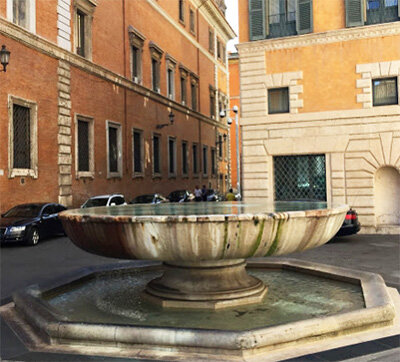
The small district of Sant'Eustachio in Rome, the one close to the Senate Palace and the Pantheon, truly has a thousand little surprises to offer us. After all, the name is linked to the tragic history of a Christian martyr, so much so that the very symbol of the area, as you can read here, is a stag surmounted by a cross. In the area we also have decorated palaces or famous cafés, but today your tour guide in Rome would like to talk to you about something else. For example, if we go to Via degli Staderari, the one that runs alongside the first seat of the La Sapienza University adorned by the famous Fountain of Books, in a small square we will find this marvel: a large basin from the Roman imperial era. What is it? Let's find out together…
Originally, it was an extraordinary monolith of Egyptian granite from Aswan, particularly interesting both for its size and the refinement of its shape. It was discovered in 1985 during excavations carried out in the "della Palma" courtyard, located between the Madama and Carpegna palaces, and belonged to the complex of the Neronian Baths. Imagine how the baths of ancient Rome were truly enormous buildings, with many large halls, basins, polychrome marbles, and more. And of all this, nothing remains except for this extraordinary basin. Being a huge monolithic block of granite, this work of art weighs tons and tons, and imagine how difficult it was, at the time of its discovery, to assemble the 8 gigantic and extremely heavy pieces in which the basin was found. Steel pins were needed to hold everything together, restoring the basin to its original shape. To give you an idea of the enormity I am talking about, I will just tell you that the basin has a diameter of 5.30 meters and weighs, in total, 25 tons! The only non-original part, but added later to place the basin where it is today, is the large base, made of Carrara marble, which weighs 8.5 tons. The basin, in short, officially became a fountain from which, even today, water gushes. The fountain was donated by the Senate to the city of Rome on December 22, 1987, on the occasion of the 40th anniversary of the promulgation of the republican Constitution, as recalled by a plaque that reads: "THE ANCIENT ROMAN BASIN FOUND AND RESTORED THE SENATE OF THE REPUBLIC OFFERS TO THE CITIZENRY ON THE OCCASION OF THE XL ANNIVERSARY OF THE CONSTITUTIONAL CHARTER AND IN HONOR OF ENRICO DE NICOLA PROVISIONAL HEAD OF STATE GIUSEPPE SARAGAT UMBERTO TERRACCINI PRESIDENTS OF THE CONSTITUENT ASSEMBLY ALCIDE DE GASPERI PRESIDENT OF THE COUNCIL 27 DECEMBER 1947 - 27 DECEMBER 1987".
See how many things you can discover? How many hidden wonders does Rome give us? Not far from here, among other things, two columns rise, also in granite, and also part of the ancient Neronian complex, where it seems that events were also held in the presence of the emperor himself. A building symbolizing imperial power, forgotten by time. Probably there is still more in the underground of the Eternal City, just waiting to be brought to light.