

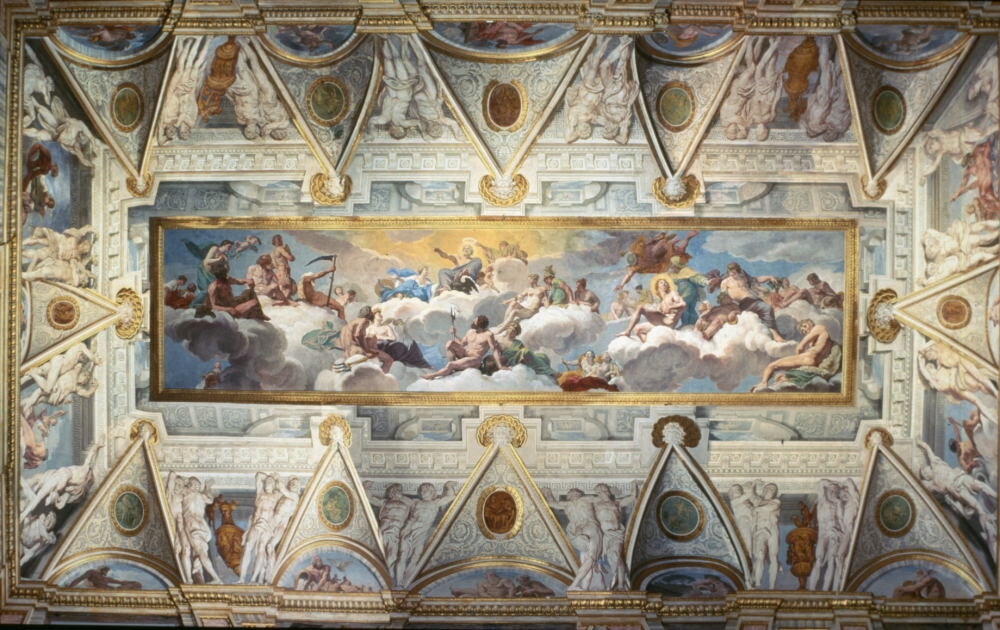
Among the most beautiful rooms in the entire Borghese Gallery in Rome is the so-called Loggia del Lanfranco, the hall that opens to visitors immediately after the stairs that take us up to the second floor. Yet another example of how the seventeenth-century villa (remodeled over the centuries), which houses the extraordinary art collection of the noble Borghese family, deserves to be admired in its entirety, including its rooms. Your tour guide in Rome has already mentioned a couple of examples, as you can read here and here. But today we are talking about one of the original frescoes, which have remained intact, in all their beauty, over the centuries.
Our eyes will probably wander a bit, perhaps focusing on the two marble busts depicting Cardinal Scipione Borghese at the far left, masterpieces by Bernini, or on various paintings that span the entire seventeenth century and beyond. However, the name of the hall immediately refers to the beautiful fresco that dominates the center of the ceiling vault, a ceiling also masterfully decorated with fake marble reliefs, elegant figures that seem to support the cornice, and masterful lunettes, also decorated in fresco. The name of the fresco is "Council of the Gods," painted by Giovanni Lanfranco around 1624. This is the only pictorial element on the wall, along with the decoration of the chapel on the ground floor, original from the seventeenth century, when the works were commissioned directly by Cardinal Scipione Borghese. Everything else was profoundly modified centuries later, especially by Marcantonio IV Borghese. In his "Council of the Gods," of course, Lanfranco gives us an overview of the most representative deities of the Greco-Roman pantheon, starting with Jupiter, seated on the clouds, with the Eagle nearby and crowned with stars. Next to him are two female figures: Juno with the peacock and Venus. To the right, we then see Mars with his unmistakable warrior's helmet, Apollo with his head framed in light symbolizing the Sun, Mercury in flight, and then Bacchus, with his inevitable bunch of grapes. Returning to the center, below Jupiter we have the pair Proserpina-Pluto with Cerberus, the faithful guardian of the Underworld, while to the left we see Neptune with the trident, Ceres the Goddess of harvests, the personification of Time with the scythe, Pan in the guise of a satyr, and finally Minerva with her olive branch (symbolizing how Minerva, or Athena in Greek, was the founder of the city of Athens thanks precisely to the gift of an olive branch). But now let's think for a moment about the name of the hall: loggia. Why is that? Upon entering, you are certain you are in a completely enclosed space. And yet, no, because when Lanfranco was called by Scipione Borghese to work in his villa, this room was, in every respect, a loggia that opened onto the garden. Where today there are windows and a wall, built later, there was once an elegant portico. For this reason, Lanfranco designed the pictorial decoration of the entire room in this way, conceiving it as a kind of union between inside and outside, between private and natural environment, between sky and earth. Inside the lunettes, interspersed with the male telamons supporting the fake cornice mentioned earlier, are the personifications of the rivers of the entire globe. But it is also the main fresco of the vault that gives us an illusory perspective, almost a sense of "opening" that in the Baroque period became almost a rule. Looking up at the sky, it seems as if you are not looking at a wall, but at the sky dominated by the Gods who command it. The clouds and figures that seem to move gracefully give a sense of lightness, a kind of freedom.
This concept, this "opening" and this illusion would become the basis of many pictorial schemes throughout the Baroque and the seventeenth century, both inside private structures and in churches or basilicas. What comes to mind, always speaking of Lanfranco for example, is the majestic dome of the Basilica of Sant'Andrea della Valle, also in Rome (here for further details). In conclusion, this is yet another room in the Borghese Gallery that does justice to a building created, among other things, to house an art collection that is synonymous with beauty, surprise, and wonder. Yesterday as today…