

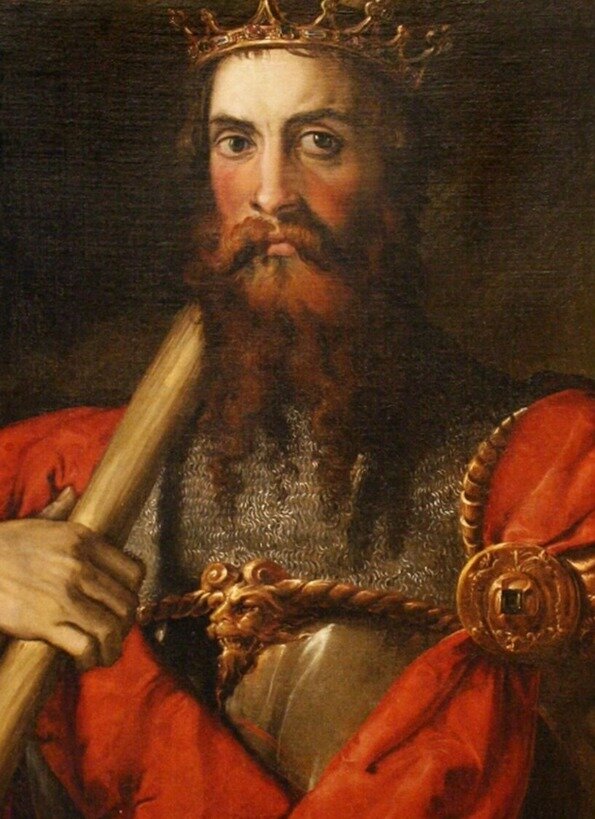
And here we are at the second and final part of the story of the dramatic sack carried out by the Ostrogoths of Totila in 546 AD, a sack that, in a certain sense, had three well-defined stages. First of all, when, following the betrayal of the soldiers stationed at Porta Asinaria, near San Giovanni, the Ostrogoths entered Rome, as written in the previous episode. And the Urbe, for the first time in its long existence, probably really risked disappearing from the face of the earth. Let's see together, thanks to your local tour guide, how this happened.
The Romans were immediately treated as slaves, at least those who were not directly slaughtered. Totila set the city on fire and, probably, his ultimate intention was to raze it to the ground, a bit like Rome itself did with Carthage a few centuries earlier. The situation was very difficult for the community of the Urbe, so much so that even the deacon Pelagius, better known as Pope Pelagius I, had to intervene, who begged Totila, right in front of the Basilica of St. Peter (standing for two centuries by then), to leave the Eternal City and go home. An episode that, among other things, seems to recall what happened in 452 AD when pope Leo I, at the gates of Rome, begged, and convinced, the king of the Huns, Attila, to leave the city (as also depicted in the famous fresco by Raphael in the Vatican Rooms, which you can see here). Another episode, therefore, of how Christian leadership was, at least, considered politically in those tumultuous years. It seems that Pelagius succeeded in his intent, or at least prevented the Basilica of St. Peter from also being razed to the ground. But certainly the same fate did not befall Rome and its inhabitants. But then Totila received a letter written by Belisarius (although, probably, it was actually written by Procopius of Caesarea, the best and contemporary source we have for these events). In this letter Belisarius almost begged Totila not to destroy Rome, mindful of what the Urbe had meant for the world up to that moment. Here is an excerpt from the letter:"Now, of all the cities existing under the Sun, by general recognition, Rome is the greatest and most famous [...] but it was a long series of emperors, many generations of valiant men, an innumerable succession of years and an extraordinary abundance of resources that made it possible for all the most beautiful works of art in the world and by the greatest artists to be gathered there [...] so much so that an insult to these monuments would undoubtedly appear a grave crime against men of all times". A heartfelt appeal that underlined how the Urbe was considered, even then, something simply unique in its kind. Not just a city, but the driving center of an entire civilization that completely changed the ancient world in many of its aspects. Destroying Rome would have amounted to a crime against humanity. Words that, apparently, touched the heart of Totila who, consequently, abandoned Rome. For the first time the Caput Mundi, for about 40 days, was completely deserted. Afterwards, with Totila's withdrawal, and this is the second stage of this journey, it was Belisarius himself who gathered some Roman citizens, the few remaining, to try to start over. But Totila did not like this, and in 549 AD he returned to the attack for the second time, besieging Rome again. Thanks to another betrayal, exactly like the first time, the leader of the Ostrogoths re-entered the Urbe, this time to stay and govern it, like an emperor. Two years later, however, and here is the third stage of this exhausting and tragic journey, and after the death of Belisarius, Emperor Justinian sent another army to Italy, led by General Narses, who besieged Rome (the third siege in five years, then), conquering the city. Totila then died in an ambush in Umbria.
Thus a sad page in the history of Rome closed, to open a whole new one: from that moment on, in fact, it was gradually the popes who administered, and then governed, the Eternal City. Certainly the Roman citizens learned that the protection of the Eastern Roman emperor, in his golden Byzantium, was not always salvific, quite the contrary. The perception changed, as such a distant figure, physically and politically, as the emperor no longer guaranteed the survival of the Eternal City. Someone else was needed who actually lived within the walls, who knew every single corner and nook. This process, which led the papacy to rise as the only true political leader of Rome, lasted another couple of centuries, at least until Charlemagne. But then, in every sense, it was a whole different story…