


By now, if you follow this blog, you know very well how much the Vatican Museums don't only exhibit masterful and famous works of art or curious ancient sculptures (like this Hercules in bronze). In fact, the Vatican Museums also have some rooms and galleries that are not part of the normal route, the one that takes you directly to the Sistine Chapel. Once you arrive at the Sala degli Animali, surrounded by spectacular and curious sculptural representations of different animals, you can reach a small room: the Cabinet of Masks . And here's what a local tour guide in Rome can tell you about it.
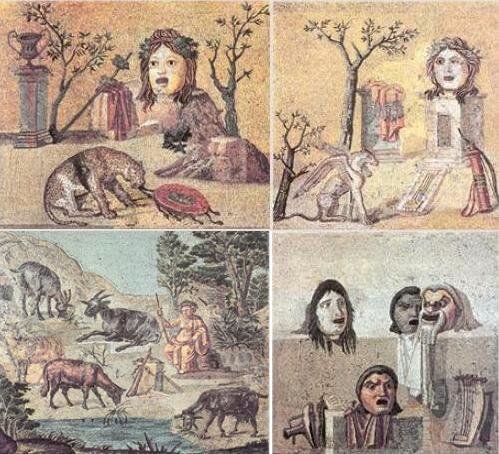
It is a small room in the square tower of Innocent VIII, pope of the late fifteenth century . A room that looks directly onto a belvedere, complete with a view of Monte Mario, which was completely reused in the eighteenth century to make it accessible to the public. Initially it was the architect Dori who restored the room, but in reality we owe the architect Simonetti the embellishment works, which enriched the room with stuccos, friezes, polychrome columns and frescoes. The name of the room, however, all derives from some masks that are clearly visible in these four mosaic panels. They are the real protagonists here! These are four mosaics found in Villa Adriana in the second half of the eighteenth century, and datable around the second century AD. Sold in the Vatican Museums, the main figures are obviously the mask. The first box, top left, is perhaps the most explicit. We find four masks, which refer to the Roman theater and comedy, with some attributes nearby such as the cithara and the kantharos, a cup used in antiquity for drinking and serving wine. A widespread method in the Greek and Etruscan spheres, which the Romans made their own. The second panel, top right, shows a lyre and a griffin, as well as a mask. They are all attributed to Apollo, protector and deity of the Muses and, consequently, of the Arts in general. The third box, at the bottom left, in addition to the inevitable mask, has a thyrsus (stick with a pine cone on the top) and a tiger , symbols attributed to Bacchus, God of wine and rebirth. Finally, a beautiful bucolic scene with shepherds and goats on a completely naturalistic background. Thanks to the necessary checks, it was understood that the four panels have a different dating, in which they dance about 20 years apart.
Therefore, the Hadrian's workers probably detached these mosaic portions from other locations to place them side by side here, in this extraordinary floor that puts us in contact with fun, nature, the arts, wine and everything that could have to do with the otium, the moment in which the Romans should have restored spirit and body, according to a social and cultural scheme that has come down to us through innumerable written sources. In short, a clear message, which in the eighteenth century was embellished by the white and later red frame with vines and fruits, also in mosaic, which today completely surround the four panels. In short, a beautiful historical puzzle here at the Vatican Museums, which greatly enhances some essential aspects of life in ancient Rome!