

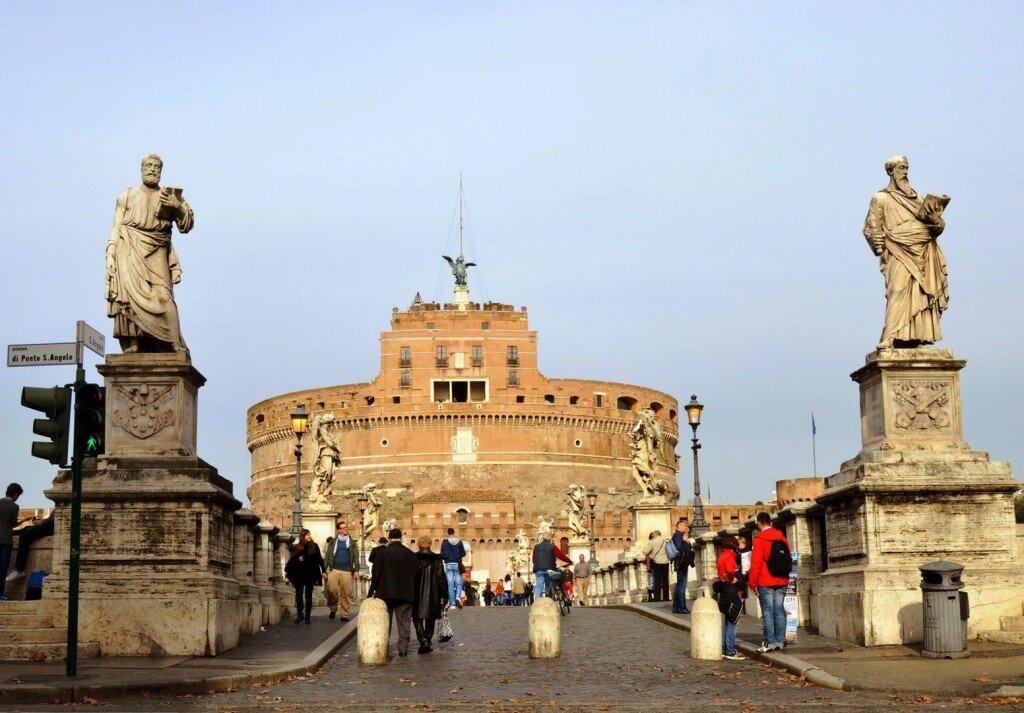
Here is the access, from the left bank of the Tiber, to the historic Ponte Sant'Angelo in Rome. Undoubtedly one of the areas of the Eternal City where beauty, spirituality and history have a greater load because, let's never forget, for centuries this has been the favorite spot for that multitude of pilgrims and faithful who tried to reach the St Peter's Basilica. Walking along Ponte Sant'Angelo, surrounded by 10 angels bearing the symbols of the Passion of Christ (as a sort of Via Crucis ), with the majestic St Angel Castle in the background, has no equal, even for a tour guide like me... A bridge that, however, brings with it numerous anecdotes and curiosities. And here's one, all for you!
At the beginning of the bridge and before the angels, there are two statues: one represents St. Peter with his characteristic keys (by Lorenzetto in the sixteenth century ), and one represents St. Paul, with sword and book (by Romano of the fifteenth century). It is easy to see them one next to the other, since they are the two patrons of Rome, as well as those who, more than others, contributed according to the Christian tradition to spread the Word in the ancient city. Not only that, however, because these two statues were the protagonists of a very curious pasquinade! Do you remember what we mean by this term? Read this article, starring the famous Pasquino, to better understand the value of a true, satirical and fun, "pasquinata"! We are at the end of the sixteenth century, when Pope Sixtus V finally implemented a repressive policy towards all kinds of criminals. In the course of only five years, as his pontificate lasted, public executions increased considerably. In this way, they strongly wanted to put a stop to rampant crime. Among other things, it seems that the pontiff did not like the reputation he had made in the city, precisely because of his strong sense of justice, so much so that he even punished those who, unwittingly, dared to criticize his work. Episodes of summary justice which, for example, are depicted by means of marble portraits found in Piazza Navona, as you can read here. But let us return, after having described the historical and social context, to the sculptures of the patron saints of Rome .
One morning five hundred years ago, the Romans woke up to see the statue of St. Peter decorated with a cloak and two boots placed near his feet, complete with a walking stick! One note read a hypothetical dialogue between Peter and Paul. Paul asks the reason for that clothing, and Peter replies: "Seeing what I have done in the garden of Gethsman, I better go away" . What had he done so bad that he had to run away? In the Bible we read how, at the moment of Jesus' arrest and to defend him, he cut off the ear of one of the soldiers with a sword :"Then Simon Peter, who had a sword, drew it out, struck the servant of the high priest and he cut off his right ear. That servant was called Malchus " (John 18, 10). A crime that Sixtus V would have punished! After all, the pope's repressive policy would have been capable of affecting even the Saints of Heaven...