

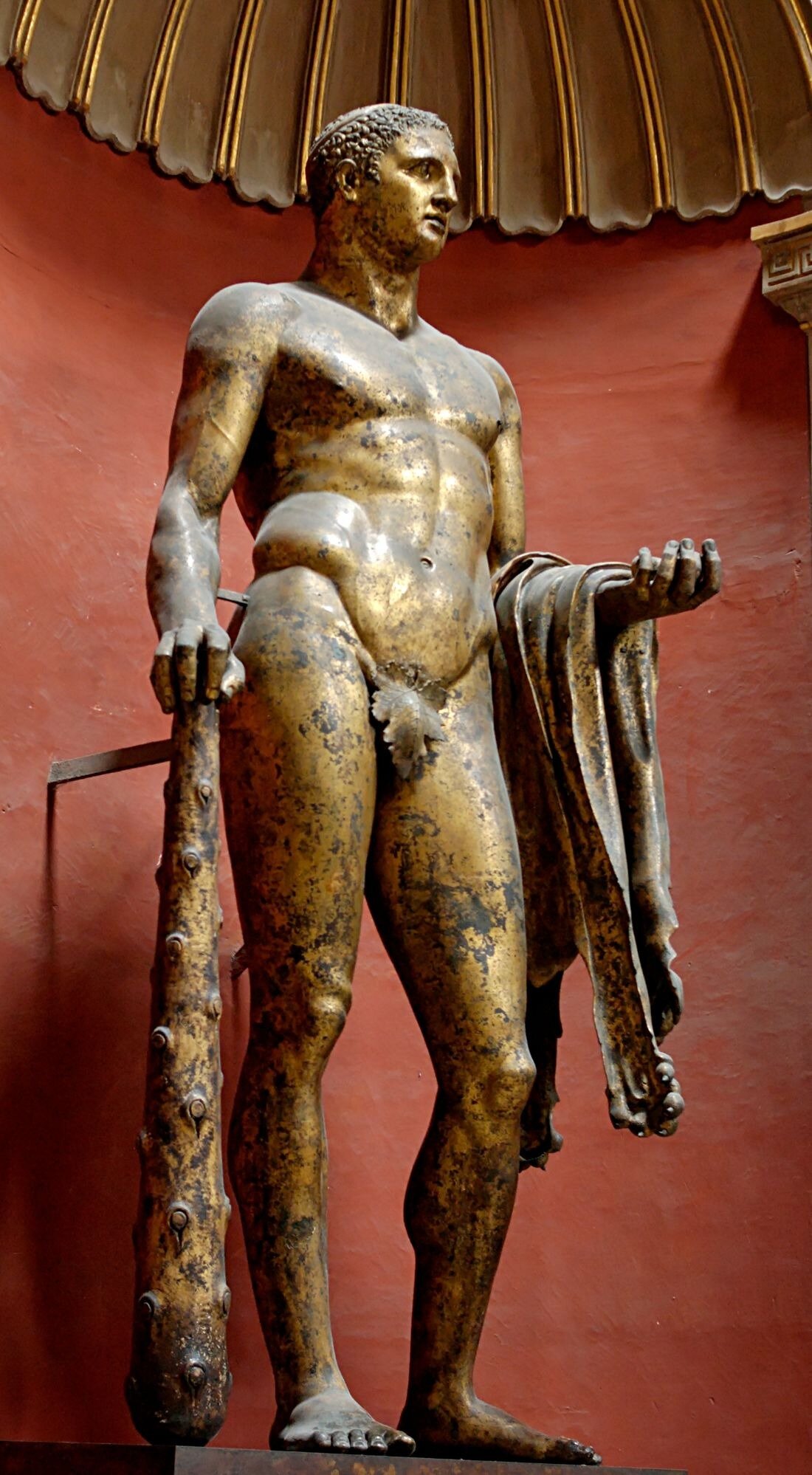
Among the wonders of the Vatican Museums in Rome do not miss this bronze Hercules, which for more than a century has embellished the so-called Round Room, already widely marvelous with the floor mosaic of the third century a.D. and the enormous red porphyry labrum in the center. But why is this extraordinary bronze statue, already precious for the simple fact that it has come down to us, worthy of note? There are many reasons, and one of them also concerns the forces of nature. With my visitors I always stop here, describing them this amazing artifact.
Dating from around the 1st century a.D., in fact, this beautiful bronze sculpture probably adorned the famous Teatro di Pompeo, as it was found with amazement in 1864 near Palazzo Pio-Righetti, located at one of the extremities of the historic square of Campo dei Fiori, where one of the most traditional markets of Rome is still held today. It was really an extraordinary discovery but even an expensive spending for the pope of that time, Pius IX (an important historical figure for Rome, to know more click here). You have to know that the pontiff purchased the bronze sculpture for 50.000 ecus! The muscular body, almost disproportionate to the head, highlights the ideal of power and strength of the Greek hero, with the gripped club and the three apples of the Hesperides on his left hand which, from classic attributes as they are, make the man unmistakable: he is Hercules, the famous demi god. So you should not be impressed to know that over the centuries Hercules became a model, used by kings or emperors to express their power. Think about the gorgeous marble bust that is host in the Capitoline Museums of Rome which is depicting Commodus in the guise of Hercules. But in addition to the superficial beauty, this work at the Vatican Museums also hides a somewhat dark and particular past, something that makes this bronze sculpture of Hercules, here in the Vatican Museums of Rome, worthy of all our attention.
In fact, this extraordinary bronze statue (covered with a leaf in the lower parts to respect a certain morality of the period), was found inside a sort of tomb, placed horizontally inside a pit which in effect it looks like a sepulcher. Why this particular attention for a sculpture, certainly imposing of course, but which was only one of the many of the ancient city? The answer is given by the letters engraved on the travertine slab placed above the statue by the ancient Romans and the remains of a lamb. On the slab we find the initials FCS, namely Fulgur Conditum Summanium, which clearly indicate how the statue was struck by lightning. While the lamb remains tell us how the sculpture of Hercules was ritualized and specially buried during a ritual to appease the divine wrath that had manifested itself with the power of lightning. On the other hand, the latter was in any case a divine sign which, therefore, had to be sacred and remembered. And millions of tourists, even today, who populate the already wonderful rooms of the Vatican Museums of Rome everyday, where other bronze sculptures open glimpses of ancient civilizations (like this one) in one way or another, cast a glance on a statue that has a lot to say about the customs of ancient Rome.