

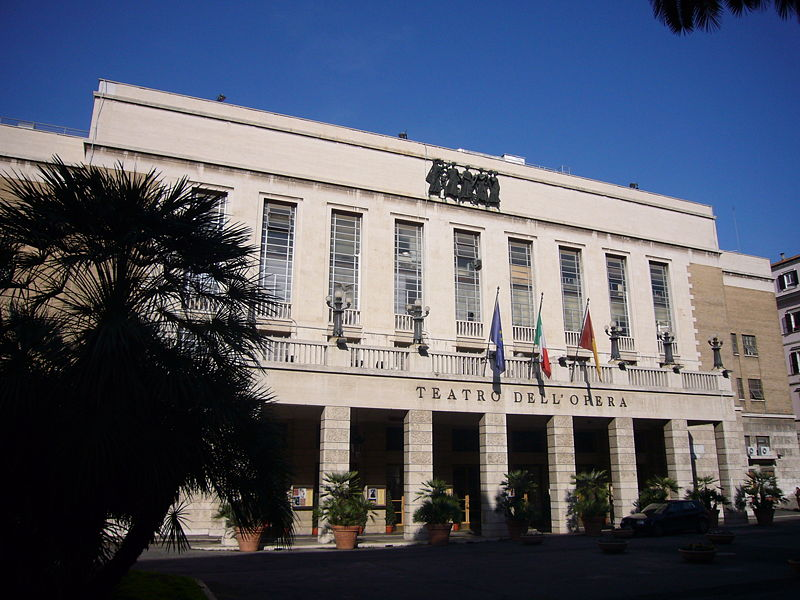

In Rome we have not just Colosseum, an ancient or sacred side, because the Eternal City offers other kind of wonders, such as the Opera House. Ready to explore one of the modern symbols of Rome?
Today the Opera House suffers a little for lack of funding and, also, due to a general disaffection in respect of the theatre, but we should never forget how this building, like others more ancient or recent, is coming from the Greek-Roman traditions, from the ancient way to represent the world, from the feelings and emotions of humans displayed through shows. A very old tradition that is revived today in this theatre, built at the end of the 70's of the XIX century. The Opera Theatre of Rome was opened with great fanfare and in the presence of king Umberto I and queen Margherita of Savoy in 1880, with the “Semiramide” by Rossini. The land where the Opera Theatre stands, a few steps from the Viminale palace, was urbanized thanks to Francesco Savero de Merode, the protagonist of the newborn Kingdom of Italy and shrewd real estate.
At that time, especially after the proclamation of Rome as Capital of the Kingdom of Italy in 1871, there was a real race construction, with the goal of making Rome at the height of the other european capitals. A hunger for brick, concrete, monuments, ministries and new massive buildigns that saw the demolitions, the new boulevards and symbols of Rome which runs towards modernity, symbolised by buildings such as the Palazzo delle Esposizioni on the Via Nazionale and the theatre. De Merode, like others, bought many lands and areas, in particular around the newly formed Termini Train Station. Why here? Because he was sure that this area could improve, thanks to the proclamation of Rome as the new capital, its value. There was, after all, a period of a few months in which, for purely physiological and legal matters, Rome was just about to become the Capital of Italy. And in this short span of time many people, including our De Merode, tried to make favourable agreements with the Municipality of Rome for the acquisition of new plots of land before the entrance of the Government that, of course, would like to decide everything. So we can say that the Opera Theatre was built due to a strong speculation, that was the real protagonist of the Rome of the late XIX century.
Today we can see the Opera Theatre, in its simple forms, thanks to the changement made by the architect Marcello Piacentini who worked for years in Rome, radically changing the building at the 1926, that at that time was recently purchased by the Municipality of Rome. In the course of the years, the Opera Theatre had boom and crisis, with teachers, dancers or musicians of any era that played a part in the cultural life of Rome and of the theatre, which houses in its interior an object that represents a record: the largest crystal chandelier in Europe! Imagine that weighs three tons, is three metres high and is composed of 27 thousand crystals of Bohemia. I would say that is very bright...