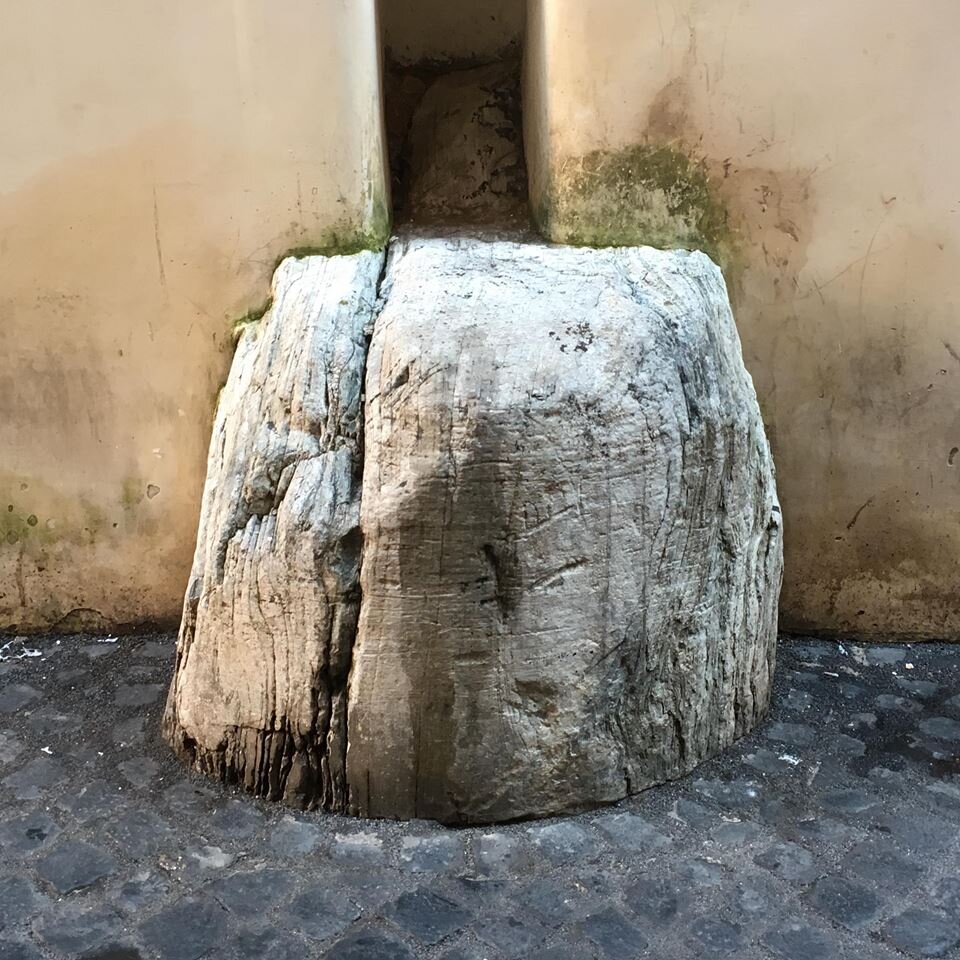
Near the Pantheon stood, in Roman times, a very peculiar temple that perhaps, today, no one would ever dream of building.
Some time ago, as you can read by clicking here, I told you about a large block of marble visible near the church of Santa Maria in Aquiro, just a few steps from the Italian Parliament. A big fragment linked to a fanciful legend, but also a way to understand how the ancient past of Rome is easily visible. You just have to walk, even along the little alleys of the Eternal City. But this marble block tells something else, since it speaks to us of the construction of the Temple of Matidia, built in 119 AD at the will of the powerful and famous emperor Hadrian (click here to get an idea of who he was). A temple certainly very special, since this Matidia was Sabina's mother, Hadrian's wife. This man, therefore, funded the building of a temple, that is a sacred building, to the divine figure of his mother-in-law. Congratulations also from your local tour guide in Rome!

As often happens in the Eternal City, the discovery of the remains of this building was entirely accidental. We must go back in time, to that sixteenth century when very many buildings, especially ecclesiastical ones, were the subject of reconstructions or restorations. In the area of Piazza Capranica a hospice was erected, dedicated to the care of orphans, right next to the church of Santa Maria in Aquiro. Centuries passed and the building, by then dilapidated, was taken on lease by the Senate of the Italian Republic. The necessary restorations began, and at once something unexpected came to light: stumps of four sturdy marble columns, remains of a staircase and a platform in concrete about 9 metres thick. Below, a unicum in the Roman architectural landscape. Archaeologists, in fact, found traces of a kind of stilt platform, datable to the 1st century BC. Something that was later used by Hadrian to build the temple to his deified mother-in-law. A perfect example of how Rome is made in layers, in every sense. These few remains, together with the discovery, nearby, of a fistula with the words in relief templo Matidiae, convinced scholars of the soundness of their find. They had found the ancient temple of Matidia.
From studying the remains (just think of the column base linked to the legend of the knight Orlando, as mentioned at the beginning of the article), the building must have been very large. We are talking about a temple surrounded on three sides by a portico, whose columns must have been about 17 meters high. An octastyle peripteral temple. So it had a row of columns running around the central body of the building, with 8 columns on the pronaos, at the entrance. The question everyone asks is why Hadrian, whose temple stands in the immediate vicinity (here for more details) would have had to create such an important work for his mother-in-law. Did he want to pay tribute to his wife Sabina? Probably, in reality, he just wanted to look good. Matidia, in fact, was the niece of the famous Trajan, the optimus princeps, one of the most beloved emperors. Moreover, according to some historical sources, it was Matidia herself who suggested to Trajan that he name Hadrian his successor to the throne when, in fact, the emperor was not very inclined to make such a choice. A woman considered attractive and well liked, in some way Matidia had carved out her space in Roman society of the time. Even a great temple like this, therefore, could fall within the realm of propaganda. Despite this, however, it is fascinating to discover how it is enough to dig, here in Rome, to bring to light pieces of memories of the glorious past of the Urbe, the Eternal City.