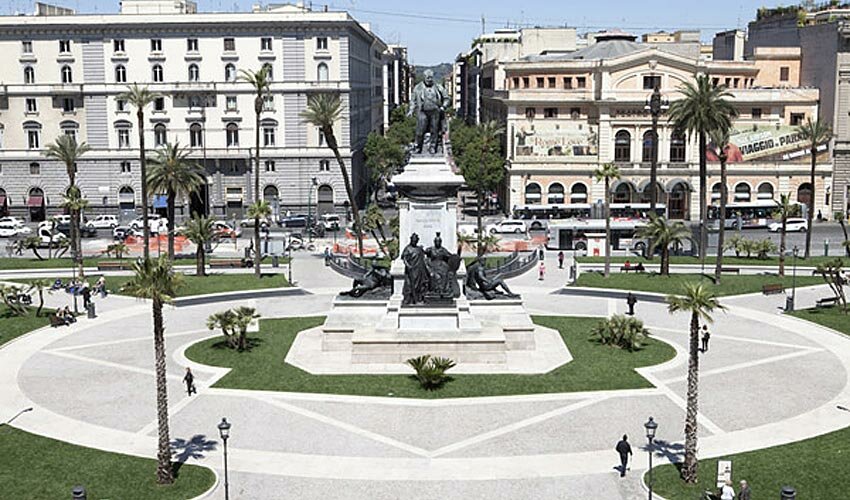
Piazza Cavour, behind the Palazzaccio, partly symbolizes the whole history of this famous Roman district, in many ways.
As is known, the Prati district, the last in Rome to be officially founded, has seen a lot in its rather short history. One of the key hubs of the whole area is the so-called Palazzaccio, as we call it in Rome. The main Palace of Justice, with a turbulent period behind it (as you can read here). Undoubtedly, though, to counterbalance the huge bulk of this building there is the little square behind it, conceived also to pay tribute to a man, a statesman I would say, who gave so much to found what is our nation: Camillo Benso Count of Cavour. A man who, whatever one may think, made history. For this it seemed natural, in September 1895, to inaugurate this monument. Too bad that, as always, it wasn’t all smooth sailing.

First of all, in the previous decades Prati was not yet as we know it today, since its current look mainly comes from the grand real-estate building speculation carried out in the very last years of the 19th century, then continued on the occasion of 1911 (the fiftieth anniversary of the Unification of Italy) and after the Second World War. Where today the monument to Cavour stands, imagine, once there was a famous bowling green, used by young and old, as well as countless taverns. Finally, a large parking lot for vehicles (carriages at the time) completed the distinctly city and local atmosphere you could breathe here up to 1885, when an area of 27 thousand square meters was leveled to build this monument. The ceremony for laying the first stone, on March 14, 1885, was attended by many, including those reporters from whom we can draw some interesting details. First of all it was a cold morning, and it took great effort to move the first stone, a block of travertine weighing seven hundred kilos. As was customary at the time, and not only then, inside the block a sort of time capsule was placed. And it is not the only one in Rome, as you can understand by reading here. A small hollow lead tube inside which were left (and are still there today) some coins from the time as well as parchments with hymns and praises, and also words written in their own hand, dedicated to the rulers of the time: King Umberto I and his consort, Queen Margherita. But here are more curiosities from your local tour guide in Rome.
Years and centuries go by, but after all the criticisms are always the same. We are in the presence of a monument dedicated to a statesman, therefore to a politician. A divisive figure by definition, especially at a time when many, despite everything, did not look kindly on the unification of Italy, let alone the annexation of Rome to the kingdom. In the columns of the Messaggero, therefore, one reads the criticisms raised about the making of the monument, criticisms that, of course, focused above all on the cost of the work:"… a monument that will cost a sum, and for which the memory of Count Cavour truly had no need to be handed down to posterity". Very clear words, no doubt about it. Not only that, because years later all of Prati was, often, targeted by criticism. A neighborhood without sense or rules, a “checkerboard city, struck by death even before it had lived”, as Emile Zola wrote. And, so as not to miss anything, here is that there were those who did not like the choice to place the statue right there. If you notice, in fact, Cavour looks straight at the Palazzaccio, while turning his back on Piazza Mazzini, an area dedicated to another hero of the Italian Risorgimento. Many saw a certain malice in it, so much so that the comments, with the usual Roman irony, were of this tenor: “Why does Cavour turn his back on Mazzini? Did they perhaps quarrel?”. A sterile controversy in this case, I'm sorry, since Piazza Mazzini arose more than thirty years after this laudatory monument which, like it or not, is still there today to recall a historic moment for Rome. And not only.