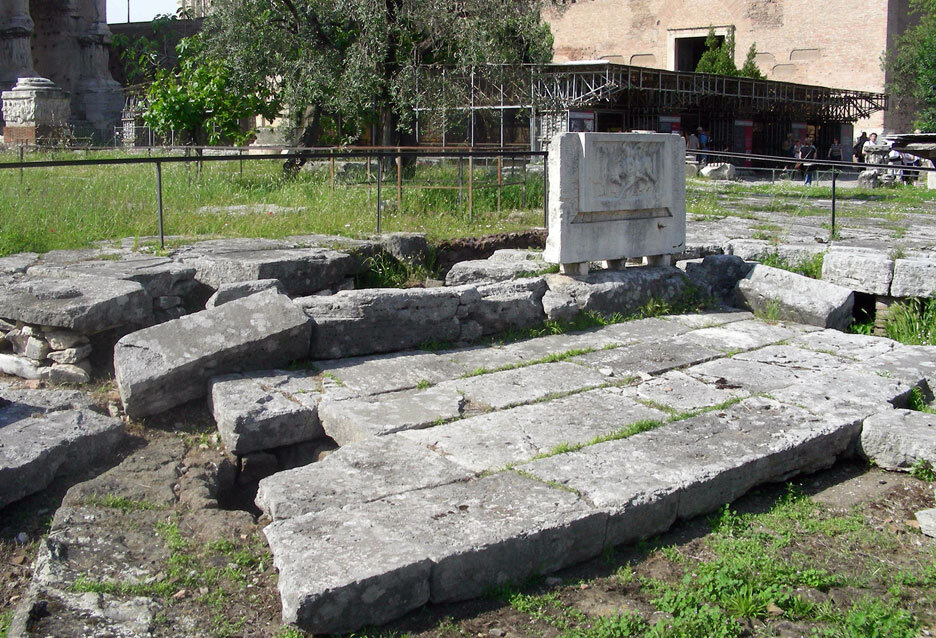
The Lacus Curtius shows how a sacred area, dear to the Romans, soon became a legend (or more than one).
We return to the Roman Forum, the center of the world according to the ancient Romans. A truly fascinating area, full of buildings able to show us the real, everyday life of the ancient Urbe. And right near the Basilica Iulia (in front of it, looking toward the center of the Roman Forum), you can make out a small trapezoidal area. It is already interesting in itself, since here you can notice the walking level from the Caesarian age, when the great Julius Caesar promoted a series of works in the zone. Today, in fact, when visiting the Roman Forum you walk on the level created under the principate of Augustus, who was forced to thoroughly restore the area which was, unfortunately, devastated by a fire. In this trapezoidal area, called Lacus Curtius, you can see bases, perhaps for statues or altars, and the replica of a marble relief which today is kept in the Tabularium of the Capitoline Museums (which has many fine works, like this). In the relief we see a man on horseback, pointing toward the ground. Let’s see better what it is, together with your tour guide in Rome!

There are many legends surrounding this sacred, fenced-off area. The name, Lacus Curtius, would derive—especially according to Livy (but also Plutarch and other ancient sources)—from the young soldier, and hero, Marcus Curtius. A kind of chasm opened up in the Forum, and at once everyone began to think the gods were angry with the Romans. How to appease them? Simple: a fine sacrifice. The problem was that time was wasted figuring out what could be more sacred and important in Rome. The army with which the Caput Mundi was expanding (we are in the 4th century BC, when the Urbs began to dominate the Italian peninsula, step by step). Or the Senate, the political guide of this great city? Then the young soldier Marcus Curtius stepped in. For him the most important thing was honor, or better still love for the fatherland, for Rome. A shining example of virtus, as there were very many, according to ancient sources. It makes me think of what is frescoed in the Capitoline Museums, and of the story of the first two Roman consuls, Brutus and Collatinus (here to learn more). But also Mucius Scaevola or Horatius Cocles, as well. Examples of people who sacrificed themselves, or their own loved ones, in order to save the Roman community. The fact is that Marcus Curtius wasted no time, and hurled himself headlong into the chasm, dying to save Rome.
The area was paved in marble and fenced off, while the opening (or rather the well) there was always an object of special devotion, so much so that everything was also embellished with a few sculptures. Right here, moreover, in 1553 the marble slab was found depicting the act of heroism and virtue, as told earlier. A marble slab later reused, as was customary for the Romans, since on the reverse one reads an inscription praising Surdinus, a prefect, who in Augustus’ time repaved the Roman Forum. This, however, is only one of the legends about the Lacus Curtius. According to some, especially Varro, here Metius Curtius, great Sabine warrior, almost met his death (we are at the dawn of Roman civilization). “Metius was dragged into a marsh by his horse, made ungovernable by the din of the pursuers, and this drew the attention of the Sabines too, who feared losing so charismatic a figure: shouting and making broad gestures to him, they showed their attachment, and he managed to pull himself out of the mire.” The area of the Roman Forum after all, before being monumentalized under the Etruscan kings, was muddy and marshy, after all. Varro again, instead, tells us that the Lacus Curtius was nothing but an area fenced off at the will of the consul Gaius Curtius (5th century BC), who decided to consecrate the area to Jupiter after a lightning bolt fell right here, causing a great hole. What is the truth? What is the legend? We will never know, but it is certain that, once again, the Roman Forum in Rome can always slip, alternately, between reality and myth. I leave you with the passage from Livy that tells us of the affair of Marcus Curtius, perhaps the story that more than any other, in various ways, strikes one. “From an earthquake shock or from some other cause, it is said that almost in the middle of the forum a cavity of immense depth opened up. […] The soothsayers proclaimed that one had to consecrate to that place, if one wished the Roman state to be eternal. Then they relate that Marcus Curtius, a young man distinguished in war, reproached his fellow citizens because they remained uncertain whether in Rome there was any good greater than arms and valor; then, as silence fell around, turning his gaze to the temples of the immortal gods that rise above the forum and the Capitoline and stretching his hands now to the sky now to the wide chasm of the earth, toward the gods of the Manes, to them he devoted himself; then, mounting a horse furnished with the most splendid ornaments, he hurled himself armed into the cavity, and over him gifts and fruits were thrown by a crowd of men and women.”