


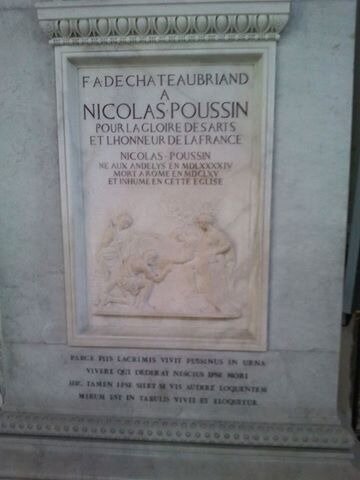


Today I’m about to describe to you one of the mysteries of Rome and of Baroque culture, one of the many examples of this kind found in the Eternal City that make the Urbe a place full of wonders but also, as in this case, of stories that are at least rather fanciful.
In our case it must be said how, in the Baroque age and beyond, there were many ways for men of letters and artists to draw close to the ancient world, and one of these ways goes by the name of Arcadia. What is it? Arcadia was seen as a sort of utopian land, inhabited by shepherds who had no kind of worry: they didn’t have to work, they could spend fine days delighting in the nature around them, with a land always fertile that did not need to be tilled. This mythical area would be in Greece, and it was made famous, in painting, by Guercino’s work Et in Arcadia Ego, later followed by Poussin’s painting of the same name, an artist much admired in Rome and in Europe, during the 1600s. A perfect world, in short, made immortal also by Virgil who, in his Eclogues, sets all the events in this utopian land, a locus amoenus (a place to live in serenity and peace). But what does all this have to do with the funerary monument to Poussin here, in the Basilica of San Lorenzo in Lucina?
Poussin, however, was not only a skilled master but, according to the chronicles, also a lover of wordplay and of more or less esoteric messages, just like this one. We are in the Basilica of San Lorenzo in Lucina, just a few steps from the very central Via del Corso. Shortly after the entrance, on the right, you will find a funerary monument, dedicated precisely to Poussin. We notice the shepherds, protagonists of the land of Arcadia, and among them a cryptic message... Et in Arcadia Ego. What does Et in Arcadia Ego mean? Premising that we are facing a mystery, we must immediately note how the phrase, in Latin, is grammatically wrong. In fact the verb “to be” is missing, which usually goes at the end. Correctly, the phrase should be expressed as Et in Arcadia Ego sum (I am in Arcadia). What could all this mean?
Both Guercino and Poussin placed some symbols of death, such as human skulls, in their works. The meaning, then, is simple: even in a utopian and perfect land like Arcadia, death can arrive. The inescapability of life, in short, a theme so dear to European artists and scholars of the 1600s. But here is another meaning, the most esoteric of all! According to some, in fact, the phrase Et in Arcadia Ego sum would hide something much bigger. By anagramming the words, we can reach this conclusion: Arcam tango Iesu, which means "Here lies the tomb of Jesus"! In short, according to some, Poussin would have taken to the tomb (so to speak) this secret, hiding it in his famous phrase. And here, before his marble tomb located in the Basilica of San Lorenzo in Lucina (commissioned by the French poet Chateaubriand to pay him homage), we find that same phrase, half-hidden, between two shepherds. A mystery, a legend and a thoroughly Roman story, which make Rome a city rich in meanings and anecdotes that for a local tour guide like me is always a pleasure to discover and share.