

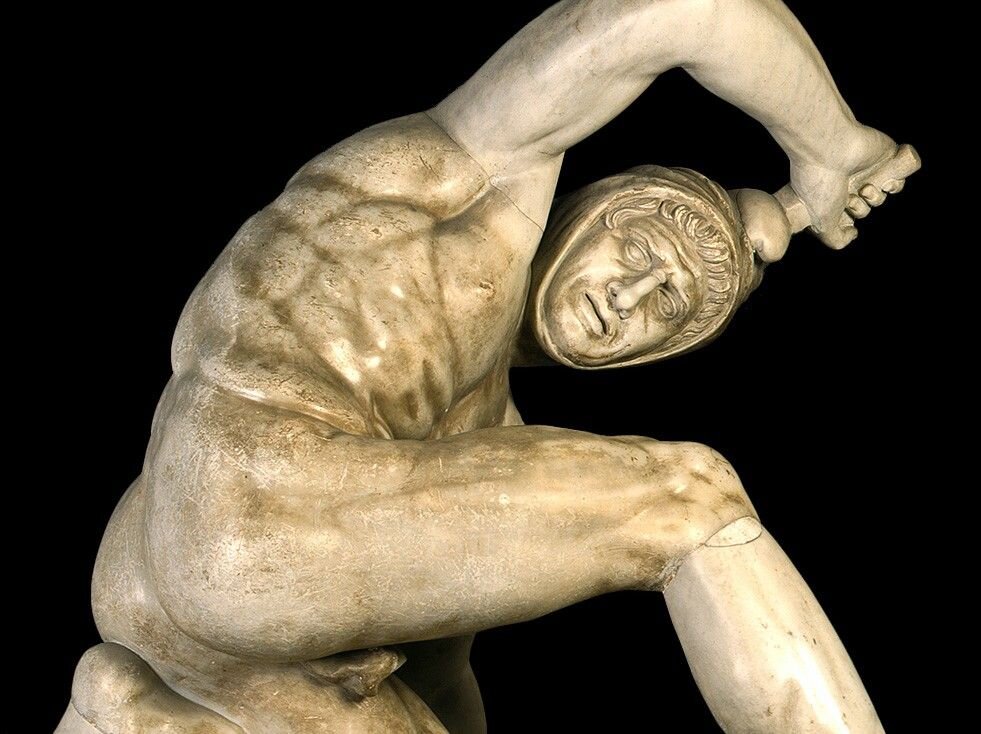
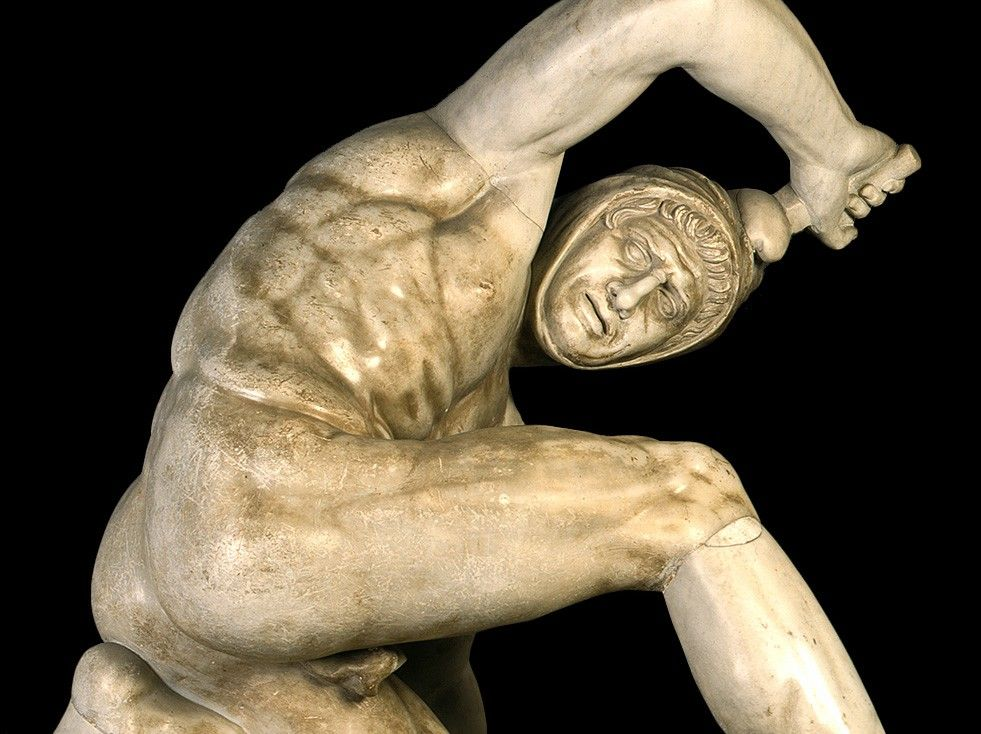
In the Gallery of the Candelabra at the Vatican Museums in Rome, among Roman-era marble works, beautiful mosaics and an absolutely incredible ceiling, there is also this strange statue showing a man in the act of defending himself, raising his sword and his right arm. Here is a striking example of how art, in the past, was used for clear political aims.
We are looking at the so-called Persian Warrior, dating to the early 2nd century A.D. Many elements make us understand that we are facing a barbarian, an uncivilized man in the eyes of the Romans and therefore recognizable as an enemy. In particular, the Phrygian cap he wears attests to the origin of this soldier who, with great fear and perhaps awareness of an imminent death, attempts a last, desperate defense. It is precisely the expression on the face that gives drama to the scene, together with the splendid rendering of the body that makes us understand we are before a soldier, almost defeated as well. This marble statue is a Roman copy of one of four sculptural groups, probably in bronze, commissioned in the 2nd century B.C. by Attalus II king of Pergamon, a powerful Greek city-state. The ruler conceived these sculptural groups as ex voto in favor of the Gods, thanking them for having brought numerous military victories in favor of the Greeks.
A sacred donation which, consequently, also had a political value as it underscored Greek dominance over the nearby non-Greek peoples. Probably this sculptural group was part of the so-called Small Donarium, a set of sculptural works donated by King Attalus II to Athens and placed along the southern section of the Acropolis wall, recalling Greek victories against the Galatians, the Persians, the Amazons and the Giants (the latter two were common scenes in Greek public art, a way to honor the Gods themselves and the Greek lineage). In particular, probably, the Small Donarium served to commemorate the historic victory in the battle of Marathon, when in 490 B.C. the Persians were defeated by the Greeks. It is worth noting how this sculpture, like others belonging to the same group, was found in the early 1500s during the major restorations of Palazzo Medici, today better known as Palazzo Madama. It is curious to know how the Romans, in any case, loved Greek art so much as to be truly captivated by it, so much so that over the years they replicated countless works of art, later reused for Roman propaganda or, more prosaically, as war trophies or ornamenta. In short, this is why it is easy to find, even today, in our museums a "Roman copy from a Greek original". A nice way to say that the Romans truly cared, if we may put it that way, and in different ways, about the artistic fortunes of the Greeks. In part they copied its beauty and style, sometimes even using the same political aims. Nice, isn’t it?