

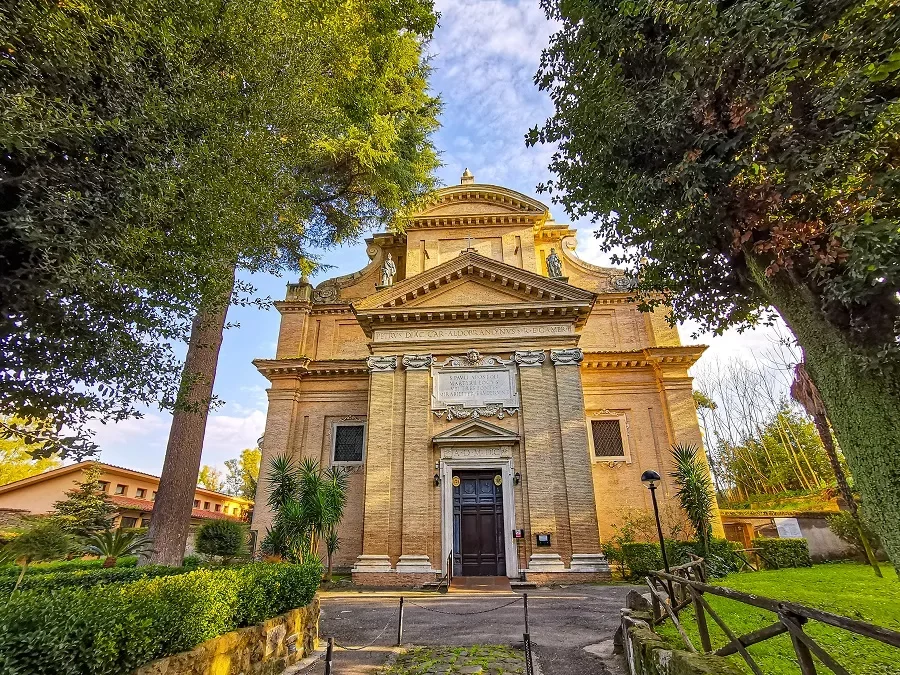
The area of Tre Fontane, close to the Laurentina, famous for its abbey and the other two historic churches in the area, is remarkable in many ways. Certainly, anyone looking to take a break from the city chaos is welcome here. For me, your tour guide in Rome, it's always a pleasure to organize a tour here, exploring the sacred sites of the area as well as its history. Of course, people mostly come to Tre Fontane to retrace the steps of Saint Paul who, according to tradition, met his end right here. And today, by the way, I want to tell you about the church built right above the spot where, according to some sources, he was beheaded. The place where he was martyred: the church of Saint Paul at Tre Fontane.
There is mention of a very early sacred shrine here since the 6th century AD, and then in the 1500s, as we read from an inscription at the top of the facade, Cardinal Pietro Aldobrandini took care to finance the construction of a real church. In the second half of the 1800s, many works were carried out during the pontificate of Pius IX, as shown by the wonderful Roman-era mosaic depicting the Four Seasons, brought here from the archaeological area of Ostia Antica and placed inside the church. A touch of the ancient that is always welcome. Architecturally, this place of worship dedicated to Saint Paul is very simple and intimate, and is enlivened, on the side altars, by a copy of Guido Reni's Martyrdom of Saint Peter and the Beheading of Saint Paul by Passerotti (late 1500s). Speaking of mosaics, it's interesting to note that on the floor of the small entrance vestibule there is also a section of cosmatesque decoration, from the medieval period, found during the extensive 19th-century restoration works. So far, this is the brief description of the sober church which, of course, owes its fame mainly to being built above the site of Saint Paul's martyrdom, as confirmed by the inscription on the facade: "S. Pauli apostoli martyrii locus ubi tres fontes mirabiliter eruperunt ("place of the martyrdom of Saint Paul the Apostle where three springs miraculously gushed forth"). But exactly, which springs are we talking about? Entering the church, on the long side opposite the entrance, you will notice three beautiful niches decorated with polychrome marble elements, three small grates topped by a bronze relief depicting the head of Saint Paul. Here there are three wells from which, for centuries, the faithful and pilgrims drew water (hot, cold, and lukewarm). In 1950, due to harmful infiltration and after numerous studies, the wells were closed, as the water was found to be polluted. Remarkably, as early as the late 1500s, these three wells are mentioned, probably already in use for a very long time, perhaps centuries. There is an aquifer below, used by all those traveling along the Via Laurentina towards Rome. But then, according to hagiographic tradition (regardless of faith), it began to be said that the springs are actually miraculous. Because they were opened, miraculously bringing forth water, at the exact moment when the head of Saint Paul, beheaded here, touched the ground, bouncing three times on it.
The synoptic texts do not specifically mention this episode, but if we read the Acts of Peter and Paul, an apocryphal text from the 6th century AD, we read: “(…) Standing, facing East, Paul prayed for a long time. After prolonging his prayer, conversing in Hebrew with the fathers, he stretched out his neck without saying a word. When the executioner struck off his head, milk spurted onto the soldier's clothes. The soldier and all those present, at this sight, were amazed and glorified God who had granted Paul such glory; and on their return they reported to Caesar [that is, Nero] what had happened. He too was amazed and embarrassed.” And then, bouncing on the ground, water sprang forth. This is why the church, from a religious point of view, is so important. One more reason to visit Rome and the area of Tre Fontane, don't you think?