

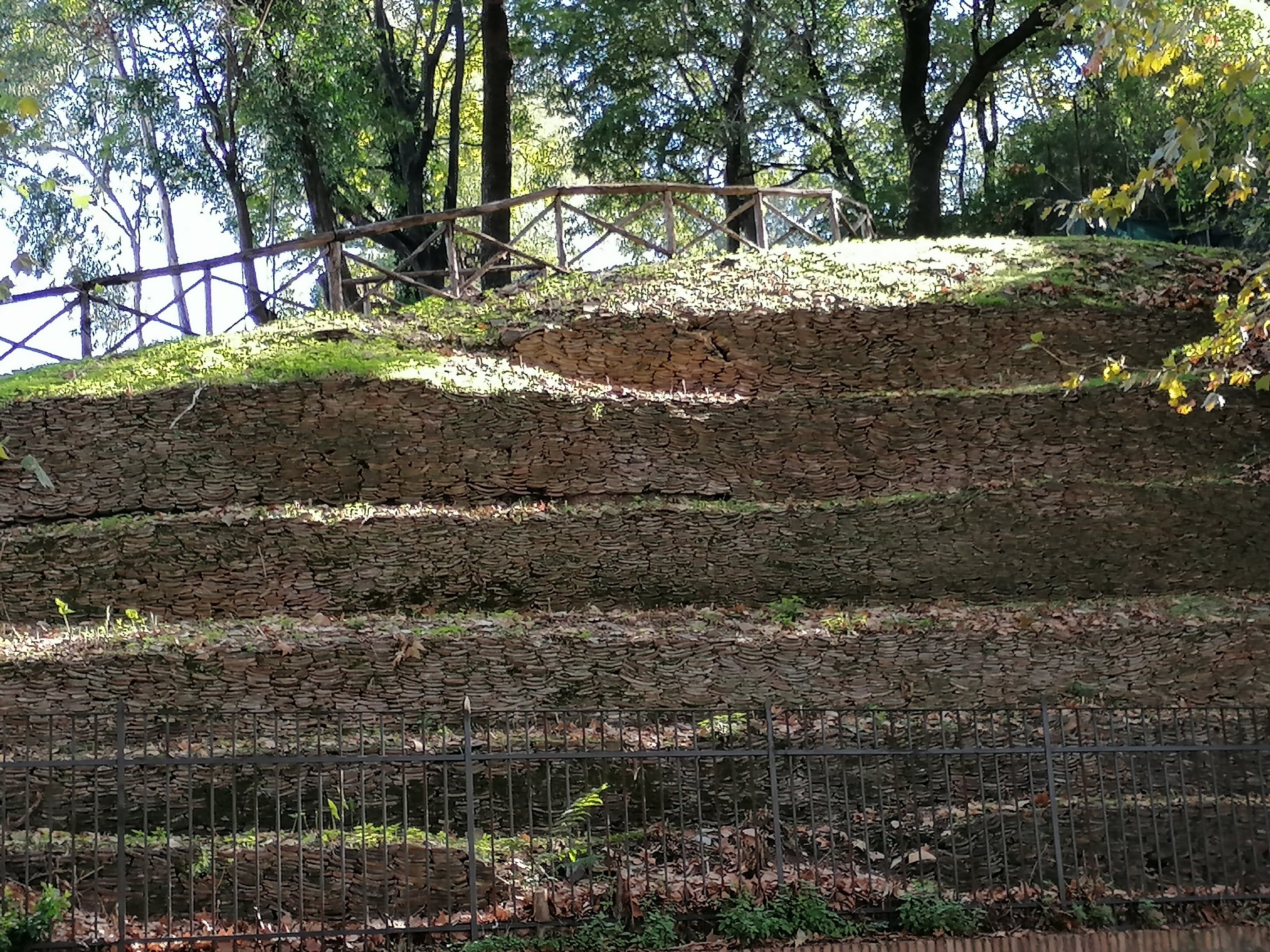
Today your tour guide in Rome takes you back to Testaccio, a neighborhood that is a symbol of the city, where you can definitely eat well while always staying in touch with the ancient face of this extraordinary place that is Rome. Something that will surely remind you of Testaccio is the famous Fountain of the Amphorae (which I wrote about here), but there is something truly unique in the Roman landscape that I recommend you visit, perhaps before enjoying a delicious lunch in one of the local restaurants. I'm talking about the famous Monte dei Cocci. Let's discover it together!
Standing 36 meters high, Monte dei Cocci, also called Mons Testaceus, is a truly artificial hill that was created since Roman times. It is certainly not natural, considering the large amount of lime that has been found here, as you can still clearly see when climbing the hill. This material was excellent for preventing landslides and also for curbing the bad smells and miasmas that could come from here. Moreover, especially thanks to the presence of clay, inside the mound a constant temperature of around 10 degrees could be maintained. Why? Let's start from the premise that, since the Republican era, where we now have Testaccio, along the banks of the Tiber, there was a very busy river port. Imagine the scene. A city in continuous expansion that needed foodstuffs for the survival of the population, marble to build imposing buildings, and various materials for the sustenance of the Urbe itself. Around the port, buildings of various kinds sprang up, such as an emporium, for example. It goes without saying, among other things, that where tons and tons of goods of various kinds were unloaded daily, something could go wrong. Or think, as in our case, of the countless amphorae containing oils of various kinds. These were unloaded, and there remained the problem of where to store the amphorae. The problem was solved by creating this sort of artificial dump, an open-air hill made up of the remains of more than 53 million amphorae. The oldest fragment dates back to 144 BC, the newest to 251 AD. Amphorae of different origins and manufacture, which could carry spices or other types of food. Amphorae that could no longer be used because they broke during transport, or simply because the material that arrived at the river port was transferred into other containers to be transported to the city center. This is to give you an idea of how much material was dumped here over the centuries! Something impressive that takes us back to the ancient world, to when Rome was a metropolis in continuous expansion, capable of swallowing tons of objects or materials in order to survive. This is the Monte dei Cocci (now you clearly understand the origin of the name), but that's not all. Because in a millennial city like Rome, even an artificial hill, which was nothing more than a dump, has been reused on more than one occasion.
Over the centuries, some dug into the hill to create shops or small emporiums. Others, to take advantage of the pleasant and constant temperature that could be enjoyed by digging into the fragments of the amphorae, used the spaces as a wine cellar. It is no coincidence that right here at Monte dei Cocci, when Testaccio became the heart of the festivities and fun linked to the Roman Carnival, many people came to enjoy more than one glass of wine, reveling and spending time in various ways. Monte dei Cocci, for example, became the theater of the so-called ruzzica de li porci, in which poor pigs were rolled down the slope of the hill and then killed (if they didn't die on their own as a result of the fall), cooked, and eaten in large quantities. Not to mention the wonderful Roman ottobrate, when even the nobles came to these parts to enjoy the mild temperature and the old-time atmosphere that you can still breathe in this corner of Rome. From fun to war, if it is true that in 1848 an artillery battery was installed here against the French (by clicking here you can understand what I'm talking about), or if Monte dei Cocci was used as a target by bombers for practice. You see, then, how much this corner of Testaccio can tell us?