

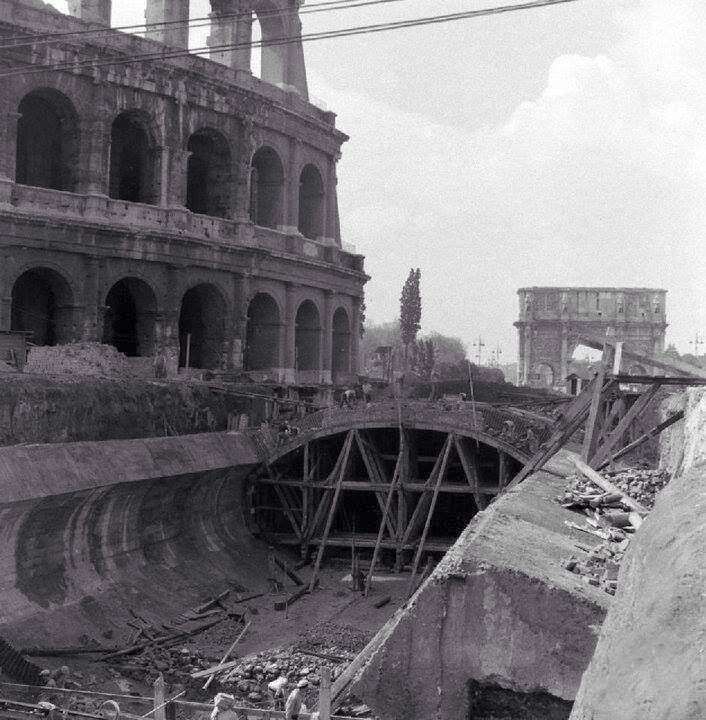
This is the historic photo of a fundamental moment for Rome, for the development of its public transport, and for all Roman urban planning. In this snapshot, you see workers at work on the construction of the tunnel for Rome's Metro Line B, at the Colosseo station. How many cities in the world can boast a metro stop right in front of a monument that's about two thousand years old? Personally, as a tour guide, just like thousands of other fellow citizens who pass through that metro stop daily, it could all seem ordinary, even the Flavian Amphitheater itself. And try to imagine how, even today, decades later, thousands of people a day use this line, thousands of Romans and tourists get off at this stop, perhaps without even glancing at the giant of Rome. Nevertheless, even a single railway stop can have its own genesis, and not just a privileged location.
The history of the first metro line in the Urbe dates back to the 1930s, when Mussolini himself decided to equip Rome, finally keeping pace with other European urban realities, with a functional and modern metro line. It's no coincidence that, even today, the line starts from Laurentina and generally from the EUR area. In fact, Mussolini, on the occasion of the Universal Exposition he planned to inaugurate in 1942 (a project that never started due to the war), wanted at all costs to connect Termini station, the city's main station, with the new district, EUR (an acronym for Esposizione Universale Roma) that Mussolini wanted to create for his global event. And again, it's no coincidence that, originally, the name of the new line was supposed to be Ferrovia E42. To save a bit on infrastructure and money, part of this metro line uses the same stations and interchange nodes as the Roma-Lido, a line that already existed at the time of Mussolini, whose projects began in the second half of the nineteenth century. In any case, the works were never completed on schedule, again due to the outbreak of the Second World War. Only in 1948 did the construction sites resume, leading to the inauguration of the first section, Laurentina-Termini, in February 1955 in the presence of President of the Republic Einaudi. Only in 1990 was the Termini-Rebibbia section inaugurated, connecting another quadrant of the city to the main station. Finally, a curiosity: why, if this is Rome's first metro line, is it called B and not A? Simply because when the second and more modern line, A, was inaugurated in 1980 at the behest of Mayor Petroselli, it was so advanced for the time that it couldn't take a back seat to anything, not even compared to a railway line like Line B, as Petroselli himself would call it, whose construction began back in the 1930s.
What matters is that even today we can use these stations, just steps away from some of the city's symbolic monuments. And that's not all, because more stations are being added in the area, such as the one at the Imperial Forums which, like the one at San Giovanni (both belonging to Line C), is a true museum containing some of the wonders unearthed by archaeologists and workers digging beneath Rome. This city is an endless treasure, isn't it?