

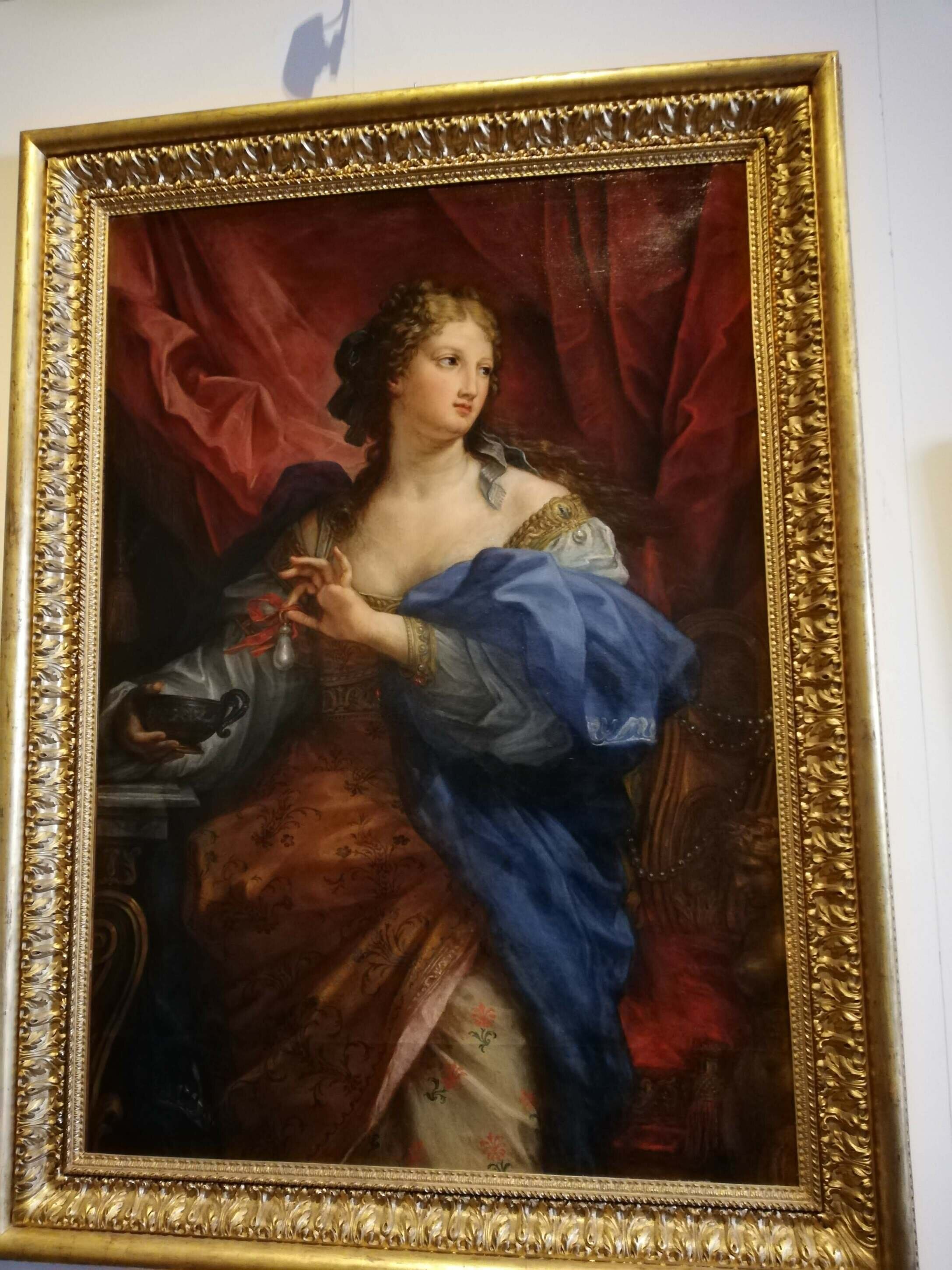
As you can better read here, Palazzo Venezia is, without a doubt, one of the symbols of Rome. Not only because it is a historic building and interesting for multiple reasons, but also because the rooms of the building are steeped in history, even recent history. Certainly, however, what also captures attention is the permanent collection of the Museum of Palazzo Venezia, capable of housing within it a miscellany of artworks of different kinds, styles, and historical periods. In particular, today, your tour guide in Rome will tell you about a wonderful painting, a work by Carlo Maratta (a famous artist active in the Eternal City in the XIX century). A work of art that closely concerns some rather unpleasant events. Let's look at them together.
Here you have, then, the splendid Cleopatra, a work by Carlo Maratta. A beautiful Cleopatra, the last descendant of the Ptolemies, very famous for having had love stories with important personalities of ancient Roman history, but dressed in eighteenth-century fashion. Here we see the woman intent on dropping a large pearl into a basin, in her right hand, full of vinegar. Why? To show Mark Antony, absent here in the painting, that she had so many riches that she could even dispose of a large pearl like this. The episode is described by Pliny the Elder but also by other ancient authors. Although it is quite difficult for a pearl to dissolve in vinegar (let's say you would have to wait a very, very long time), it is certain that this episode contributed to making the figure of Cleopatra almost mythical. A fickle woman, certainly, but also extraordinarily rich, so much so that she could play a bit like a cat with a mouse, making Mark Antony struggle beyond all measure before being able to start a relationship with her. It is undeniable how this almost magical aura that surrounded Cleopatra transcended the centuries, if it is true that even in the eighteenth century men like Maratta depicted her at the height of her power and splendor. The figure of Cleopatra stands out strongly from the background filled with that red drapery, which gives more strength, a vibrant but at the same time elegant strength, to the whole composition. But now let's focus on Cleopatra. Carlo Maratta used as a model, and not for the first time, his wonderful daughter: Faustina. According to the chronicles, she was truly beautiful, so much so that many knew her and many fell in love with her. One man in particular, the Duke of Genzano. The problem, however, is always the same: social class. Since he was a duke and she was the simple daughter of a simple painter (although active and famous like Maratta), the Duke of Genzano could never officially ask to marry a girl of such low social standing. So, one day, he ordered his henchmen to kidnap her. It is said that, one morning, Faustina and her mother were walking to go to mass. Then, all of a sudden, they were surrounded by some men. It seems, however, that, even with the help of some passersby, the two women managed to save themselves, foiling the attack. Sometimes, then, there is a happy ending! The Duke of Genzano was, in fact, indicted, convicted, and exiled.
Surely it is a shame to have to learn about unpleasant events like this, when a man tries to take a woman by force and violence. Who knows, perhaps the strong personality of Cleopatra, as handed down to us by ancient authors, may have inspired Maratta to use his own daughter as a model. The fact remains that a simple painting, here at the Museum of Palazzo Venezia in Rome, can open up interesting glimpses, both positive and negative, on ancient history and on that closer to our own times.