

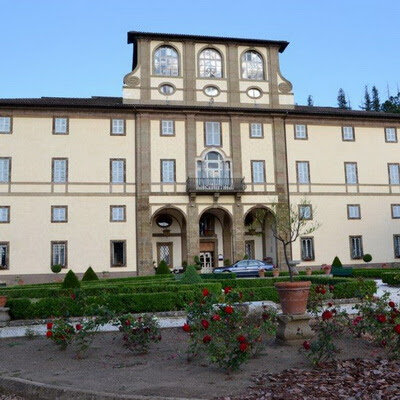
Let's continue the story about some of the wonders that can be found just a few steps from Rome, including the Castello di Santa Severa or that of Pratica di Mare (you can find some information here). In this case, however, your local tour guide takes you to Frascati, in the heart of the Castelli Romani which, since ancient times, has represented a small corner of paradise and relaxation, with breathtaking views, outside the Urbe. In the photo, we see the Villa Tuscolana known as "La Rufinella", situated in a truly enviable position as it is located right above the hill overlooking Frascati, to the south of Rome. Let's discover more about this historic building.
It is no coincidence that it can be considered among the best villas in the area, an area full of noble buildings constructed in past centuries and built to escape from the city life and chaos of Rome, as well as to emphasize the heritage and opulence of those who wanted these villas. Also, the Rufinella, among other things, stands on the remains of what was an ancient suburban villa belonging to a wealthy and noble Roman. Many members of the elite of the Roman society of the past, the aristocrats in short, did not disdain at all the purchase of extraordinary places where they could perhaps spend the scorching summer days which, in a city like Rome, even centuries ago could turn into an inferno. It is no coincidence that the trend did not wane over the centuries as even the nobles in the Middle Ages or the Renaissance did the same. For example, Villa Rufinella owes its name to Monsignor Alessandro Ruffini, bishop of Melfi, who had this beautiful house built in 1578. Today not everything remains of the original sixteenth-century building, but certainly, the villa has lost none of its elegance and in the use, for example, of the "sperone" (a local stone), for some walls. It should also be noted that the villa was restored in the eighteenth century by Luigi Vanvitelli. We then arrive in 1804, when Pope Pius VII sold the villa, previously ceded to the Papal State, to Lucio Bonaparte. The family of Napoleon was seizing the possessions in the hands of the pontiffs, considering that Rome itself, at the time, was under French domination. It is interesting to know how Lucio Bonaparte, exactly as happens in the Eternal City, financed a series of archaeological excavations in the area, recovering many interesting artifacts. As you can see, therefore, a building can be rich in history, being a direct witness to the vicissitudes that a city as ancient as Rome has undergone, also involving the suburbs and surrounding areas.
I conclude by recounting a curious episode. We are in 1817, and the group of bandits Gasperone, "renowned" and very active in the area, attempted to kidnap Lucio Bonaparte during one of his lavish parties in the large gardens of the villa. He was saved by his butler, who with quick thinking and cold blood donned the clothes of the Prince, passing himself off as him and saving his life. What one does for a noble...