

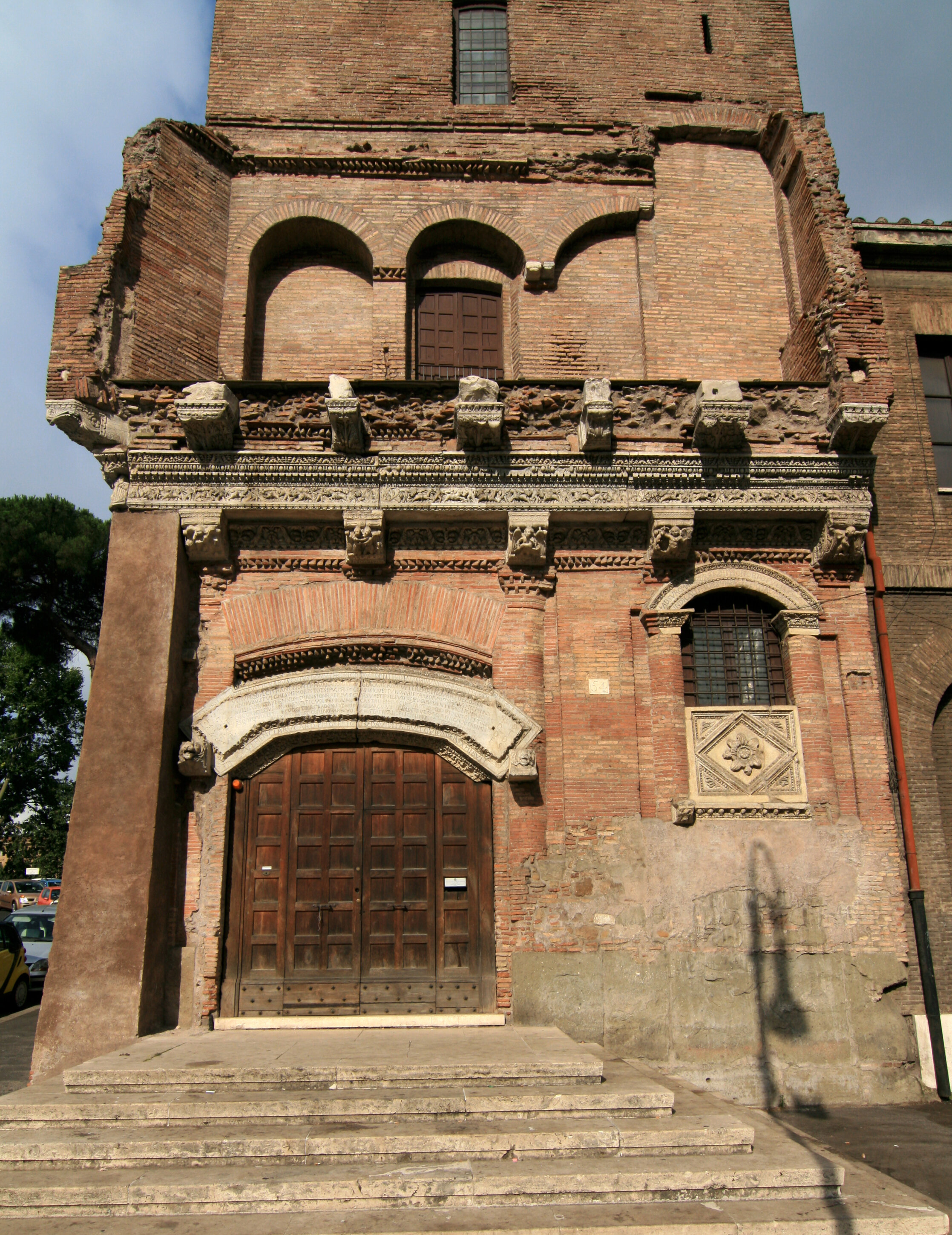
The so-called Casa dei Crescenzi, which grows close to the Forum Boarium and just before the church of San Nicola in Carcere (and by clicking here you can read a curiosity about it), is a beautiful example of how people lived in Rome in the Middle Ages, especially if you belonged to a noble family. It is also an excellent way to understand the extraordinary beauty of the Eternal City, which in a small piece of land shows, in all its beauty, ancient temples with marble columns, a very particular monument such as the Arch of Janus or a wonderful medieval church like that of Santa Maria in Cosmedin. But as a tour guide, today, I would like to draw your attention to something that is not so easily visible: a quite original medieval house!
This building, which dates back to around the 11th century, owes its name to Niccolò, a member of the powerful Crescenzi family who had his bridge built right here, close to what was once the Ponte Emilio (now named Ponte Rotto as it no longer exists) . residence . What we see today is only the memory of what the house really must have been, which was probably much larger. What really fascinates are the beautiful marble reliefs that run all around the house and, also, the numerous attributions that the building has had. In the past, in fact, this residence was called Domus Pilati, due to the famous Pontius Pilate. Reason? During the Middle Ages, to commemorate the Passion of Christ, Mount Testaccio was used as a Roman Golgotha and, during the performance, the person who personified Pilate showed himself from the balcony of this building. Furthermore, the Casa dei Crescenzi is absolutely unique for some epigraphic testimonies that tell us about the character of Niccolò, the one who decided on its construction. The owner of the house, located in a strategic point of Rome (since at the time there were only four bridges that crossed the Tiber), wanted to mark a long testimony written which makes us understand how Rome, still in the Middle Ages, could have an aura who aroused respect and inspiration. Among the sentences that Niccolò had engraved we read, for example, that "it was not vainglory that pushed him (Niccolò) to build this house, but the desire to renew the ancient decorum of Rome" , and that "that sense of rebirth of ancient expressed in the exaltation of the building, erected both to decorate the city and to renew the ancient grandeur of Rome" .
Very clear words I would say, also accompanied by phrases on the transience of life , on how "Death comes on wings; for no one life is eternal, our stay is short and its very course is light. Even if you were to flee the wind, even if you closed a hundred doors, if you commanded a thousand escorts, you would not go to sleep without dying" As if to say that, in the end, only Rome is eternal. And, after all, if you look closely and think about it, there could be a grain of truth, don't you think?