

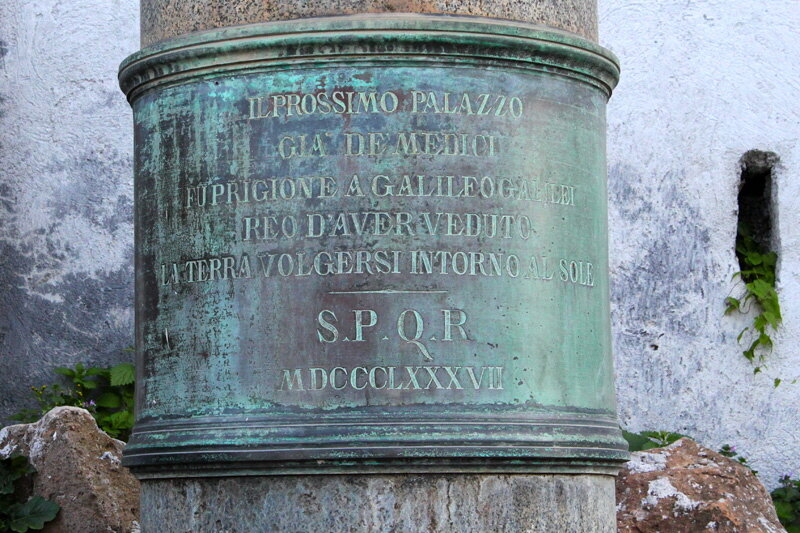
Having the facade of the Church of Trinità dei Monti behind you and, therefore, the Spanish Steps in front of you, turn right heading towards the Renaissance Villa Medici (that is full of unusuale beauties, as you can read here). Close to the entrance of the beautiful building that once belonged to the powerful banking family (now the seat of the French Academy), you will notice a solitary granite column with a bronze inscription. Well, now you are getting in touch with Galileo Galilei, a man who really changed our very conception of the world, of the universe, of our way of thinking, of doing science and beyond. As a local tour guide I point out that, often, it is the inscriptions that appear around the city that are really important. Why this plaque ?
Because it is here, right inside Villa Medici, that Galileo Galilei probably spent the worst period of his life. We are in 1630 and Galilei, after he had already come to Rome more than once trying, in every way, to present his assertions and his theories (which for him, considering the concrete evidence brought to support his theses thanks to instruments such as the telescope, were true certainties). He came into contact with Cardinal Bellarmine, a Jesuit who probably liked the Galileo's ideas, even allowing him to speak at the Collegio Romano or in front of a crowd of scholars, refuting his ideas. In 1611 he also managed to enter the circle of the Accademia dei Lincei, whose sole purpose was to penetrate the truth and look beyond it, like the eye of a lynx, above all by surpassing that biblical truth which had founded human knowledge up to that moment. But in 1630 Galileo Galilei persuaded himself to ask the Florentine Inquisition for the imprimatur for the publication of his work: the Dialogue on the Two Chief World Systems. It was the pinnacle of his talent and his perseverance, a publication where he collected all the evidence that demolished the old conceptions according to which the Earth was the center of the universe and everything revolved around it, including the Sun. As we know, Galileo was the one who canonized Copernicus' discovery, stating with certainty that we revolve around our star, the Sun (narrowing down a lot). However, after two years, the Inquisition of Rome wanted to see clearly and forced Galileo to come here to abjure, not accepting his theses. In 1633 the famous trial took place against the scientist who, despite having stated in the prologue of his work that he had always been faithful to the truth of God and the Church, was forced to abjure and reject all his theories, now considered heretical. Galilei was sentenced to life imprisonment but, perhaps precisely because of his influential friendships or, who knows, for having convinced more than a few prelates, he managed to serve part of his sentence right here, at Villa Medici.
He was, therefore, a guest of the Grand Duke of Tuscany for a long time and then, shortly after, he moved to Siena. Only in 1887 did this plaque, affixed to this column, recall the period of forced imprisonment, albeit gilded, that Galileo had to endure locked up in the magnificent rooms of Villa Medici. Sometimes you just need to know where to look, here in Rome, to get in touch with history...