

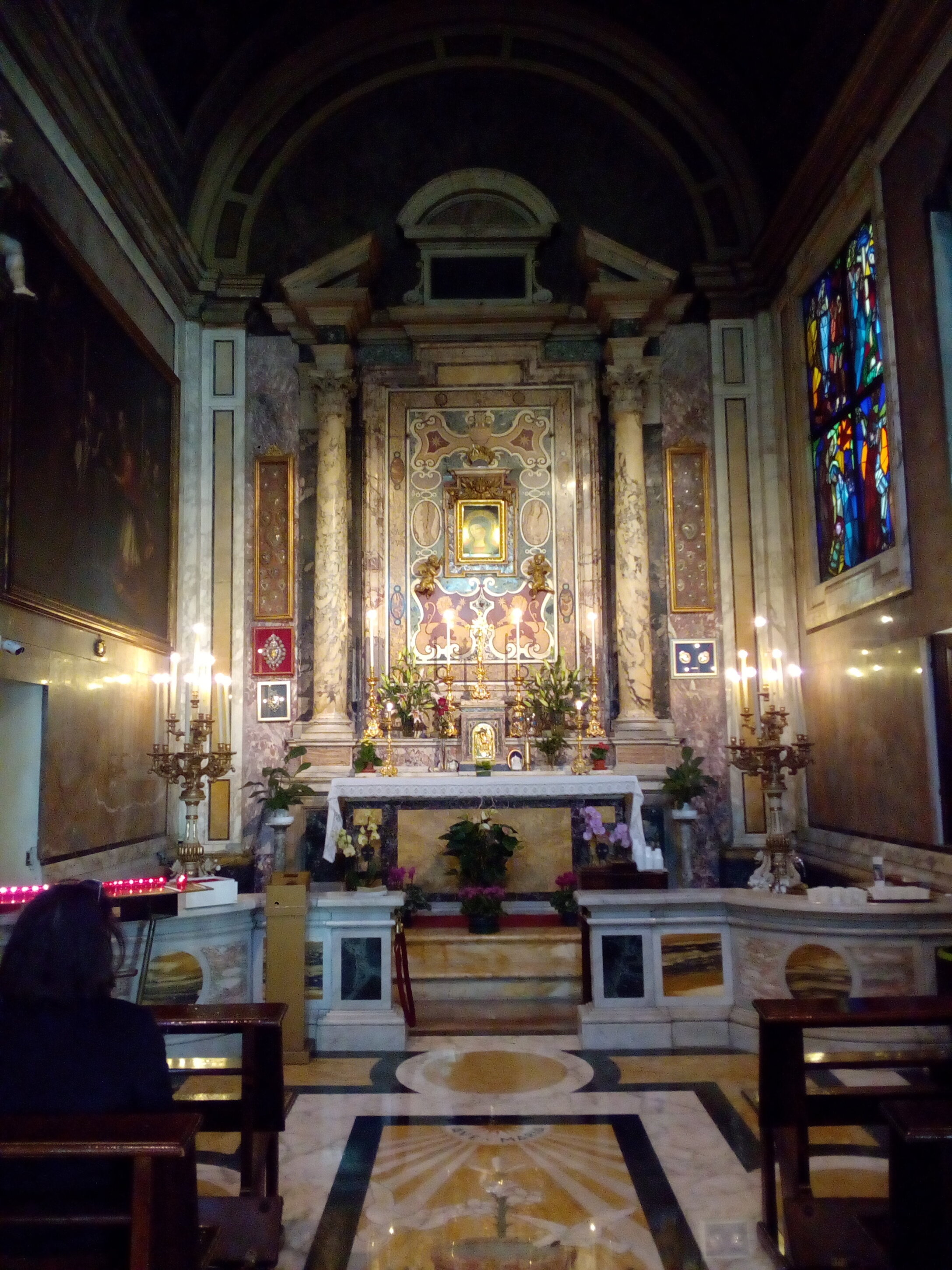
There are churches in Rome venerated because they became the protagonists of miracles or, in any case, events beyond human understanding. Historic churches that are worth visiting, even with a tour guide or simply by faith, not only for their historical and architectural value, but above all for their religious memory. Often, then, the undisputed protagonist of miraculous events is the Madonna, and this place of worship is no exception.
Here we are in front of the Church of Santa Maria in Via, of which today we see the sixteenth-century forms given by Giacomo della Porta and Francesco da Volterra. We have great works of art inside, finely decorated with polychrome or rare marbles (such as the African black of the balustrade that borders the altar), such as for example the Annunciation by Cavalier d'Arpino, the master with whom he worked and Caravaggio also collaborated. But, in reality, the true origins of the church sinking into the miracle that occurred in 1256. There was no church, but the large stable of the private property of a cardinal, complete with a well inside for water. A servant, perhaps intentionally, threw a heavy tile decorated with the image of the Virgin into the well. The tile fell down, but suddenly and impetuously the water began to flow out of the mouth of the well, without stopping. It was unstoppable, and the chaos that this caused alarmed all the servants, so much that they were forced to wake the landlord up, the cardinal Capocci with a start. Only a man of the church could grasp that miraculous tile, as we find written in some chronicles. "When with them [you serve] great amazement they realized that on the waters more than a hand's high from the parapet of the well, a tile was floating, almost as if it were light wood, on which the image of Mary was seen. longing to possess the prodigiously immobile image on the waters that gurgling and falling all around on the ground; but every effort turned out to be vain, because as many times they were on the point of grabbing it, as many times by submerging it took it out of sight and slipped out of their hands, no matter how tirelessly they tried the test again Tired, finally, of such a game, they thought it best advice to inform their Most Eminent master, who, hearing the story, as most devoted as he was to Mary Most Holy, dressed in the cardinal's robes, descended with all his noble court to the stable and , having made a short and fervent prayer to Mary, he entered the water which he poured everywhere and with the greatest jubilation of his heart he was able to grasp without difficulty risen the blessed effigy of Mary".
Having captured the effigy of the Virgin Mary, the cardinal blessed it and prayed over it, asking Pope Alexander IV the following day to build a church in place of the stable. It almost seems as if the tile didn't want to be thrown down there, like a useless object...this is the tradition, however, which still resists, strong, even today. Every day pilgrims, faithful or simply curious stop at the first chapel on the right, the one in which the real tile stands out above the altar. A chapel finely remodeled and decorated in the eighteenth century, as it appears to our eyes. And still today the well, which really exists, offers water considered miraculous and thaumaturgical. By means of a tap, and under the supervision of the guardians of the church of Santa Maria in Via, everyone can access the holy water. Even Rome, therefore, has its own little Lourdes...