

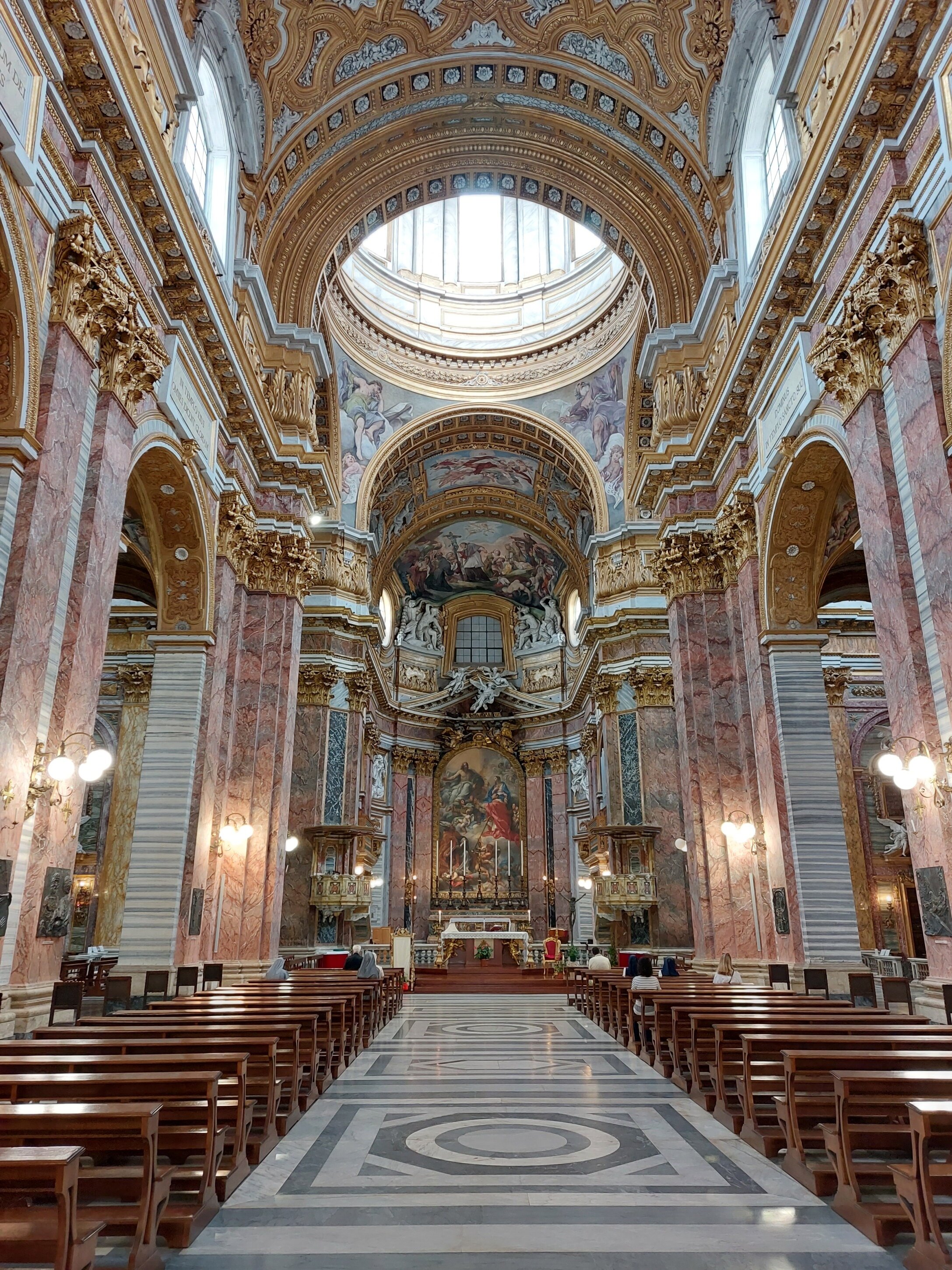
Via del Corso is very famous for being the Roman shopping street but, on the other hand, it has been one of the major routes of the Eternal City for centuries. Today we are surprised by the Roma Store or the largest Apple Store in Europe but, on closer inspection, Via del Corso also has something else: noble palaces, monuments from the Roman era, churches. Among the latter I mention the Basilica of San Giacomo in Augusta, a very interesting basilica whose plastered facade has a grand and majestic feel. And here, today, your tour guide in Rome offers you the Basilica of Saints Ambrose and Charles whose construction dates back to 1471.
We are in the Rome of Sisto IV, pontiff of the Sistine Chapel, who officially founded the Confraternity of the Lombards, at the time a large community in Rome. Let us not forget that the Caput Mundi attracted people of all kinds, social backgrounds and places of origin, especially pilgrims. For this reason, as is also the case today in the largest cities in the world, foreign communities began to settle in Rome, helping their fellow citizens. Let's not forget that Milan and the entire Lombardy area were certainly not part of Italy, which did not exist at the time. Thus it was that pope Sixtus IV gave them a small church in Campo Marzio, dedicated to the Madonna del Tufo, and of which we have news as early as the tenth century. We have to wait until 1612 to see something new, when Cardinal Omodei spent 70,000 scudi (a high figure) out of his own pocket to completely rebuild the basilica, which in the meantime was dedicated to Sant'Ambrogio. The architect and creator of the basilica is certainly Onorio Longhi, although much of his own was placed by his relative Martino Longhi the Younger. Even Borromini, with all his susceptibility and irascibility, was involved. All great artists born in northern Italy and then transplanted to Rome, where it was easier to obtain commissions of great depth and importance. As often happens, due to lack of and difficult financing, as well as numerous changes in progress, the construction of the place of worship suffered numerous impediments and slowdowns. It should be noted that, subsequently, the basilica was also dedicated to San Carlo Borromeo, canonized in 1610. Another important Lombard saint, San Carlo by that group of saints that the art of the Counter-Reformation of the early seventeenth century wanted to show, sanctify and make know.
Art was a powerful communicative tool, capable of reaching anyone. The artistic forms, of various kinds (painting, sculpture and architecture), at the time had to reflect the new trends sought by the Church of Rome, which had to recover the consensus lost due to Luther 's invectives. Let us not be surprised, therefore, if this basilica has such monumental forms. If the dome, designed by the brilliant Pietro da Cortona, is the fifth largest in Rome, if numerous works of art show great examples of Christian virtues. In the left aisle of the church, for example, there is a chapel dedicated to an 11th-century Norwegian saint who renounced his faith to embrace Christianity. We see a canvas in which the saint is intent on defeating a dragon, personification of the evil pagan religion. Finally, linger over the high altar and, remaining captured and enraptured by the typically late Baroque stuccos and gildings, which give an almost mystical aura to the environment, go around the ambulatory (the only example in Rome of a circular corridor that goes around the apse , such as the Milan Cathedral). Pause in front of a shrine, located just behind the main altar. Just read the inscription to know that the Heart of San Carlo Borromeo is kept there! Certainly a strange relic, but one of the most common in Rome at the time, which more and more faithful wanted to bring back into his arms after the terrible blow of Luther and his Protestantism. A very particular church, there's no denying it!