

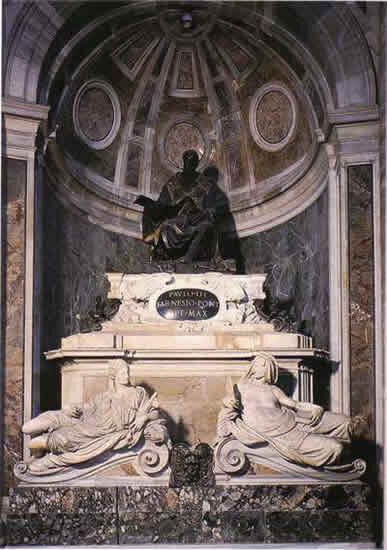
Let's go back to the extraordinary Basilica of St. Peter in the Vatican City, about which I have already written both as regards the origin (click here), and to describe one of the most poignant and engaging wonders (click here). But in this extraordinary basilica, visited every year by millions of tourists, there is much more to admire: relics, extraordinary and famous wonders such as Michelangelo 's Pietà but also many funerary monuments dedicated to popes of the past. One, in particular, is interesting for various reasons, even if it is very difficult to be able to approach it as it is placed in an area usually closed to the public. I'm talking about the funeral monument dedicated to Paul III, an important pope who reigned in the first half of the sixteenth century. Follow me on this journey through religion, art and ... gossip!
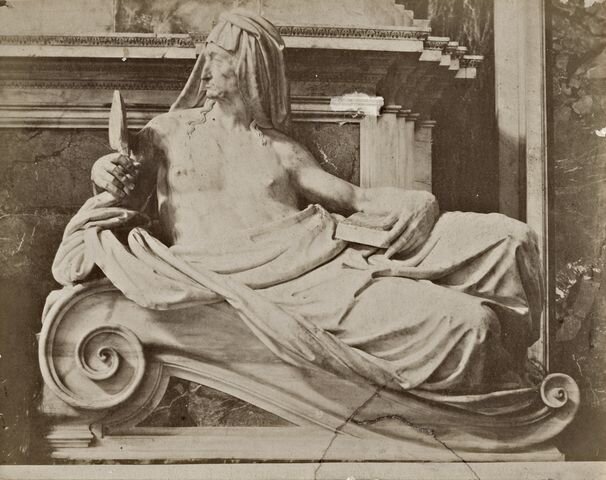
The pope Paul III Farnese, a member of one of the prominent aristocratic families at the time, is remembered above all for his tireless effort in promoting the Council of Trent which, according to official intentions, should have found a meeting point between the Roman Church and Protestants (which later did not happen). A powerful man and a great lover of art, his funerary monument fully reflects his importance and social class. The bronze statue that represents him is haughty but powerful, while the two allegorical figures half-lying at his feet allude to some of his great virtues: Prudence and Justice. Nothing strange up to now, since personifications of various virtues were often among the favorite subjects of funeral monuments, characters used to enhance, in life, the alleged moral and ethical qualities of the deceased. Both personifications come, however, from real human models that inspired them. The first, Prudence, is the one you see on the right, in the photo. Curiously it is an elderly female figure and, very, very strangely, particularly similar to... Dante ! Try to look at her face, her nose and her eyes! It looks like a kind of Dante in a female version! Wanted or not? We will never know, although what seems certain is how the sculptor, Gugliemo della Porta, for the representation of Prudence was inspired by Giovanna Caetani, mother of Paul III. A tribute, regardless of the portrait itself, to the powerful pontiff 's mother.
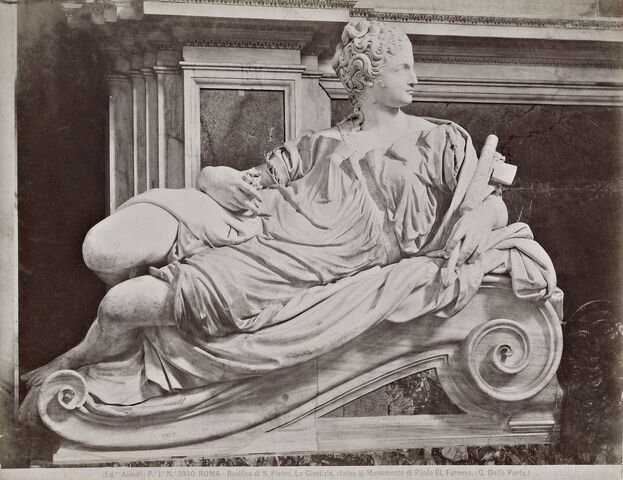
What we are sure of, however, is the misfortune that happened to the other allegory, that of Justice on the left. As you can see, it is not naked or half-naked like the other one, and this is because the drapery (in white-tinted bronze) was added by Bernini a century after its realization. Reason? The chronicles tell us that Justice struck for its beauty and perfection, and someone fell in love with it a lot, really a lot. So much so that he was able to be locked in the basilica at night, spending hours and hours in the company of his "beloved". Obviously the man (according to different versions an English or a Spanish lord, if not even an altar boy) had psychic problems, which did not prevent him from staying, almost lying according to the chronicles , an entire night with the statue. The only way to stop him was to arrest the man and cover something that, due to its natural beauty, caused scandal and sensation. This story closely resembles a similar episode that occurred, however, in the presence of another absolute masterpiece of art: Canova's Paolina Bonaparte, which is exhibited at the Borghese Gallery. Here, however, the scandal was perhaps even greater, considering that we are in St. Peter's Basilica, the most important in all of Rome. The same scandal, after all, that caused the young girl who inspired the sculptor to portray Justice: none other than Giulia Farnese, most likely the Paul III's daughter. Among other things, she was a very famous court woman and a lover of many powerful men, as well as famous for her beauty. Evidently, even in sculptural form, it aroused hot spirits...