

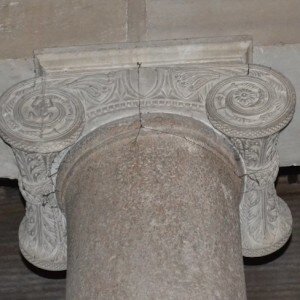
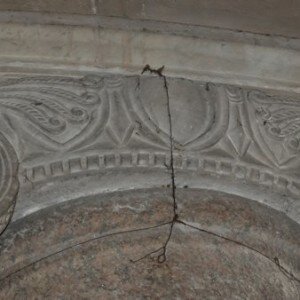
Do you know the Basilica of San Lorenzo fuori le Mura, in Rome? I highly recommend that you dedicate some of your time to it, especially for the fact that the place of worship is particularly interesting for its blatant medieval appearance, for its fascinating cloister, for the frescoes that decorate the entrance porch. But I wouldn't be a real local tour guide here in Rome if I don't give you one more reason to visit the Basilica of San Lorenzo fuori le Mura. Are you ready to slowly look for two particular reliefs? One in the shape of a frog and one in the shape of a lizard ?
Try to review all the capitals of the splendid columns that delimit the central nave, Ionic style capitals with their desired characteristics. On two of them, towards the end of the nave , you will see a lizard and a frog. Why something like this? What is behind it? Probably a story of self-esteem and personal revenge. We are in late Republican Rome, and two architects were making a name for themselves, having built the two temples dedicated to Jupiter and Juno in the Portico d'Ottavia . Probably the two were famous for having been among the main financiers of the religious buildings. And in the old city, being able to show off a certain personal wealth, among other things used to enrich Rome with monuments and the Romans with new buildings, was a very important social rule. Imagine the pride of creating a work so beautiful and central to city life... but now also imagine the despair in not being able to put your signature, your name and your identity! Yes, because a law prohibited architects or artists in general from signing their works. The reason? We do not know for sure, but it probably all lies in the low class and social consideration enjoyed by the artists of the time, considered almost simple laborers (with very few exceptions).
Well, the two architects did not give up, and after numerous refusals by the Senate they found the solution. The two were called Sauros and Batrakos, which translated are, respectively, Lizard and Frog. In short, it seems that despite everything a sign of their passage, a signature on their beautiful work, they wanted to leave it. Hidden and, in theory, in full compliance with the law, as these figures are not proper names. It is thought that Pliny also spoke of this particular signature, although he probably did not refer exactly to the reliefs present here in the Basilica of San Lorenzo outside the Walls of Rome. We could ask ourselves a further, final question: why is this capital located in this basilica and not in the original site? Simply because in Rome over the centuries everything has been moved and recycled! And among a thousand ups and downs, these capitals with their curious animal decorations have reached this point...