

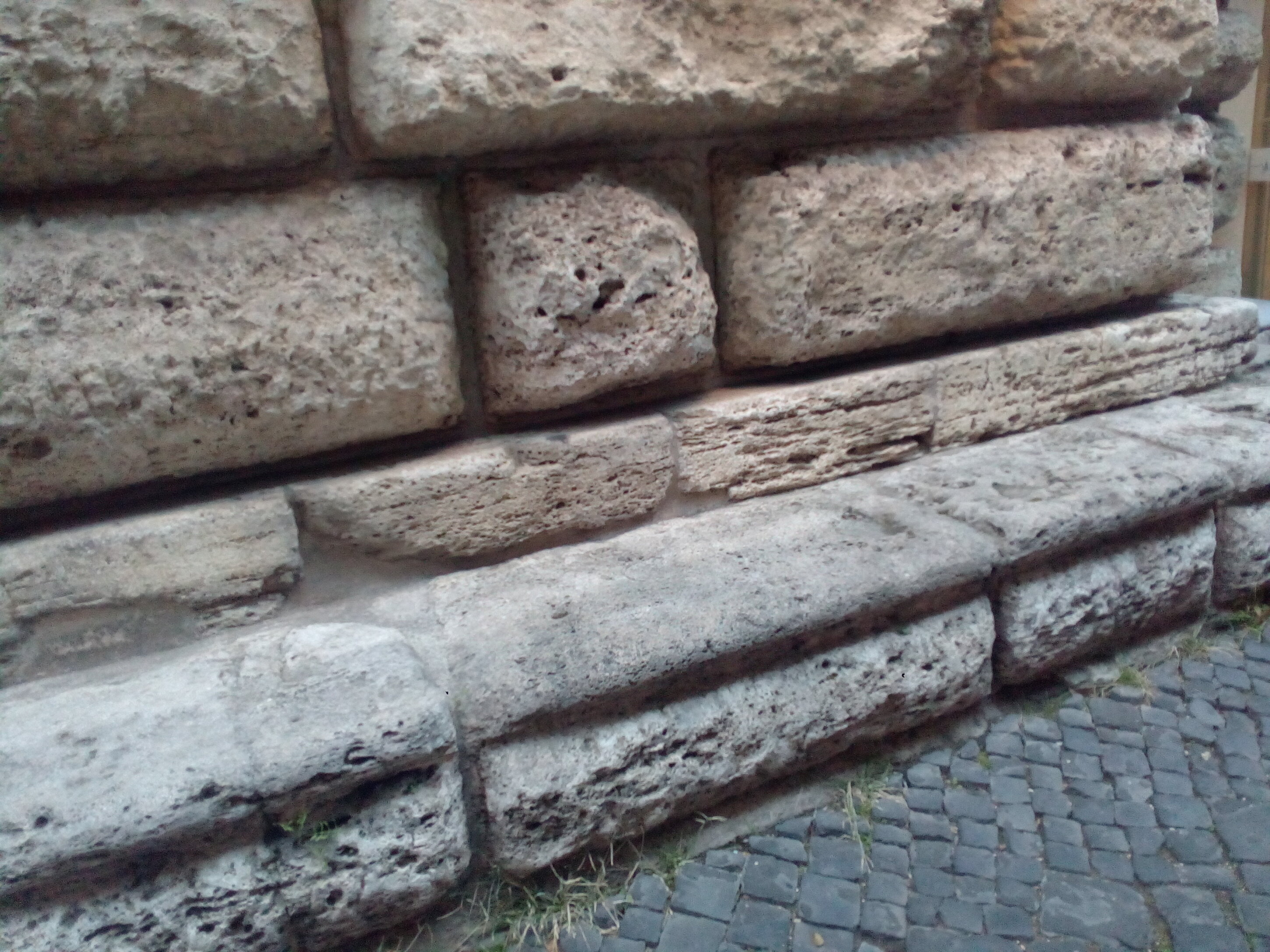
Walk in Rome it is easy to run into something apparently anomalous, but which actually hides something historical and important. After all, the purpose of a local tour guide is just that: to make visitors discover some interesting gems. Like what I'm going to talk about, curious testimonies of a grandiose building that had to be built to modernize the Eternal City and to glorify a very active pontiff, both from an urban and artistic point of view.
These travertine blocks, leaning almost with melancholy on the facade of a hotel, are the so-called Sofà di Via Giulia. We are, in fact, in the famous street that passes near Campo de' Fiori , Via Giulia precisely. Famous in Rome already in the fifteenth century, with the name of Via Magistralis, (a reference to the concept of the main road), initially it was nothing more than a muddy path and not so straight, being full of curves! Already Sixtus IV, in his precious work of renovatio urbis, thought of modernizing this important communication route, but the one who really radically changed the history of this road was pope Julius II Della Rovere (hence the current name), who promoted a series of initiatives to modernize the city. The Sixtus IV's nephew really spared no expense in trying to make Rome modern, for the perspective of the time. After all, from such an energetic pontiff, as you can read here, nothing else could be expected! Thus it was that Via Giulia became one of the main viae rectae of the city, almost a kilometer long and flanked by palaces and noble houses. And these anonymous blocks? Julius II, as a custom of the time, also thought of celebrating himself a little by building the so-called Curia Iulia, a court that was to overlook the street. It should have been something monumental and public: on a quadrangular scale and surrounded by arcades, the courthouse would have had four corner towers, like a kind of castle! Bramante, the great trusted architect of the pontiff and the man who, more than others, supported the lines and ideas of the architecture of the past for his projects at the height of the Renaissance, was called to draw up the works and draw up the project. Too bad that, as often happens, it all ended with the death of both, and the building was never completed. Much changed over the centuries, with restorations, demolitions and demolitions. And of the immense, but already incomplete, court of Julius II that would have brought so much glory to himself and to the city, only a few anonymous pieces remain.