

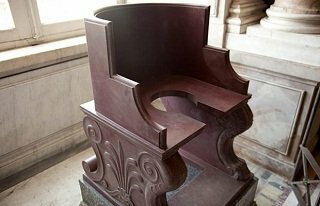
One of the enigmas, or great curiosities , of the history relating to the popes and the Holy Church resides in an ancient marble block in the shape of a strange chair, with a central hole that closely resembles a toilet bowl. This, which we see in the photo, is kept in the Vatican Museums in Rome and is called the Stercoraria Chair. We are in the so-called Cabinet of Masks, an intimate and private area of these wonderful museums where, at times, I have the opportunity to access to take numerous visitors on tour. This particular chair enters, by right, to be part of the numerous and varied history of the papacy. Here because.
There were three of them in the world, and they were directly and personally used by the popes in the centuries ago. The motivation? Even today there are some theories, but the one that is the most popular is the following: through that forum, especially during the investiture of the new pope, it was customary to check the... sex of the pontiff! Once elected in the St Peter's Basilica, a long procession accompanied the newly elected up to San Giovanni in Laterano, still today officially considered the seat of the Catholic Church of Rome. This procession was one of the key events for the Romans, something that certainly did not happen every day and that captured the attention of all citizens. Sitting on this chair, the new pontiff attended the ceremony in his honor and then, at a certain point, he saw a vicar or member of the clergy check his gifts... genitals! It seems that once it was checked that everything was where it was supposed to be, the phrase "Testicolus non habet, Papa non posset" was pronounced, which can be translated as "If there are no testicles, Papa cannot be". But why this strange custom? Why did we have to go to so much trouble to confirm the pope's sex?
Probably, because of the famous pope Joan , who during the Middle Ages managed, almost miraculously and unbeknownst to everyone, to be elected pope despite her being a woman! According to tradition Giovanna was a very pious young woman who absolutely wanted to become part of the clergy. Having cut his hair, she managed to enter the seminary by passing himself off as a male, also thanks to her face and body, with such delicate but not overly feminine features. History would have it that, incredibly, she entered the conclave and got herself elected pope. Too bad that, precisely because of a love affair with a priest, she became pregnant, thus being unable to hide her true nature anymore (all this happened in the 9th century). Precisely to avoid the repetition of similar situations, the Dung Chair was conceived, a practice abolished as early as the sixteenth century at the behest of Leo X Medici. According to others, in reality, this very particular chair served to remember to the popes they were none other than men, and certainly not God on earth. Creating something like this, which can immediately make us think of purely human tasks, therefore served to remind the popes, that over the centuries, at times, they felt much more than mere spiritual eminences, that they had to always be with the feet firmly on the ground.