

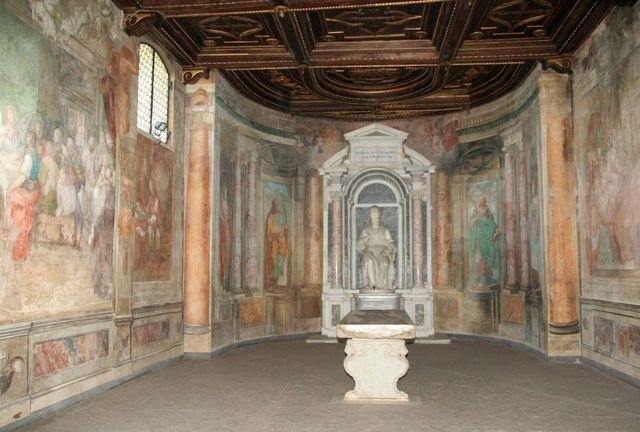
If you walk around the Caelian Hill you cannot miss the so-called triclinium pauperum (literally the soup kitchen), which consists of three small oratories that rise near the Basilica of San Gregorio. The whole area, believe me, is full of mysticism and, above all, brings with it the historical memory of a very important man for the Holy Church: pope Gregory the Great. Follow me on this journey between art and tradition to discover a hidden corner of Rome that a tour guide like me recommends.
Among the three oratories mentioned above the more ancient is the one dedicated to Santa Barbara, dating back to the 12th century. Here, according to tradition, every day Santa Silvia and her son San Gregorio (who was pontiff at the beginning of the 7th century a.D.) distributed free food to the poor people. Also, in the memory of Christ and his Last Supper, on Holy Thursday the pontiff himself dined, right around the marble table that you see in the center of the hall masterfully frescoed in the sixteenth century, with 12 poor people, offering them a meal. Not only that, because according to tradition one day a foreigner showed up, declaring himself poor. The diners thus would have risen to 13, but the pope did not hesitate and accepted the newcomer, who turned out to be an Angel. In short, Gregory the Great was certainly a pious man, capable of giving his life and money to the Church, truly at the service of the poorest and most needy. This miracle (not the only one that happened to the pope, as you can read here) also makes us understand the extraordinary nature of the historical figure of Gregory the Great, who gave an important impetus to the local deaconies, ganglia of the clerical administration that he also took care of assistance to the poor. He was also among the first popes to really administer Rome, detaching himself a little from the yoke of the Byzantines and Byzantium, in a period certainly not easy for a figure, like that of the pontiff, who was forming his own political leadership and administrative.
For example St. Gregory wrote that he felt "in the midst of the waves (...) I am oppressed by so many tribulations that I do not have time neither to read nor to write". But the story, however, does not end there! Remembering the miraculous apparition of the Angel and the help given by the pope, until 1870 the popes used to offer dinner to 13 poor people. Too bad that, from this episode, it seems that the superstition of the number 13 at the table derives! You know that this practice would bring misfortune and evil eye, right? Well, initially we begin not to be 13 around a table simply in order not to repeat a fact and a miracle of divine origin. Then, somehow, popular belief saw in the number 13 something malicious and to be avoided. However that may be, what matters is that, even today, we have the direct testimony, through stories and traditions, of a man who became pope who, reading the chronicles of the time, gave himself to help the most needy, another corner of Rome capable of taking us back in time, between legend and reality.