


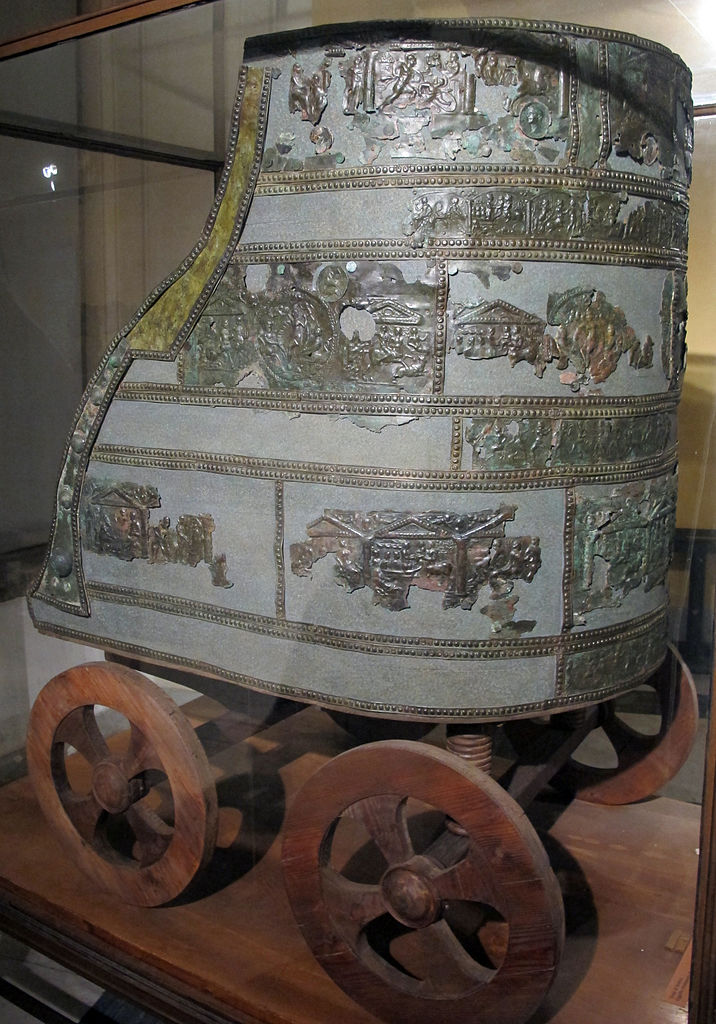
At the Capitoline Museums of Rome, at the Palazzo dei Conservatori, is host and preserve an unusual work of art: the so called Tensa Capitolina. What is this artifact? Basically it is the result of the resolution and perseverance of a man and a scholar. But it is also an example of how it can be very difficult to rebuilt something that is unknwon, especially if there are only some fragments of it. Don't forget how at the Capitoline Museums of Rome are always able to give us amazing wonders, like his one.
Moreover the Tensa Capitolina was a charriot used for specific parades, having bronze slabs as decoration from the IV century a.D. First of all I have to say that it is a magnificent example of the ancient roman art which gives its existence to a famous scholar and expert of the etruscan art which came from Rome: Augusto Castellani. During the XIX century this man, a member of a family of antique dealers and historians, had one main purpose: to leave in Rome what can be found in the roman countryside. He opened stores in Rome in order to show the so called "anticaglie" (antiquities) and, just to say something, he was an important member of the "Archaeological Commission", which was established in Rome when the Eternal City became the capital of the kingdom of Italy. Augusto Castellani found, at the 1872, at the roman countryside, some well refined bronze foils which were realized with a specific tecnique named repoussage. Close to them Castellani found also some wooden foils. He was the first scholar who understood which they can be related to a specific charriot, that can be used mainly for religious processions or rituals. Probably this works of art was made for some religious parades that, as happens today in Italy and not only, were provided for several reasons. So the Tensa Capitolina is the result of the deeds of a man who loved to study, discover and search.
Then imagine how this charriot was probably used even to move important people, like kings for example, who had the privilege to be moved in this way. Moreover you have to know how the bronze decorations, or better what was found about them, is developped on six stripes depicting scenes from the Achilles' life. Amid the episodes we recognize the bath of the little hero, when his mother, Teti, washed his feet (but not the heel...). It is impressive how Castellani was able to think how the bronze foils can belong to this specific work of art. But don't forget how at the Capitoline Museums in Rome masterpieces like this one are easy to see.