

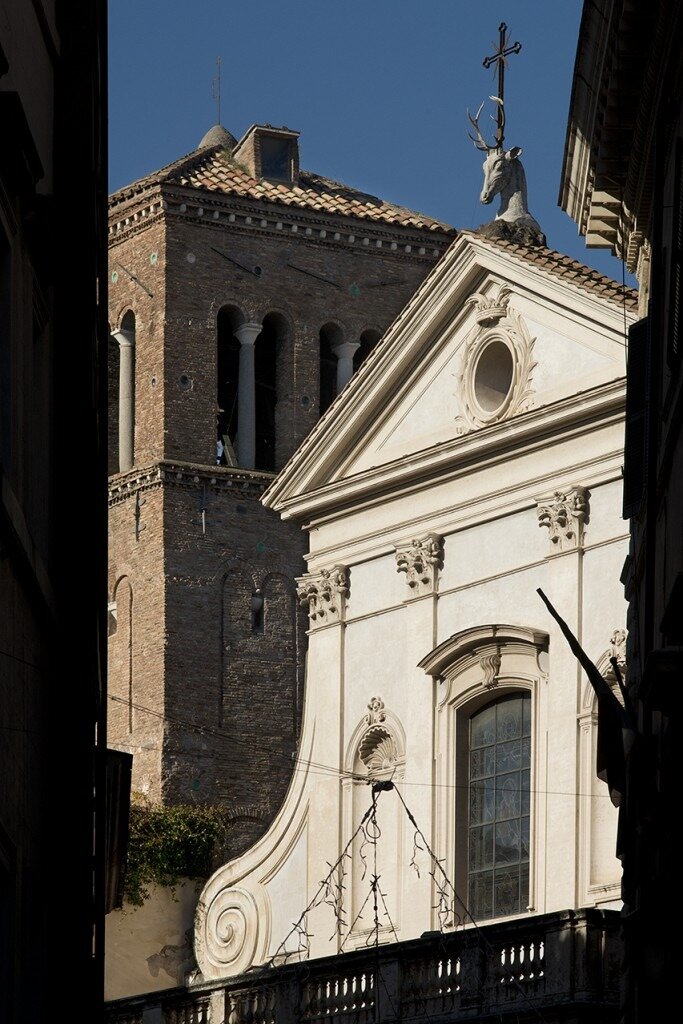
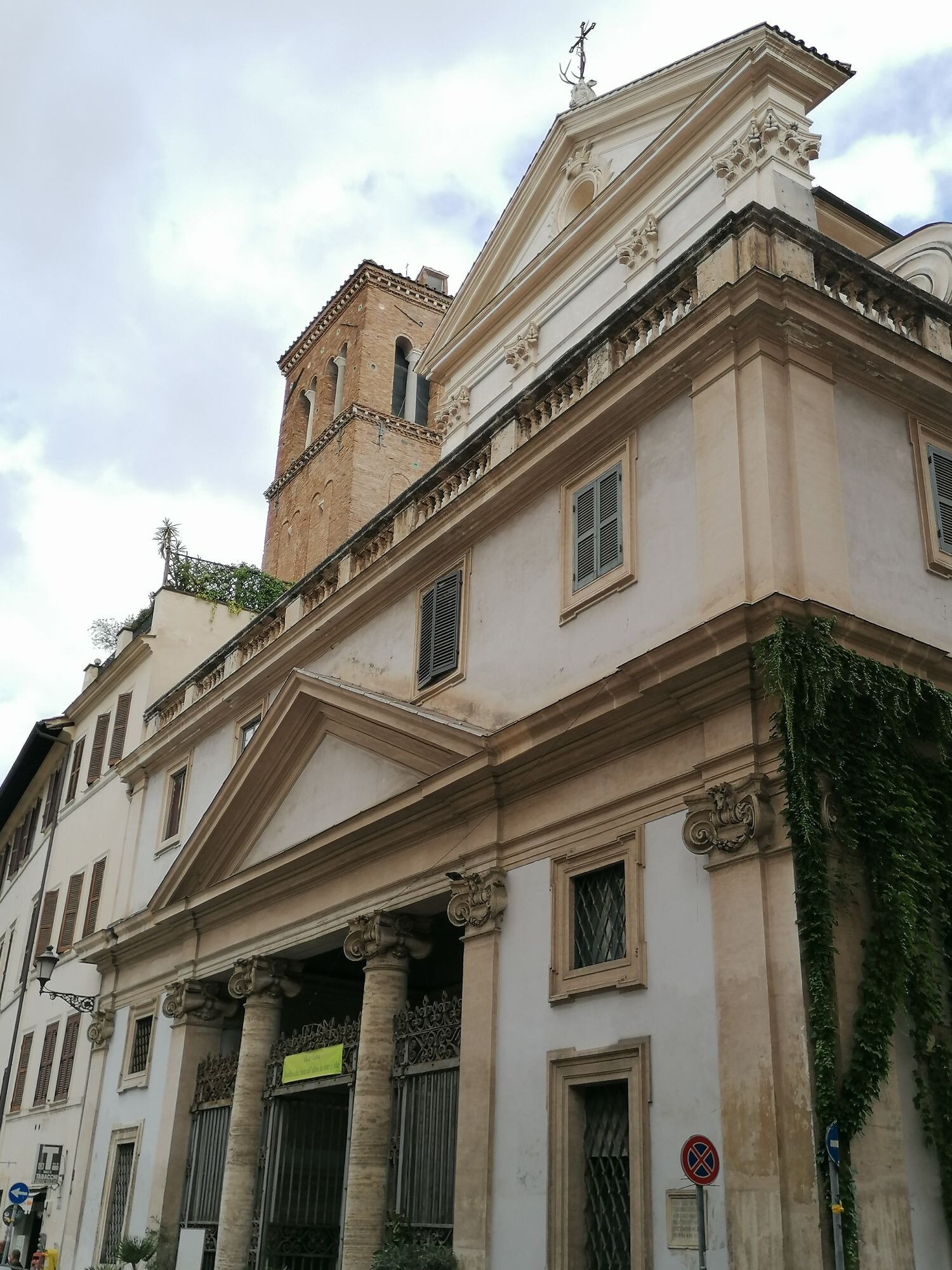
Today we have external photos of the Basilica of Sant'Eustachio in Rome, which stands in the small square of the Roman district of the same name, very picturesque and characteristic. The really curious thing is the deer head, having wonderful horns, which stands out on the top It is the church, a very interesting and apparently completely out of the context. Reason? Let's discover it with a local tour guide of Rome, someone who knows a lot of curiosities about the Eternal City!
Everything derives from the saint to whom the whole district is dedicated, that Eustachio who, in reality, was called Placido and was an ordinary Roman citizen, however a centurion. Of clear pagan faith, he was particularly fond of hunting, a popular and deeply felt activity in Roman society of the 2nd century a.D., when being a good hunter also meant being a strong and valiant man. According to the chistian tradition, that obviously is posthumous, one day, wandering near some paths in the mountains near Tivoli, something disconcerting appeared in front of Eustachio: a deer, which he had been looking for for a long time, with the image of Christ in beautiful and dazzling view between the horns. A real vision with a strong emotional impact that strongly affected the soul of the hunter and centurion, a soul that for the first time had proof of divine power. Suddenly he and the whole family converted to Christianity, changing his name from Placido to Eustachio. He lived under the reign of Hadrian, an emperor who was never particularly hard on the Christian community, it must be said. Despite this, however, according to his hagiography, Eustachio was tortured, he and the whole family, in an unspeakable manner. First, he was thrown into an arena full of lions, who dared not touch him, approach him, or tear him to pieces. Indeed, according to some testimonies the ferocious animals lowered their heads and walked away. Then, to kill them definitively, the Roman authorities decided to lock Eustachio and his family inside a hollow bronze statue in the shape of a bull. This statue was placed on a brazier, so much so that it became incandescent. Imagine the pain and horror of such torture: being burned alive!
The tortures described here are also found in other martyrologies, stories relating to martyrdom, often bloody and cruel, to which men of faith went against in order not to submit to the Roman Empire and its divinities. Furthermore, as happened in this case, divine intervention is also noted, as many saints or martyrs were not killed immediately, since the first or subsequent tortures often survived, even in a miraculous way. This is the case, for example, of the lions who, subverting the expectations of the Romans, did not tear Eustachio to pieces. But even in this case there is a further miracle, which made the story even more extraordinary from the Christian point of view. It is said, in fact, that death occurred, and after the bronze bull was cold, the Romans took care to clean up everything, removing the corpses from the terrible death trap. But when the bodies were pulled out they were incredibly good condition, as if they had never been burned. The incorruptibility of the soul is also reflected in the body, in this case. The same deer is also found painted on the facade of the Renaissance building located right in front of the church, as well as in the famous Fountain of Books located nearby. Interesting to understand how much a simple symbol can tell a lot, right?