

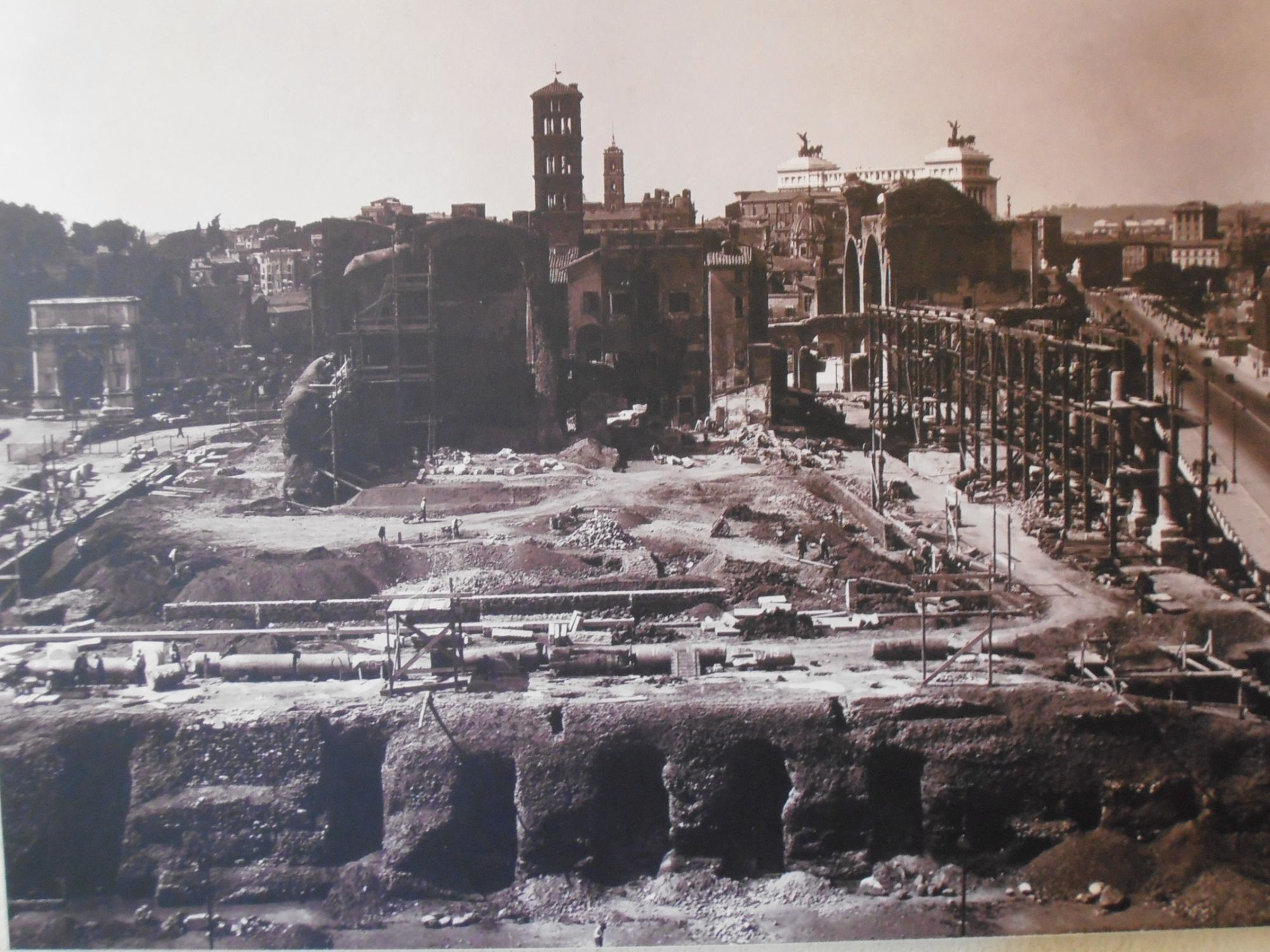

Here we have historical photos about excavations that have changed, I would even say permanently, the very heart of Rome: the Roman Forum! Here, and surely all Romans know what we are talking about, there is one of the most iconic streets of Rome: Via dei Fori Imperiali. An example of how, in a certainly recent era, reason of state and propaganda can be put in the first place rather than prevention and enhancement of cultural heritage. Let's see together why I wrote that.
In about 8 years, from 1924 to 1932, the whole archaeological area of the Roman Forum was involved in a large campaign of excavations, aimed above all at bringing to light new amazing examples of the millenary history of Rome. In fact, the fixed idea by Mussolini, great head of the Fascist Party, was to found a Third Rome: after that of the emperors and the Popes, here is that of the Duce. Despite the overexposed concept was already been idealized in the Risorgimento period, so much so that Mazzini, for various reasons, already spoke about the Third Rome, it is certain that in Mussolini's view the discovery of ancient Rome, its new re-proposal even physical, had a high propaganda value. To found, therefore, this sort of Third Rome it was necessary to find a tangible connection between his new city and the ancient one, sung and loved for centuries by various poets and artists. For this reason Mussolini promoted a gigantic excavation campaign, with which he tried in every way to bring out as much as possible. This was not dictated only by purely political reasons, since for years now in Italy and not only archeology became a very useful tool for the definition of cultural heritage, for its enhancement and preservation and for the identification of common cultural values of the past. Furthermore, from the point of view of his propaganda machine, Mussolini decided to commission a large boulevard that today is very easy to see: the so called Via dei Fori Imperiali. A long road which partly buried a sector of the ancient Roman Forum.
And let's not forget that the area of the Forum in which the roadway runs today was, since the sixteenth century, a real neighborhood inhabited by hundreds of people who lived in houses built above the ancient ruins, which were also reused to erect private buildings. Despite the pompous inauguration, which took place on horseback, Mussolini perhaps would not have expected all the criticisms rained on his project. Even today, knowing how much can still be found under the road surface, despite its usefulness for traffic and more, many wonder if it is worth keeping this great avenue active. And between projects of bridges designed to dominate it, or others that aim to completely get rid of the road, recent history and its historical photos certainly remain to remind us how Rome continues to change even in the modern era...