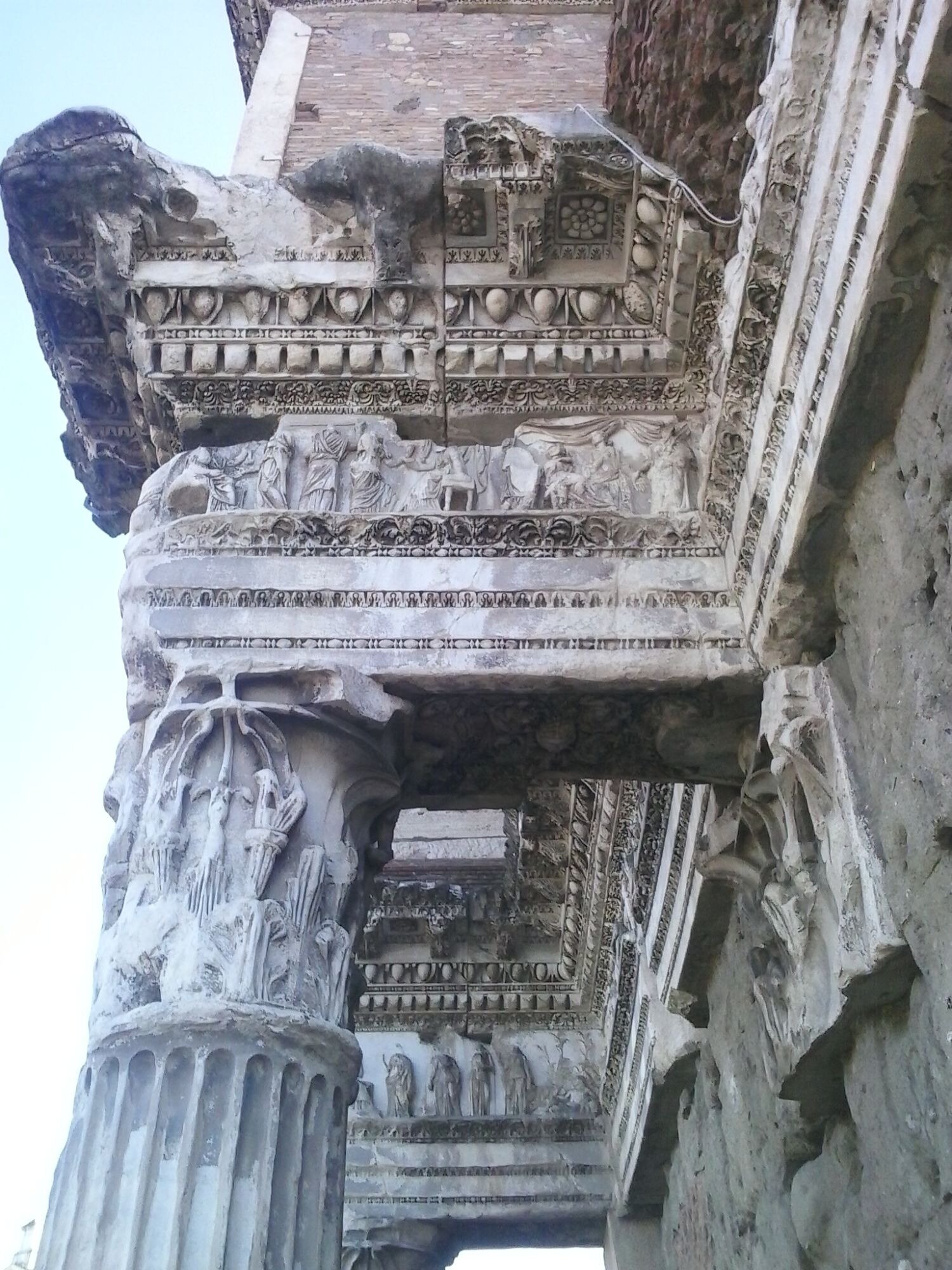
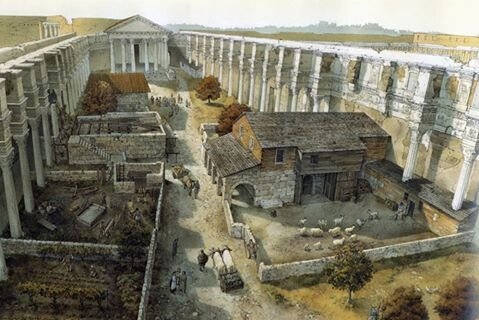
Here is a reconstruction of what the Forum of Nerva looked like in the Middle Ages, a good example, in my opinion, of how Rome has changed a lot over the centuries, and how iconic and central places for the inhabitants of the Caput Mundi have been transformed. Also for this reason, today, Rome is considered a sort of lasagna (excuse the culinary term), to indicate the numerous historical layers of which it is composed! For a local tour guide like me is easy to be here, almost everyday. But the next time that you will walk along the Via dei Fori Imperiali, in the city centre of Rome, try to take a glimpse to the marble ruins of the Forum of Nerva. You will really travel in time!
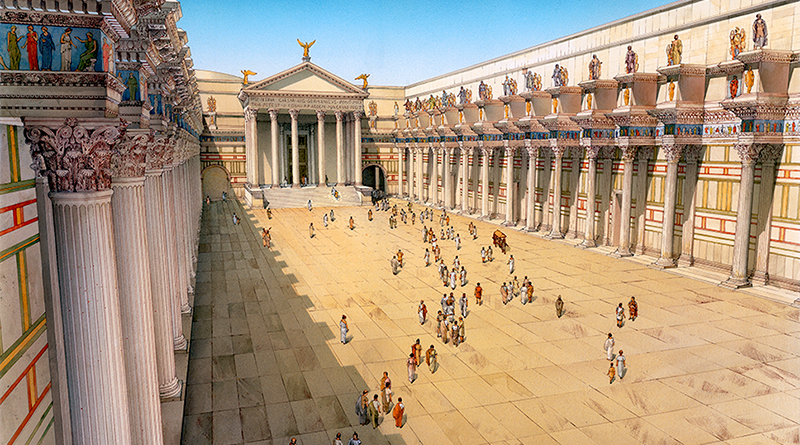
Here we are in one of the so-called Imperial Forums, an area very much central of ancient Rome. This Forum appeared as a long corridor, a sort of passage 120 meters long and 45 meters wide which was, among other things, to act as a link between the two other adjacent forums (that one of Augustus and the other one dedicated to the Peace and commissioned by Vespasian) For this reason the form of this new public square in Rome is so particular and different from the previous forums, since in this case it was necessary to adapt it to the limited space available. The forum in question was the penultimate to be built in the city and, although the name by which it is known today refers to the emperor Nerva, who inaugurated it in 97 a.D., in reality it is very likely that it was his predecessor Domitian who commissioined the works, already ten years earlier. Imagine being surrounded by a marble colonnade, interspersed with continuous friezes depicting scenes from the life of Minerva, goddess of wisdom and justice. Imagine walking on a marble floor too, and having a beautiful temple in front of you, obviously dedicated to Minerva. We are in a place where the main message was one: justice!
Here, in fact, public executions were carried out, in the eyes and in the presence of the deity deputed to justice, a key element of Roman law. Obviously, the continuous friezes and reliefs that revolved (and of which valuable traces still remain today) around the square focused on episodes in which the divine justice was honored (such as the famous myth of Arachne, the woman transformed into a spider for trying to rival with a goddess). In short, all this, when the Western Roman Empire had already collapsed, slowly transformed itself into a small and poor inhabited center. Simple houses, probably with courtyards next to useful for breeding, limestone suitable for taking as much material as possible (marble, bricks, clay and more) and then reselling it, commoners perhaps dressed in rags, who live for the day, and who walk where history was made... Since the ninth century we have news of some houses built here, some even of an aristocratic character (nothing strange, as in the Middle Ages the noble families tried in every way to reconquer, architecturally and politically speaking, monuments or urbanized areas of the ancient city). In short, a Rome that has evolved over time. A Rome that has never ceased, however, to maintain its monumental character.